
The Divine Desire: Creation, Companionship, and the Image of G-d
And G‑d said: “Let us make man in our image, after our likeness…” (Genesis 1:26)
G‑d desired to have an abode in the lower worlds (Midrash Tanḥuma, Nasso 16)
And let them make Me a Sanctuary, that I may dwell among them. (Exodus 25:8)
I am my beloved’s, and my beloved is mine. (The Song of Songs 6:3)
Synopsis
This essay asks two questions that are usually treated separately: Why did G‑d create the world, and why did He create human beings in His image and likeness? It surveys several classical answers—the divine desire for kingship, the bestowal of kindness, the revelation of glory, the realization of the sefirot, and, above all, the Chabad doctrine of Dirah Betachtonim, G‑d’s desire for a dwelling in the lower worlds. Each explanation illuminates a different dimension of the human mission.
I propose that the two questions converge. Dirah Betachtonim may be understood, kivyachol, as a divine desire for companionship. A dwelling is not merely a structure; it becomes a home through those who share it. If companionship requires sufficient likeness for genuine reciprocity, then the creation of humanity in the divine image is not incidental to the purpose of creation but its precondition. The concealment of G‑d in the “lower worlds” likewise becomes essential: companionship must be freely chosen. On this reading, mitzvot do more than express obedience, praise, or service to G‑d—they make the world a home in which the Creator and His creatures can dwell together. The final section deepens this companionship through the biblical imagery of bride and groom: creation and covenant become a love story whose arc moves from intimacy through estrangement toward reunion.
The distinctive proposal of this essay lies not in the suggestion of divine companionship by itself, which has precedents, but in reading Dirah Betachtonim through that lens: G-d seeks not merely a residence but residents, and the divine image provides the likeness necessary for reciprocal relationship. I further argue that such language need not compromise divine perfection, because companionship is not a pre-existing good that G-d lacks; in creating otherness, G-d creates the very possibility—and the very category—of companionship.
Introduction
Life is too short to worry about small questions. Why not tackle Big Questions? I mean, really Big Questions. Like, why did G‑d create the universe? Does G‑d not have anything better to do than to create this lowly world with its petty little problems (from G‑d’s perspective, that is)?
Or, let us try another Big One: Why did G‑d create human beings in His image and likeness? When I look at myself in the mirror, I don’t feel particularly divine—but maybe you do. Moreover, what does it even mean to be created in the image of G‑d, who has no image?
These are the kinds of questions I like to think about. And thinking about them, I realized that they are related—one question hints at the answer to the other. But first, let us dive deeper into these questions and see what the Jewish tradition has to say about them.
This essay begins with a survey of the classical reasons Jewish sages give us for why G‑d created this world. These include the principle that “there is no king without subjects,” the exercise of divine kindness, G‑d’s glory, and the Kabbalistic principle that the divine attributes (sefirot) seek expression. From there, we will turn to the explanation emphasized in Chabad philosophy—that G‑d desired a dwelling in the lowest of the worlds, Dirah Betachtonim. I will argue that “the image of G‑d” provides a clue to the inner meaning of Dirah Betachtonim: a dwelling is ultimately a place of companionship.
I. The Proposed Reasons for Creating the World
I am not the first to ask why G‑d created this world. However, prophets and sages cautioned us to exercise humility in this quest, for we cannot know G‑d’s reasons. Indeed, the prophet wrote:
For My thoughts are not your thoughts, neither are your ways My ways, saith the Lord. (Isaiah 55:8)
Maimonides also cautions us that we cannot fathom the knowledge of G‑d, which is a part of His essence (“G‑d and His knowledge are one”).1 He holds that G‑d’s essence and attributes are beyond human comprehension, because the human intellect is limited in its capacity to understand the divine. Therefore, he argues, it is impossible to ascertain the reason for creation. Thus, in The Guide for the Perplexed, Maimonides writes:
…the apprehension of the nature of the Creator is impossible, for there is no relation between Him and any of His creatures, and no attribute which we ascribe to Him expresses His true essence. . . .2
Abarbanel writes that the best we can do is work our way backward and ask: Now that the world has been created, what is our role in it, and what might its purpose—and therefore the reason for creation—be?3
Why is it so important for us to know why G‑d created the world? It is critically important! How else are we to know what our mission is? If we want to discover the meaning of life and align ourselves with our life’s purpose, that inquiry begins with the question: Why did G‑d create the world?
The Talmud, Midrashim, Jewish philosophers, kabbalists, and Chasidic masters offered various explanations, each highlighting a particular aspect they wanted to emphasize. One of the most famous explanations relates to the sovereignty of G‑d as the King of the Universe.
1. There is no King without Subjects
Rabbeinu Bechaye writes, ein melech b’lo am—“There is no king without a nation.”4 The meaning of this statement is readily apparent. Anyone can proclaim himself a king. However, unless there are people who follow his lead and accept his sovereignty as loyal subjects, such a proclamation would be little more than empty words and self-aggrandizement. It is the subjects who accept a ruler as their king who make him a king. Therefore, without people accepting the sovereignty of G‑d and the yoke of the kingdom of heaven (kabbalat ol malkhut shamayim), G‑d would be lacking, as it were, the title of King (Melech).
Considering such an argument, we must remember that, in His essence, G‑d is perfect and therefore lacks nothing. But on that level, He is completely unknowable and unrelatable. As Kabbalah teaches, on the level on which we can relate to G‑d, He manifests Himself through ten divine emanations—the ten sefirot, the last of which is Malkhut (“sovereignty”). The sefirah of Malkhut represents the sovereignty of G‑d, the Heavenly Kingdom (Malkhut Shamayim). For Malkhut to be meaningful to us—or, in other words, for us to perceive the Almighty as King—He must have a nation that accepts Him as its King, that is, a nation that accepts the yoke of the Heavenly Kingdom.5
Chabad Chasidic philosophy highlights a deeper aspect of the relationship between king and subjects. The founder of Chabad, Rabbi Schneur Zalman of Liadi, writes:
“There is no king without a nation.” The intent [of the term “nation”] is to refer to people who are on a level on which they can be called [the king’s] nation, i.e., they are people like him and share a certain relationship with him.6
This “certain relationship” implies a certain similarity, as it were. It would be meaningless to declare yourself king of the pebbles on a beach or the trees in a forest. One can be a king only over other people who, while sharing the king’s essential humanity, recognize that his nobility, wisdom, and power far transcend their own and willingly accept his rule. From this perspective, G‑d had to create human beings in His image and likeness so that there would be some “similarity” allowing people to relate to the heavenly King as His subjects. Thus, this classic explanation for the creation of the world also helps answer why the Creator made people in His image and likeness.
2. The Kindness of G‑d
Another explanation, offered by Rabbi Moshe Chaim Luzzatto (Ramchal)7, is that the world was created not for G‑d’s sake but for the benefit of man: creation is the realization of G‑d’s inherent kindness:
The purpose of creation was for God to bestow of His good upon others.8
The Almighty G‑d has an infinite capacity for kindness, generosity, and benevolence.9 However, one cannot be generous to oneself—to express kindness, one needs someone else to be kind to. Thus, G‑d “needed” to create someone upon whom to shower His kindness and generosity:
It is the nature of one who is good to bestow good to others.10
Once again, we need to remind ourselves that, in His essence, G‑d is perfect and absolute and lacks nothing. That exalted level, however, is beyond our reach or comprehension. On the level on which G‑d relates to us through His ten emanations, the sefirot, one of these sefirot, Chesed (“loving-kindness”), seeks realization. It is like a talent that begs to be realized. Women are endowed with the ability to bear children. This unique capacity seeks realization and may manifest in the natural desire to have children—what is sometimes called the “maternal instinct.” As another example, there is a story about a Jewish pianist during the Holocaust who, of course, had no access to a piano in a concentration camp. He found a piece of coal and drew a keyboard on the pavement so that he could “play” by pressing his fingers against the would-be keys.11

Figure 2.
When someone has a talent for music, that talent will find a way to express itself even in the unthinkable environment of a concentration camp. Every talent begs for realization. G‑d’s talent for kindness begged for realization, too. So G‑d created the world and human beings toward whom He could direct His kindness.
While this explanation addresses the question of why G‑d created the world, how does it address the question of why G‑d created human beings in His image and likeness? The answer is simple—what greater kindness could there be than to create people in G‑d’s own image and likeness? We are all a little bit divine because we are created in G‑d’s image and likeness. If people truly realized that, they would act differently; there would be no wars, no crime, no disrespect… This realization obliges us. It demands nobility of spirit and, above all, overflowing kindness. If we are created in G‑d’s image and likeness as a realization of His kindness, then we, too, must realize the talent for kindness that we inherited from our Creator.
While this explanation is usually attributed to Ramchal, we find an earlier source in Etz Chayim, where Rabbi Chayim Vital writes:
…When it arose in His will, blessed be His Name, to create the world in order to do good to His creatures, that they might recognize His greatness and merit to be a vehicle for that which is above, to bond with Him, blessed be He…”12 (Emphasis added)
Ramchal develops this idea further and explains that perfect kindness requires free will. In fact, this idea is very old.13 I once heard a parable that illustrates the concept.14
Once, the attribute of kindness, Ḥesed, rose to the Throne of Glory and asked, “Master of the Universe, why aren’t You kind?” G‑d agreed with His attribute of kindness and created human souls. He placed these souls in Paradise, where they basked in the rays of the divine glory. After a while, Ḥesed rose again to the Throne of Glory and demanded, “Master of the Universe, why are You still not kind?!” Once again, G‑d agreed with Ḥesed, took human souls from Paradise, clothed them in physical bodies, and placed them in the physical world. At last, the divine attribute of kindness was satisfied.
The meaning of this parable is this: For G‑d to realize His kindness, He needed someone to be kind to—that was the essence of the first complaint by Ḥesed, which begged for realization. In response, G‑d created souls and showered them with divine light, causing them to experience immense pleasure in Paradise. However, this pleasure was unearned—it came for free. The Jerusalem Talmud observes that “one who eats from another is ashamed to look at him”—the principle commonly known as nahama d’kisufa, “bread of shame.”15 Bread received as charity may save a person’s life, but it can hardly give the recipient the satisfaction of earning it. One truly enjoys the fruits of one’s labor when they are earned by one’s own effort. Bread received for free is called the bread of shame. That is why the highest form of charity is helping a person become self-supporting. This was the substance of Ḥesed’s second complaint. G‑d is perfect, and His kindness must likewise be perfect. Ḥesed was not satisfied that G‑d’s kindness came in the form of unearned gifts. So G‑d agreed with His attribute of kindness, clothed those souls in physical bodies, placed them in the physical world, and gave them freedom of choice. Now people can freely choose to do good or evil. They can earn their blessings rather than receiving them for free. This is perfect kindness. The attribute of kindness was finally satisfied—it found its realization.
This fits well with an explanation of why G‑d created Adam and Eve in His image and likeness, according to which G‑d endowed people with freedom of choice. On this reading, free choice is a divine prerogative shared uniquely with human beings; even angels are not granted this same kind of moral autonomy. Creating people in His image and likeness, then, means sharing freedom of choice with humans—endowing them with this truly divine quality and giving them the ability to earn their bread in dignity rather than eat the bread of shame.16
3. Give Glory to G‑d
A daily morning prayer, Uva L’Tzion, contains the following phrase:
Blessed is He, our G‑d, who has created us for His glory.17
According to Rabbi Berlin (the Netziv),18 this is an explicit statement of the purpose for creating the world: that we give glory to G‑d.19 Indeed, as the prophet wrote,
Every one that is called by My name, and whom I have created for My glory, I have formed him, yea, I have made him.’ (Isaiah 43:7) (Emphasis added)
This nation I have created for Myself, in order that they should tell My glory. (Isaiah 43:21)
Similarly, the Mishnah states in Ethics of the Fathers:
All that the Holy One, Blessed be He, created in His world, He created only for His glory, as it is said (Isaiah 43:7): “Everything that is called by My Name, and which I have created for My glory, I have formed it, even I have made it.”20
At first blush, this reason seems to be at odds with Ramchal’s explanation. According to Ramchal, the world was created for us—to bestow G‑d’s kindness upon us. In contrast, the Netziv, following the Mishnah cited above, holds that the world was created for G‑d and His glory. This is not surprising, however, in view of the Arizal’s teaching that all divine emanations, the sefirot, seek realization in this world. Just as Chesed (“kindness”) is one of the ten sefirot that begs for realization, so too does the sefirah of Hod (“glory”)21. Hence, we can say that the world was created for the glory of G‑d, just as we can attribute the reason for creation to the manifestation of any of the ten sefirot.
But how does this explanation fit with the creation of man in G‑d’s image and likeness? Allow me to illustrate with an example. As is well known, academic jobs do not pay especially well. People generally do not go into science to make money; they are driven primarily by insatiable curiosity. Yet scientists are human and have egos—some more, some less. Everyone thrives on success. For many scientists and academics, the praise of their peers matters more than wealth. It may mean relatively little to a university professor that someone outside academia admires his work; it can mean a great deal to receive a Nobel Prize or a fellowship from a professional society recognizing outstanding scientific achievement. The respect and admiration of peers who can best understand the research—or find flaws in it—are especially prized. Myriads of angels praise G‑d all day long. Various traditional Jewish sources state that all animals, indeed all creatures, praise G‑d.22 Yet the praise of people created in G‑d’s image and likeness—people capable of doubting G‑d’s existence or believing in Him—is especially dear to G‑d. As it is written:
And You, holy One, are enthroned upon the praises of Israel.23
Only humans created in G‑d’s image and likeness can offer their Creator truly meaningful praise and honor.
4. Self-Realization
We have already touched on this theme: G‑d created the world to realize His talents—or attributes, the sefirot—such as sovereignty, kindness, and glory. This idea comes from the Zohar, which explains the purpose of creation as follows:
…in order that there be creatures that will know Him in every measure by which He directs His world, with kindness and with judgment, according to the acts of humankind. For if His light would not spread to each of His creations, how would He be known? In what way would be fulfilled, ‘All the earth is filled with His glory’?”24
Expounding on this statement, Rabbi Chayim Vital writes, “Without the act of creation, all of G‑d’s infinite perfections lie in a state of potential.”25
On the one hand, this explanation unifies and subsumes the previous explanations because, as we mentioned earlier, all of G‑d’s talents and attributes seek realization, which is possible only through the creation of the universe. On the other hand, it runs into the fundamental problem that plagues every attempt to answer the question “Why did G‑d create this world?” If G‑d is truly perfect, He lacks nothing, needs nothing, and wants nothing. The Rebbe Rashab addressed this difficult problem when he26 wrote:
For a created being, what is potential is not actual. But above, this is not so: Potential is not lacking actuality. Potential and actual exist as one.27
If so, merely by possessing the potential to be kind, G‑d was already kind; by possessing ten attributes expressed as the ten sefirot, G‑d had already and automatically realized them all. So why create a physical world? Hold that question—the answer this essay will ultimately propose must wait until one more explanation is before us.
5. The Abode in Lower Worlds
The explanation offered in Chabad philosophy for the creation of the world is Dirah Betachtonim—that G‑d desired to have a dwelling place in the lower worlds.28 This concept is based on Midrash Tanḥuma:
R. Samuel bar Naḥman said, “When the Holy One, blessed be He, created the world, He longed to have an abode below just as He had on high. . . .29
Although this idea is fully articulated in the Midrash, it remained largely obscure until Rabbi Schneur Zalman of Liadi, the founder of the Chabad school of Hasidic thought, elevated it into the central organizing principle of his philosophical system.
This declaration frames the human mission not as a self-centered quest for personal salvation or spiritual perfection but as a cosmic construction project. The individual’s life is endowed with meaning because it contributes to the fulfillment of a divine architectural plan. The “lower worlds” are not an obstacle to be overcome or a prison from which to escape, but the very building site for this divine edifice. This world, with its inherent spiritual darkness and concealment of the divine, is specifically chosen as the location for G‑d’s ultimate revelation.
Rabbi Schneur Zalman of Liadi and the subsequent Chabad Rebbes made this concept a cornerstone of Chabad theology. The doctrine received especially extensive elaboration in the works of the fifth Rebbe of Chabad, the Rebbe Rashab.30
Chabad philosophy does not stop at identifying the reason for creation; it also tells us how to live in harmony with that reason—how to build for G‑d a dwelling in the lower worlds. It draws on the statement of the Zohar that through the subjugation (iskafiya) and transformation (ishapcha) of our evil inclination, we reveal G‑d throughout all worlds.31
Several aspects of the notion that G‑d created the world because He desired a dwelling place in the lower worlds require explanation.
First, how can we say that G‑d desires anything? One can desire only that which is lacking, yet G‑d is perfect and lacks nothing. This is the same kind of question we encountered earlier when discussing why G‑d wished to be King or to exercise His kindness. This is precisely the difficulty addressed by the Maggid of Mezeritch, who is credited with popularizing this concept. How, then, is his approach different from the explanations already offered? The Maggid teaches that one cannot ask questions about a desire. This teaching was repeated by the Alter Rebbe and remains the standard answer in Chabad literature. Such a desire comes from an essence that transcends logic and reason. In other words, it is not the result of a lack but a desire arising from the very essence of G‑d, which transcends understanding. Moreover, in the sefirotic tree, desire is associated with Keter, which is higher than Chokhmah (“wisdom”) and Binah (“understanding”). One might object that reasons can often be given for our desires. Yet this may be true only when different desires are mutually exclusive, as they are in this world. We can explain why we prefer one thing to another because we cannot have—or perhaps cannot choose—both. G‑d, however, being unlimited, can desire more than one thing at once. It is therefore meaningless to ask why G‑d desires one thing rather than another when He can desire both. G‑d is nimna hanimna’ot—literally, “restricting [all] restrictions,” the “paradox of paradoxes.”32 For this reason alone, questioning G‑d’s desires is meaningless.
Furthermore, how are we to understand the notion of a “dwelling place” in reference to the Almighty? Any dwelling—whether a palace, a house, or an apartment—exists in space and has an address. But the Omnipresent G‑d transcends the space He created. One of His names is HaMakom (“the Place”), indicating that He is the “place” of the world, not the other way around. So how can G‑d have a place in the world? Midrash Tanḥuma provides the answer:
The Holy One, blessed be He, said this to him [Adam], ‘This is what I longed for, that just as I have a dwelling on high, I would likewise have one below. Now when I have given you one command, you have not kept it. 33
Apparently, the Almighty desires that we human beings obey His will below just as the angels obey His will in the worlds above. G‑d was very “disappointed” by Adam and Eve’s failure to fulfill their mission and, consequently, withdrew His presence, the Shekhinah, from this world. In the Chasidic framework invoked here, angels do not have an evil inclination or human-like freedom of choice, whereas we humans do. It appears that G‑d wished specifically for humans—who are so full of themselves that they mistake their G‑d-given freedom of choice for complete independence from the Creator—to obey His will nevertheless, as an exercise of that very freedom. When that happens, G‑d brings His presence, the Shekhinah, into this world and finds a dwelling place below, as it is stated:
And let them make Me a sanctuary, that I may dwell among them. (Exodus 25:8)
Note the grammatical peculiarity: “dwell among them,” not in it—the sanctuary—as one might expect from the first clause of the verse. This is the meaning of Dirah Betachtonim, a dwelling place in the lower worlds: when we sanctify ourselves and the world around us through the performance of divine precepts, mitzvot, which express G‑d’s will, G‑d dwells among us.
Another aspect of the word dira (“home” or “dwelling place”) is that only in your own home are you free to be fully yourself. Thus, to create a home for G‑d in the lower worlds means to make Him sufficiently “at home” here that He need not hide or constrict Himself lest His infinite light overwhelm the world. In essence, creating a home for G‑d means refining the finite vessels of this world so that divine infinity can manifest within the finite vessels of the physical world.34
This seems hardly possible. Indeed, wherever infinities appear in physics, we suspect that something is wrong—or at least incomplete—in the theory. Infinities regularly appear in our most fundamental theory of matter, quantum field theory (QFT).35 On a technical level, these infinities are removed through renormalization.36 Their appearance in the first place, however, leads some physicists to think that QFT is not the final word. Similarly, when we encounter infinities in General Relativity, as in the study of black holes or the Big Bang, we take them as a sign that the theory does not yet incorporate quantum physics. General Relativity is incomplete, and the search continues for the elusive quantum theory of gravity. Even in mathematics, a movement known as ultrafinitism seeks to expunge infinities from mathematics altogether.37
And what are the lower worlds? “Lower” and “higher” are spatial concepts. How are they to be understood with respect to G‑d, who transcends space? Rabbi Schneur Zalman addresses this very question in chapter 36 of Tanya. It may be understood as follows.
The unfolding of creation, accompanied by an ever-diminishing revelation of divine light, is depicted as the ontological chain of worlds called seder hishtalshelut.38 In the highest of the four worlds, Atzilut (the world of Emanation), beings have no independent sense of self; they are utterly nullified and absorbed in the divine light shining brightly in Atzilut. In the next world, Beriyah (“Creation”), spiritual beings possess some sense of selfhood, although they remain nullified to the Creator. The diminishing divine light allows selfhood and ego to emerge, and with ego, evil—however minute—enters the scene. In the next world, Yetzirah (“Formation”), the light becomes dimmer still, and created beings are no longer completely nullified. Ego and evil grow stronger. In the lowest world, Asiyah (“Action”), creatures can be unaware of their Creator and perceive themselves as entirely independent. Evil prevails in this world. And this is the world in which we live.
Thus, the lower worlds are those in which creatures can feel completely independent of the Creator, to the point that they can even question His existence. Only in this world, where we possess freedom of choice, can G‑d be proclaimed our King—by our free choice, rather than by fiat, which would make Him a dictator rather than a benevolent King. Only in this world, where we can overcome our evil inclination and serve G‑d despite it, can we earn our reward, thereby allowing G‑d to exercise His attribute of kindness (Ḥesed). And only in this world, where we can sanctify ourselves and our surroundings by freely choosing to obey G‑d’s will, can we make for G‑d an abode in which He will dwell among us.
No one should make the mistake of thinking that if G‑d wants to dwell down here, He is not here now—or was not here before. That would be a categorical mistake. G‑d is Omnipresent: He is everywhere, and in another sense nowhere, because He transcends the very concept of space that He created. G‑d is both transcendent and immanent—He utterly transcends the worlds and fills them at the same time. In this context, to dwell means to reveal Himself. When we obey His will, G‑d reveals Himself to us and makes His presence known.
II. The Proposed Reasons for Creating Humans in His Image
The Torah states:
And God said: ‘Let us make man in our image, after our likeness… And God created man in His image; in the image of God He created him… (Genesis 1:26–27)
Classic biblical commentators offer several explanations of this verse. One explanation offered by Rashi suggests that “image” means type, as if to say, Let us make man in our type. “After our likeness,” according to Rashi, means the ability to discern and understand. Another explanation suggests that the image of G‑d means that man, like G‑d, possesses freedom of choice.39
Kabbalists suggest that the shape of the human body (and soul) follows the pattern of the ten sefirot: Keter—skull; Ḥoḵmah—right hemisphere of the brain; Binah—left hemisphere; Da’at—midbrain40; Ḥesed—right arm; Gevurah—left arm; Tiferet—torso; Neẓach—right leg; Hod—left leg; Yesod—procreative organ; Malkhut—female.
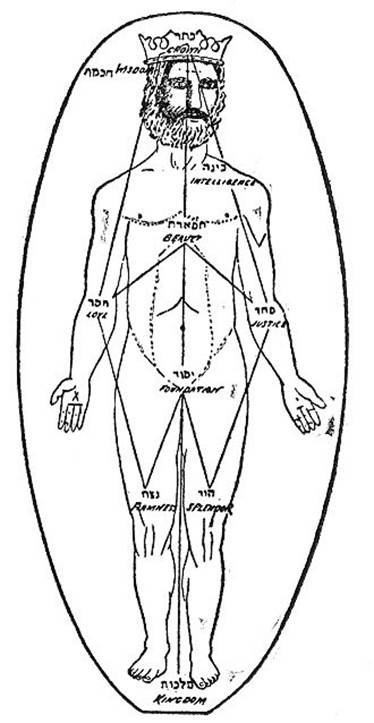
Figure 3. Sefirot in Configuration Yish—Man
This Kabbalistic doctrine, which presents the human body—and, spiritually, the soul—as a realization of the divine sefirot, is highly significant. It establishes a common “genetic” code that human beings inherit from G‑d. This will prove critical to my proposed explanation of why G‑d desired a dwelling place in the lower worlds.
1. The Big Why
The first three classical explanations for the creation of the world—the fourth, self-realization, subsumes them, as we saw—mesh well with explanations of why human beings were created in G‑d’s image and likeness. To review: Rabbeinu Bechaye’s explanation (anticipated in Pirkei De Rabbi Eliezer) that G‑d desired to be King, and that there is no king without a nation, fits naturally with the idea that man was created in G‑d’s image: for a king to rule, there must be some similarity between king and subjects. Ramchal’s explanation that G‑d wished to bestow kindness and therefore needed someone else to be kind to likewise fits our suggestion that the greatest kindness was creating man in G‑d’s image. The Netziv’s explanation—that G‑d created the world so that people could praise and glorify Him—also requires some degree of “similarity.” As we explained above, praise from one’s peers is especially precious. This, too, helps explain why G‑d chose to create human beings in His image and likeness: only the praise of beings created in G‑d’s image could possess this particular significance.
One explanation for the creation of the world, however, stands apart in this regard: the teaching of Midrash Tanḥuma, elevated by the Alter Rebbe into a cornerstone of Chabad theology, that G‑d desired Dirah Betachtonim, “a dwelling place in the lower worlds.” What possible connection can G‑d’s desire for a dwelling in the lower worlds have with the creation of human beings in His image and likeness?
2. Loneliness and Companionship
With all due humility, I would like to suggest an additional way of understanding the reason for creation. Dirah Betachtonim may be understood as a divine desire for companionship.41 Several biblical passages, I believe, point in this direction.
Let us compare two verses in Genesis:
And God said: ‘Let us make man in our image, after our likeness… And God created man in His image; in the image of God He created him… (Genesis 1:26–27)
And the Eternal God said: “It is not good that the man should be alone; I will make him a help meet for him.” (Genesis 2:18)
In the first passage, the Bible tells us that G‑d created man (and woman) in His image and likeness. In the second, G‑d says that it is not good for man to be alone. If man was created in G‑d’s image and likeness, might this not suggest—at least homiletically—that it is not good for G‑d to be alone? Perhaps G‑d is expressing here, as it were, something of His own condition. If we were to read the two verses in reverse order and substitute G‑d for man, they would read: “It is not good for G‑d to be alone. Let us make man in our image, after our likeness.”
In fact, Kabbalah and Chabad mysticism say something remarkably similar. Consider the Torah’s first verse:
In the beginning God created the heaven and the earth. (Genesis 1:1)
It begins with three words—Bereshit bara Elokim. According to the Arizal, when G‑d says, “It is not good that the man should be alone,” the verse means, on an esoteric level, that it is not good for the divine name Havayah to be alone.42 Following this line of thought, Rabbi Schneur Zalman of Liadi, in his commentary on this verse in Torah Or, 43writes that man and woman are allegorical references to two names of G‑d—Havayah (Y-H-W-H, the Tetragrammaton) and Elokim (see my essay “It Is Not Good For Man To Be Alone”).44
Now we can appreciate the deeper significance of the Torah’s very first words—Bereshit bara Elokim, “In the beginning G‑d created…” Note which divine name opens the Torah. Throughout the first chapter of Genesis, the Creator is called exclusively Elokim. The Tetragrammaton, Havayah, does not appear until the second chapter: “in the day that Havayah Elokim made earth and heaven” (Genesis 2:4). If, as the Alter Rebbe teaches, man and woman allegorically represent the divine names Havayah and Elokim, then the creation narrative itself traces the arc of the verse “It is not good that the man should be alone.” The Torah opens with Elokim alone—the name of concealment, contraction, and judgment—and does not rest until Havayah and Elokim stand joined together. Rashi, citing the Midrash, offers a parallel on the plain level of the text: at first it arose in the divine thought to create the world with the attribute of judgment (associated with the name Elokim) alone; seeing that the world could not endure, He joined to it the attribute of mercy (associated with the name Havayah).45 On the esoteric level, I would suggest, the Torah whispers its own secret in its opening breath: one name alone is not good. Bereshit bara Elokim—it is not good for G‑d to be alone.
There is a story told in Chabad tradition about the future Tzemach Tzedek as a young child.46 He was playing hide-and-seek with his friends and found such a good hiding place that his playmates, unable to find him, gave up and ran off to another game. After a long while, the little boy emerged and ran to his grandfather, Rabbi Schneur Zalman, in tears: “I was hiding, but nobody came looking for me!” The Alter Rebbe wept with the child and said: G‑d says the same—I conceal Myself, and nobody comes looking for Me.
This child’s cry, I believe, is the emotional core of Dirah Betachtonim, and it returns us to the question we left open above: What connection does G‑d’s desire for a dwelling in the lower worlds have with the creation of humans in His image and likeness? Consider what a dwelling actually is. Nobody desires a home for the sake of its walls and roof; the walls and roof are desired for the sake of those who live within them. A palace with no one to share it is not a home—it is the loneliest place on earth. To dwell means to dwell with someone. Now the grammatical anomaly we noted earlier turns out to be no anomaly at all: “And let them make Me a sanctuary, that I may dwell among them” (Exodus 25:8)—among them, not in it. G‑d never desired a residence; He desired residents. Dirah Betachtonim, I propose, is not a doctrine about divine real estate but a doctrine about divine companionship. G‑d created the world because He was, as it were, lonely and desired a companion.
And here is where this explanation—alone among all those we have surveyed—requires the creation of humans in G‑d’s image and likeness. A king stands above his subjects; a benefactor stands above his beneficiary; the glorified stands above those who sing his praises. All these relationships presuppose some similarity, as we saw, but they remain vertical. Companionship is different. It ordinarily exists between peers—or, at the very least, between those similar enough to keep each other company. One does not keep company with a pebble on the beach or a tree in the forest and, in truth, not even with an angel, who has no self to offer and no choice to make. Even in the case of the infinite and awesome Divine Being, where equality is impossible, sufficient likenessfor reciprocity—shared selfhood, freedom, relationality, and a common “vocabulary”—is required. If G‑d desired a companion, He had no alternative, as it were, but to create a being who shares something of His own nature—a creature built, body and soul, on the pattern of the ten sefirot, stamped with the family resemblance, and carrying the divine “genetic code” described above. The image and likeness of G‑d are not ornaments added to the purpose of creation; they are its precondition.
3. Companionship and the First-Person Experience
Why, exactly, does companionship require likeness? Modern philosophy of mind helps sharpen the point. Thomas Nagel famously argued that we can never know what it is like to be a bat: we may learn everything there is to know about echolocation, and still the bat’s inner experience—its first-person perspective—remains closed to us.47 Wittgenstein made a similar observation about language: “If a lion could talk, we could not understand him.”48 The lion’s words would be anchored in a form of life so foreign to ours that no dictionary could bridge the gap. Imagine, then, meeting an extraterrestrial alien built on an entirely different biochemistry. We might exchange mathematical signals with such a being, but could we truly converse with it if we shared no common first-person experiences—no hunger, warmth, fear, or love—to which our words could refer? We could not know what it is like to be that alien. Deep reciprocal companionship ordinarily presupposes meaningful commonality.
This, I suggest, is precisely why G‑d had to create human beings in His image and likeness. For us to relate to G‑d—to speak to Him in prayer and to hear Him in Torah, to keep Him company in His world—there must be some commonality of inner life between us, as it were. Tanya teaches that the human soul is “a part of G‑d above” (chelek Eloka mima’al).49 The Kabbalistic doctrine described earlier—that the human body and soul are patterned on the ten sefirot—now reveals its full significance: it is what makes the divine-human conversation possible at all. We share, so to speak, a common inner vocabulary with our Creator. When the Torah speaks of divine love, anger, joy, or regret, it is not merely accommodating our weakness; it is telling us that we and G‑d, kivyachol, have something to talk about. G‑d made us in His image for the same reason that Nagel’s bat and Wittgenstein’s lion illustrate the limits of communication across radically different forms of life: companionship is possible only where first-person perspectives overlap in some measure.
Nor is the concealment of the lower worlds incidental to this purpose. Companionship that is compelled is not companionship at all—a companion must come freely, or not at all. And one can come freely only toward a G‑d who is hidden. This is the secret of the child’s game: the hiding is not the tragedy; the hiding is the invitation. The tragedy begins only when nobody seeks. The lower worlds—the worlds of concealment, where a creature can doubt its Creator’s very existence—are therefore the only possible venue for freely chosen companionship, just as we saw that they are the only possible venue for a freely accepted King and for kindness earned rather than received in shame.
But how can we speak of G‑d as lonely? Does loneliness not imply a lack—and does not G‑d, perfect in the absolute sense, lack nothing? By now, the reader knows the answer, for we have given it twice already. In His essence, G‑d indeed lacks nothing and desires nothing, and about that level nothing at all can be said. But on the level on which G‑d chooses to relate to His creation, the Torah itself does not hesitate to speak of divine emotion—G‑d is “grieved at His heart” (Genesis 6:6); He remembers, He longs, He regrets. All such language is, of course, kivyachol—“as if it were possible”—an anthropopathic way of speaking about that which transcends all emotion.50
Abraham Joshua Heschel51 argued that the G‑d of the Hebrew prophets differs from the unmoved deity of the philosophers precisely in this divine pathos—G‑d’s passionate concern for and involvement with His creatures.52 The mystics do not deny this; they merely dare to add that the longing runs in both directions. Moreover, following the Maggid of Mezeritch, one cannot ask “why” about a desire rooted in the divine essence.
From the standpoint of theistic philosophy, which is careful not to ascribe to G‑d any limitation incompatible with His absolute perfection, I would argue that the desire for companionship need not imply a deficiency in G‑d, who lacks nothing. What does it mean to lack something? We ordinarily lack something when a possible good exists but is absent from us. Before creation, however, companionship is not a pre-existing good that G‑d somehow fails to possess, because companionship itself presupposes otherness. As the totality of all existence—ein od bilvado, “there is nothing besides Him”—G‑d is alone in the ultimate sense. His aloneness follows from His absolute oneness, but it does not limit His perfection: there simply is no “other” beside G‑d. Thus G‑d does not possess an unmet need for a pre-existing good called companionship. Rather, G‑d freely creates the possibility of otherness and thereby creates the very category within which companionship can exist.
G‑d invents, as it were, His own yearning for companionship. If anything, this novelty would be an addition rather than a limitation—except, of course, that nothing can be added to the infinite G‑d. So G‑d contracts His light in the process called tzimtzum,53 making room for others—for us—whom He can love and who can love Him in return.
There remains, however, a profound question: How can an infinite G‑d, outside of whom nothing exists, create a genuine “other” capable of companionship? I have previously suggested the metaphor of a divine dream as a possible model. A dreamer generates an entire world from within his own consciousness and yet, while dreaming, encounters its inhabitants as apparently independent others. Similarly, creation may be understood, kivyachol, as a divine “dream” in which concealment produces the experiential distance necessary for otherness. On this reading, tzimtzum does not merely make “room” for creation; it makes possible the appearance of an other who can freely turn toward G‑d and love Him in return.54
The desire for companionship, I would argue, is not one more sefirah begging for realization, like kindness or glory; it is the very desire of Dirah Betachtonim itself, seen from within.
III. G‑d’s Companions
1. The Many Faces of Companionship
In Scripture, the relationship between G‑d and His people is described through a remarkable range of human relationships: Israel is called a child, a firstborn, a friend, a sister, a beloved, and a bride. Taken together, these metaphors form a broad spectrum, suggesting that divine-human companionship cannot be reduced to a single mode of relationship.
Initially, humanity as a whole, represented by Adam and Eve, was called to relationship with G‑d. Again and again, however, humanity failed that calling. After the Flood and the generation of Babel, the biblical narrative narrows its focus from humanity as a whole to Abraham and his descendants. Through Abraham, Isaac, and Jacob, G‑d enters into a particular and eternal covenant with Israel—not to abandon the rest of humanity, but to give the broader possibility of divine-human relationship a concrete covenantal form.55
“My Firstborn”:
Then you shall say to Pharaoh: “Thus says the L-rd: Israel is My son, My firstborn.” (Exodus 4:22)
…For I have become a father to Israel, and Ephraim is My firstborn. (Jeremiah 31:9)
“My Children”:
You are children of the Lord your G‑d…” (Deuteronomy 14:1)
…Instead of being told, “You are not My people,” they shall be called “Children of the living G‑d.” (Hosea 2:1)
Bring My sons from afar, and My daughters from the ends of the earth. (Isaiah 43:6)
“My Sister / Bride”:
You have captured my heart, my sister, my bride… How sweet is your love, my sister, my bride! (Song of Songs 4:9–10)
Open to me, my sister, my love, my dove, my perfect one… (Song of Songs 5:2)
“My Friend / Beloved Companion”:
But you, Israel, My servant, Jacob whom I have chosen, the seed of Abraham My friend, who loved Me.” (Isaiah 41:8)
Did you not just call to Me: “My Father, You are the companion of my youth”? (Jeremiah 3:4)
For the sake of my brothers and friends… (Psalm 122:8)
A verse that Midrash Tehillim reads as G‑d calling Israel His “brothers” and “friends” (Midrash Tehillim 122:1; see also Shemot Rabbah 27:1).
If we take these metaphors seriously, companionship with G‑d appears not as one narrowly defined relationship but as a spectrum of intimacy—filial, fraternal, friendly, and ultimately spousal.
On the reading proposed here, G‑d desired an other capable of a genuine reciprocal relationship, and Scripture describes that relationship through an extraordinary range of human analogies, culminating in the intimacy of bride and groom.
2. Creation as a Love Story
Companionship is already an intimate metaphor, but Scripture goes further. The Torah and the Prophets repeatedly describe G‑d’s relationship with Israel in the language of love, courtship, marriage, estrangement, and reunion. The bridal metaphor does not replace the language of companionship; it intensifies it. Companionship describes the possibility of reciprocal relationship, while the covenantal imagery of Scripture reveals how intimate that relationship can become. The covenant with Israel gives a particular form to the broader possibility of divine-human companionship. Israel is chosen not for its power or numbers, but because of G‑d’s enduring love:
The LORD did not set His love upon you, nor choose you, because ye were more in number than any people—for ye were the fewest of all peoples—but because the LORD loved you, and because He would keep the oath which He swore unto your fathers… (Deuteronomy 7:7–8)
The LORD appeared of old unto me, saying: “Yea, I have loved thee with an everlasting love; therefore with affection have I drawn thee.” (Jeremiah 31:3)
“I have loved you,” saith the LORD. Yet ye say: “Wherein hast Thou loved us?” “Was not Esau Jacob’s brother?” saith the LORD; “Yet I loved Jacob.” (Malachi 1:2)
Scripture repeatedly casts this relationship in the imagery of bride and groom:
Go, and cry in the ears of Jerusalem, saying: Thus saith the LORD: I remember for thee the affection of thy youth, the love of thine espousals; how thou wentest after Me in the wilderness, in a land that was not sown. (Jeremiah 2:2)
Now when I passed by thee, and looked upon thee, and, behold, thy time was the time of love, I spread my skirt over thee, and covered thy nakedness; yea, I swore unto thee, and entered into a covenant with thee, saith the Lord GOD, and thou becamest Mine. (Ezekiel 16:8)
For as a young man marrieth a virgin, so shall thy sons marry thee; and as the bridegroom rejoiceth over the bride, so shall thy God rejoice over thee. (Isaiah 62:5)
Even when the Prophets rebuke Israel for straying, the marital metaphor remains: G‑d appears as the faithful husband who promises reconciliation and renewed betrothal:
For thy Maker is thy husband, the LORD of hosts is His name; and the Holy One of Israel is thy Redeemer, the God of the whole earth shall He be called. (Isaiah 54:5)
And I will betroth thee unto Me for ever; yea, I will betroth thee unto Me in righteousness, and in justice, and in lovingkindness, and in compassion. And I will betroth thee unto Me in faithfulness; and thou shalt know the LORD. (Hosea 2:21–22)
The metaphor reaches its fullest biblical expression in the Song of Songs (Shir HaShirim), which rabbinic tradition reads as an extended allegory of the love between G‑d and Israel:
My beloved is mine, and I am his, that feedeth among the lilies. (Song of Songs 2:16)
I am my beloved’s, and my beloved is mine, that feedeth among the lilies. (Song of Songs 6:3)
Set me as a seal upon thy heart, as a seal upon thine arm; for love is strong as death, jealousy is cruel as the grave; the flashes thereof are flashes of fire, a very flame of the LORD. (Song of Songs 8:6)
I have come into My garden, My sister, My bride. (Song of Songs 5:1)
In his final discourse, Basi LeGani, the Rebbe Rayatz cites Midrash Rabbah on this verse. The Midrash notes that the verse says not l’gan (“to the garden”) but l’gani (“to My garden”), and reads l’gani as l’gnuni—“to My bridal chamber.”
As the commentaries on the Midrash explain, the possessive form points to an intimate, private place—the chamber of union between bridegroom and bride.
The Divine Presence is thus saying: “I have come into My bridal chamber, into the place in which My essence was originally revealed.”
The Midrash continues:
In the beginning, the essence of the Shechinah was apparent in this lowly world. However, in the wake of the sin of the Tree of Knowledge, the Shechinah departed from the earth and rose into the heavens. Later, on account of the sin of Cain and then of Enosh, the Shechinah withdrew even further from this world, rising from the nearest heaven to the second, and then to the third. Later yet, the sins of the generation of the Deluge caused it to recede from the third heaven to the fourth, and so on. This progressive recession of the revealed Divine Presence is alluded to in the wording of the verse that relates that Adam and Eve “heard the sound of G‑d walking about in the garden.” (Bereishis 3:8.)
R. Abba notes: “The verse does not use the expected form of the verb, mehalech, but rather mithalech, which suggests that they heard the Divine Presence springing back in successive stages of withdrawal.”
The Midrash proceeds to explain that [after the sins of seven generations had caused the Divine Presence to withdraw seven spiritual levels from its initial manifestation in this world], seven tzaddikim arose whose divine service drew the Divine Presence down once more into this world below.56
The connection to Dirah Betachtonim is striking. Read through the bridal imagery of the Prophets and the Song of Songs, the “dwelling” below becomes more than a residence: it becomes, figuratively, a bridal chamber, a place of revealed intimacy. Creation begins with the Shekhinah dwelling below; sin introduces estrangement; and the service of the righteous draws the Divine Presence back down. From the Tree of Knowledge through later betrayals, the relationship is wounded again and again, but it is never abandoned. Our cosmic task, then, is not merely to build G‑d a dwelling in this world but to prepare the world for the return of the Shekhinah—for reunion with the Beloved. Dirah Betachtonim is the home of that relationship.
Conclusion
Elie Wiesel wrote:
I think he is condemned by himself to loneliness. God is One: he was, he is, he will be always One. One is so lonely. Maybe that is why he created human beings—to feel less lonely. But as human beings betray his creation, he may become even lonelier.57
Wiesel spoke as a survivor and a witness, not as a systematic theologian—and yet he intuited what I have argued lies hidden in the Torah’s opening verse and at the heart of the doctrine of Dirah Betachtonim. If the reading proposed here is correct, then the two Big Questions with which we began are not two questions at all, but one. Why did G‑d create the world? For companionship. Why did He create human beings in His image and likeness? Because companionship requires some degree of likeness. The image of G‑d is not one more feature of the human being; it is the reason there are human beings.
This reading also changes what it means to live a religious life. If the world was created for a King, our task is loyalty to our King in heaven; if for kindness, our task is to earn our bread with dignity; if for glory, our task is praise. But if the world was created for companionship, then every mitzvah becomes something more intimate than any of these: it is an act of relationship, a way of keeping G‑d company and becoming a faithful companion. To sanctify the physical world is not merely to build G‑d a residence but to make Him feel at home; and one is at home only among companions. Teshuvah, on this reading, is simply the moment when the hiding child’s cry is finally answered—the moment somebody comes looking.
Perhaps this is also the teaching our generation most needs to hear. Ours has been called an age of epidemic loneliness. If we are created in the image and likeness of a G‑d who, as it were, desired a companion, then our capacity for loneliness is not merely a malfunction; it is part of the family resemblance—the signature of our Maker stamped into us—and it points to the same remedy: to seek and to be sought.
Seen through the marital imagery of the Prophets, the history of creation and covenant becomes a story of love, betrayal, ecstasy, heartbreak, and promised reunion. Galut, on this reading, is a period of spousal separation. But the separation is not final:
Thus saith the LORD: Where is the bill of your mother’s divorcement, wherewith I have put her away? (Isaiah 50:1)
The eagerly anticipated reunion is the Ge’ulah—the ultimate redemption. Our task is to hasten that reunion.
How much deeper can this inquiry go? Not much—and by design. When the Alter Rebbe58 taught the answer of the Midrash and the Maggid—that G‑d desired a dwelling place in the lowest of the worlds—he added that on a desire (ta’avah) one may ask no questions.59 The inquiry stops here, at the threshold of the divine essence, exactly where the prophet warned us it would: “For My thoughts are not your thoughts” (Isaiah 55:8). We began with this caution, and we end with it. What we are permitted to say—what, I have argued, the Torah itself whispers from its opening words—is only this: the desire on which no questions may be asked turns out to be a desire for us.
Endnotes:
- Maimonides, Yad, Laws of Repentance, ch. 5. ↩︎
- Maimonides, The Guide for the Perplexed, Book I, ch. 58. ↩︎
- Isaac Abarbanel, Rosh Amanah (“The Pinnacle of Faith”), Part 3, ch. 22. ↩︎
- Rabbeinu Bechaye on Bereshit 38:30; Vayeishev 38:30; beginning of Balak; and Kad HaKemach; Rabbi Schneur Zalman, Tanya, Shaar HaYichud VehaEmunah, ch. 7. One of the earliest sources for this statement is Pirkei De Rabbi Eliezer, ch. 3: “Master of the Universe, if a king does not have armies or camps, then what is he king of? If there is no nation to praise the king, then where is his honor?” ↩︎
- Rabbi Chayim Vital, Etz Chayim, 1. ↩︎
- Rabbi Schneur Zalman, Likkutei Torah, “Atem Nitzavim: Rosh Hashanah—Section V.” See https://www.chabad.org/library/article_cdo/aid/2842494/jewish/Section-V.htm (retrieved September 1, 2022). See also Mechilta and Yalkut Shimoni on Shemot 20:3; Rashi on Leviticus 18:2. ↩︎
- Moshe Chaim Luzzatto, also known by the acronym RaMChaL (1707–1746), was a prominent Italian rabbi, kabbalist, and philosopher who authored Mesillat Yesharim, Derekh Hashem, and other works. ↩︎
- Rabbi Mosheh Chayim Luzzatto (“Ramchal”), Derech Hashem (The Way of G‑d), 1:2:1. ↩︎
- It is a standard feature of theistic theology that goodness naturally overflows (bonum est diffusivum sui), as expounded by the Neoplatonic philosopher Pseudo-Dionysius (The Divine Names, ch. 4), Augustine, and Aquinas. Aquinas argued that it belongs to perfect goodness to communicate itself; creation is therefore an act of generosity (Summa Theologiae, Part I, q. 44, a. 4). In Summa Contra Gentiles, Aquinas quotes Pseudo-Dionysius: “the good is diffusive of itself and of being.” The metaphor of the overflowing fountain comes from Neoplatonism, particularly Plotinus. Several prominent medieval Jewish philosophers, including Ibn Gabirol, were influenced by Neoplatonism. ↩︎
- Rabbi Mosheh Chayim Luzzatto (“Ramchal”), Daat Tevunot (The Knowing Heart), ch. 18, p. 4. ↩︎
- My late mother tells a very similar story in her memoirs. She began studying piano at age seven. World War II broke out when she was eight, and she was evacuated to the Ural Mountains, where there was no piano on which to practice. Starving and freezing, she drew a keyboard on the floor of the tiny hut she shared with her mother and older sister. Every day she practiced by pressing her frozen fingers against the imaginary keys—a talent begging for realization. After the war, she graduated from a music college while also studying in medical school. Listening to my mother play the piano was among the happiest memories of my childhood. ↩︎
- Eitz Chaim, Shaar HaKlalim. ↩︎
- The self-help sections of bookstores are filled with books offering advice on how to love oneself and be kind to oneself. This is, in my view, little more than a manifestation of our self-indulgent, egocentric, and all-permissive culture. This is not the approach of Judaism. ↩︎
- I heard this parable many years ago but have been unable to trace it to a written source. I previously included it in Alexander Poltorak, The Light Unto My Path: The Mezuzah Anthology (Maon Noam, Inc., 2012). ↩︎
- Jerusalem Talmud, Orlah 1:3 (Vilna 6a): “de-akhil min ḥavrei bahit mistakkel bei”—“one who eats from another is ashamed to look at him.” See also Rabbi Moshe Chaim Luzzatto, Da‘at Tevunot, §18, which paraphrases and applies this dictum to unearned divine beneficence. The expression nahama d’kisufa (“bread of shame”) does not appear verbatim in the Yerushalmi passage. For the hierarchy of charity culminating in enabling a person to become self-supporting, see Maimonides, Mishneh Torah, Gifts to the Poor 10:7. ↩︎
- See Meshekh Chokhmah on Genesis 1:26, which identifies the divine image with human freedom of choice. ↩︎
- Liturgy, Tehillat Hashem with a Linear English Translation, For Weekdays, Shacharit, Uva L’Tzion, trans. Nissen Mangel (New York: Merkos L’Inyonei Chinuch, 2020), p. 142. ↩︎
- Rabbi Naftali Zvi Yehuda Berlin, known by the acronym Netziv (1816–1893), was rosh yeshiva of the Volozhin Yeshiva in what is now Belarus. ↩︎
- Rabbi Naftali Zvi Yehuda Berlin (the Netziv), Ha’amek Davar, Introduction to Exodus, sec. 4. See also Rabbi Moshe Chaim Luzzatto (Ramchal), Da’at Tevunot, §58. ↩︎
- Mishnah, Avot, 6:11. ↩︎
- Strictly speaking, Hod is conventionally rendered “splendor” or “acknowledgment,” while “glory” usually translates kavod, which is not one of the sefirot. I am interpretively mapping the kavod of the Mishnah onto the sefirah of Hod. ↩︎
- An ancient Jewish text, Perek Shira (“Chapter of Song”), lists specific praises (taken primarily from biblical and Kabbalistic sources) offered to G‑d by different animals, stars, and other creatures. ↩︎
- Liturgy, Tehillat Hashem with a Linear English Translation, For Weekdays, Shacharit, Uva L’Tzion, trans. Nissen Mangel (New York: Merkos L’Inyonei Chinuch, 2020), p. 141. ↩︎
- The Zohar, Parshat Bo, 42b. ↩︎
- Etz Chaim, Shaar HaHakdamot, Hakdama 3. ↩︎
- Sholom Dovber Schneersohn, also known as “the Rebbe Rashab” (1860–1920), the fifth Rebbe of Chabad. ↩︎
- Rabbi Sholom Dovber Schneersohn (the Rebbe Rashab), Sefer Hamaamarim 5666, Yom Tov Shel Rosh HaShanah; see also Likkutei Sichot, vol. 6, pp. 18–25. For an English translation by Rabbi Tzvi Freeman, see https://www.chabad.org/magazine/article_cdo/aid/257216/jewish/What-is-the-Purpose-of-Existence.htm (retrieved September 6, 2022). ↩︎
- Rabbi Schneur Zalman of Liadi, Tanya, Likkutei Amarim, ch. 36. ↩︎
- Midrash Tanḥuma, Nasso 16. See https://www.sefaria.org/Midrash_Tanchuma%2C_Nasso.16.1?lang=bi (retrieved September 4, 2022); Bechukosai 3; Bamidbar Rabbah 13:6; Tanya p. 90. ↩︎
- Rabbi Sholom Dovber Schneersohn (the Rebbe Rashab), Yom Tov Shel Rosh Hashanah—Tof Reish Samech Vav. Apparently, this tradition originates with the Maggid, Rabbi Dov Ber ben Avraham of Mezeritch (c. 1710–1772), who succeeded the Baal Shem Tov as leader of the Chasidic movement. The earliest written reference I have found is in the writings of Rabbi Hillel Paritcher (1795–1864), who said that he heard it from Rabbi Dovber Schneuri of Lubavitch (the “Mittler Rebbe,” son of Rabbi Schneur Zalman of Liadi and second Rebbe of Chabad-Lubavitch), who in turn heard it from his father, Rabbi Schneur Zalman (the “Alter Rebbe”), who heard it from the Maggid. See Hosofot Or Torah 108. ↩︎
- Rabbi Schneur Zalman of Liadi, Tanya, Likkutei Amarim, ch. 27; see also ch. 10 on the transformation of evil in the tzaddik. ↩︎
- Responsa of the Rashba (Shu”t HaRashb”a), Vol. I, sec. 418; see also Sefer HaChakirah by the Tzemach Tzedek, p. 34b ff. ↩︎
- Midrash Tanḥuma, Nasso 16. See https://www.sefaria.org/Midrash_Tanchuma%2C_Nasso.16.1?lang=bi (retrieved September 4, 2022). ↩︎
- I am grateful to my teacher and friend, Rabbi Hirsh Rabisky, from whom I first heard that the essence of Judaism is the revelation of the infinite light in the finite vessels of the physical world. This can be rephrased to say that the purpose of creation is the ultimate revelation of infinite light within the finite vessels of the physical world. This may be the most condensed philosophical formulation of the purpose of creation. One could spend a lifetime meditating on this essential paradox of creation—if not for the task at hand, which is to make that revelation happen and leaves little time for meditation. ↩︎
- Quantum fields are invisible fields of energy that permeate the universe. When physicists calculate how particles interact within these fields, they must sum over all possible ways the interaction can occur. This includes the effects of fleeting, high-energy “virtual” particles. Adding all these contributions, especially the high-energy ones, can cause the mathematics to diverge and produce infinite results. ↩︎
- Renormalization is the procedure by which these infinite contributions from quantum-field interactions are absorbed into the definitions of physical quantities we can measure, such as an electron’s observed (“dressed”) mass and charge. By recalibrating the equations in terms of observed quantities rather than theoretical “bare” ones, the infinities cancel, leaving finite, testable predictions. Far from being a mere mathematical trick, renormalization is a foundational feature of the Standard Model and helps make theories such as quantum electrodynamics (QED) extraordinarily accurate. ↩︎
- I see nothing wrong with infinities existing in pure mathematics. I can justify this by the teachings of Kabbalah, according to which the very definition of the physical world is its finitude: the physical exists only within temporal-spatial limitations. Infinity is a hallmark of spirituality. Indeed, according to Kabbalah and Chasidut, mathematics exists in the spiritual strata of the world of Action—Olam HaAssiyah Ruchni. Infinities exist in the spiritual world and therefore can exist in mathematics. ↩︎
- Tanya, Likuttei Amarim, ch. 36. ↩︎
- “The image of G‑d is free will… Free will is a condensation of godliness because G‑d provides a place for his creations to do as they choose,” Meshekh Chokhmah on Genesis 1:26. See https://www.sefaria.org/sheets/270511.9?lang=bi&with=all&lang2=en (retrieved September 5, 2022). ↩︎
- We either count Keter or Da’at, but never both, because the number of sefirot must always be ten. ↩︎
- The suggestion that creation answers, kivyachol, a divine desire for an “other,” for love, or for companionship has significant precedents. Charles Kingsley argued that because G‑d is love He could not remain alone but created beings toward whom His love could be directed; see Charles Kingsley, “Thou Art Worthy,” in All Saints’ Day and Other Sermons (London: Kegan Paul, 1878), sermon XV, originally preached at Eversley in 1869. However, it is a poor precedent for three reasons: (a) Kingsley does little more than just replace the word “goodness” with the word “love,” recycling a very old idea that goodness naturally overflows (bonum est diffusivum sui); (b) we would streniously object to defining G‑d as “love”–this is a distinctly Christian idea which is foreign to Judaism; and (c) Kingsley never explained why the claim that G‑d “could not remain alone” is not impinging on G‑d’s perfection. Russian philosopher Nikolai Berdyaev developed a still more explicit theology of the divine longing for a free “other”; see Freedom and the Spirit, trans. Oliver Fielding Clarke (New York: Charles Scribner’s Sons, 1935), esp. p. 191. Berdyaev comes very close to what I am proposing here. However, he too fails to explain how the divine longing is compatible with G‑d’s perfection. See also Norman Lamm, “A Eulogy for the Rav,” Tradition 28, no. 1 (Fall 1993), on “divine loneliness” and G-d’s seeking the spiritual companionship of human beings. ↩︎
- To be sure, this esoteric interpretation of the biblical text offers an additional allegorical layer without denying the literal meaning. ↩︎
- Rabbi Shneur Zalman of Liadi, “Torah Or,” 4d–5b, ma’amar “Lo Tov Heyot HaAdam Levado.” ↩︎
- Alexander Poltorak, “It Is Not Good For Man To Be Alone,” QuantumTorah.com, February 2022, https://quantumtorah.com/it-is-not-good-that-the-man-should-be-alone/. ↩︎
- Rashi on Genesis 1:1, s.v. bara Elokim. ↩︎
- In Chabad tradition, this story is told about the Alter Rebbe and his young grandson Menachem Mendel, the future third Rebbe of Chabad, the Tzemach Tzedek. A closely parallel version is told about Rabbi Baruch of Mezhibozh and his grandson Yechiel Michal; see Martin Buber, Tales of the Hasidim: The Early Masters, trans. Olga Marx (New York: Schocken Books, 1947), p. 97. ↩︎
- Thomas Nagel, “What Is It Like to Be a Bat?,” The Philosophical Review 83, no. 4 (1974): 435–450. ↩︎
- Ludwig Wittgenstein, Philosophical Investigations, trans. G. E. M. Anscombe (Oxford: Blackwell, 1953), Part II, §xi. ↩︎
- Rabbi Schneur Zalman, Tanya, Likkutei Amarim, ch. 2, based on Job 31:2. ↩︎
- Kivyachol means “as it were,” or, more literally, “as if it were possible.” Rabbinic literature uses the term to qualify unusually bold statements about G‑d—for example, attributions of suffering, emotion, vulnerability, bodily action, or limitation. It does not simply cancel the statement as untrue; rather, it can signal that Scripture permits us to speak this way about how the divine-human relationship appears, even though such language cannot straightforwardly describe the divine essence. See Michael Fishbane, Biblical Myth and Rabbinic Mythmaking (Oxford: Oxford University Press, 2003), Appendix 2, “The Term kivyakhol and its Uses,” pp. 325–404. ↩︎
- Abraham Joshua Heschel, The Prophets (New York: Harper & Row, 1962), Part II, ch. 12, “The Theology of Pathos,” pp. 221–231. ↩︎
- The classical theistic tradition, to be sure, resists such talk: Augustine locates the restless longing in us—“You have made us for Yourself, and our heart is restless until it rests in You”—while Aquinas insists that creation adds nothing whatsoever to G‑d.[51] See Augustine, Confessions I.1 (“fecisti nos ad te et inquietum est cor nostrum donec requiescat in te”); Thomas Aquinas, Summa Theologiae I, q. 44, a. 4 (G‑d alone acts not to acquire an end, but only to communicate His goodness). ↩︎
- See my series of essays on tzimtzum: A. Poltorak, “Physics of Tzimtzum I—The Quantum Leap,” QuantumTorah.com, August 17, 2020, https://quantumtorah.com/physics-of-tzimtzum-i-the-quantum-leap/; “Physics of Tzimtzum II—Collapse of the Wave Function,” QuantumTorah.com, September 11, 2020, https://quantumtorah.com/tzimtzum-ii-collapse-of-the-wave-function/; “Tzimtzum III—Renormalization—Sweeping Infinities Under the Rug,” QuantumTorah.com, October 14, 2020, https://quantumtorah.com/tzimtzum-iii-renormalization-sweeping-infinites-under-the-rug/. ↩︎
- Alexander Poltorak, “G‑d Who Dreams: Creation, Companionship, and the Entropic Imagination,” QuantumTorah.com, December 5, 2025, https://quantumtorah.com/g-d-who-dreams-creation-companionship-and-the-entropic-imagination/. There I develop the metaphor of creation as a divine dream as a model for the cognitive dissociation or concealment required for genuine otherness, and extend the model to questions of freedom, entropy, and divine providence. ↩︎
- See my earlier essays: A. Poltorak, “Pesach—Time of Our Freedom,” QuantumTorah.com, April 18, 2014, https://quantumtorah.com/pesach-time-of-our-freedom/; “Pesach as the Fulfillment of Creation,” QuantumTorah.com, April 1, 2026 (English translation of an article in Russian published in Novoye Russkoye Slovo in 1990), https://quantumtorah.com/pesach-as-the-fulfillment-of-creation/. ↩︎
- Rabbi Joseph Isaac Schneersohn (the Rebbe Rayatz, sixth Rebbe of Chabad-Lubavitch), Basi LeGani, 5710, ch. 1, https://www.chabad.org/therebbe/article_cdo/aid/115102/jewish/Basi-Legani-5710-Chapter-1.htm. ↩︎
- Elie Wiesel, interview by Anson Lang, “A Conversation with Elie Wiesel,” Bold Type (Random House), 1999, formerly available at http://www.randomhouse.com/boldtype/1299/wiesel/interview.html. ↩︎
- Rabbi Schneur Zalman of Liadi (also known as the Rav, Baal HaTanya, or the Alter Rebbe; 1745–1812) was the founder of Chabad Chasidic philosophy and of the Chabad-Lubavitch movement. ↩︎
- Af al ta’avah ein makshim kushyot—“on a desire, one may ask no questions”—a saying attributed to Rabbi Schneur Zalman of Liadi concerning the Midrashic statement that G‑d “desired to have a dwelling in the lower worlds” (Midrash Tanḥuma, Nasso 16); cited by Rabbi Sholom Dovber Schneersohn in Hemshech Yom Tov shel Rosh Hashanah 5666 (Brooklyn: Kehot), p. 7 (p. 8 in the 2017 Kehot edition). ↩︎


