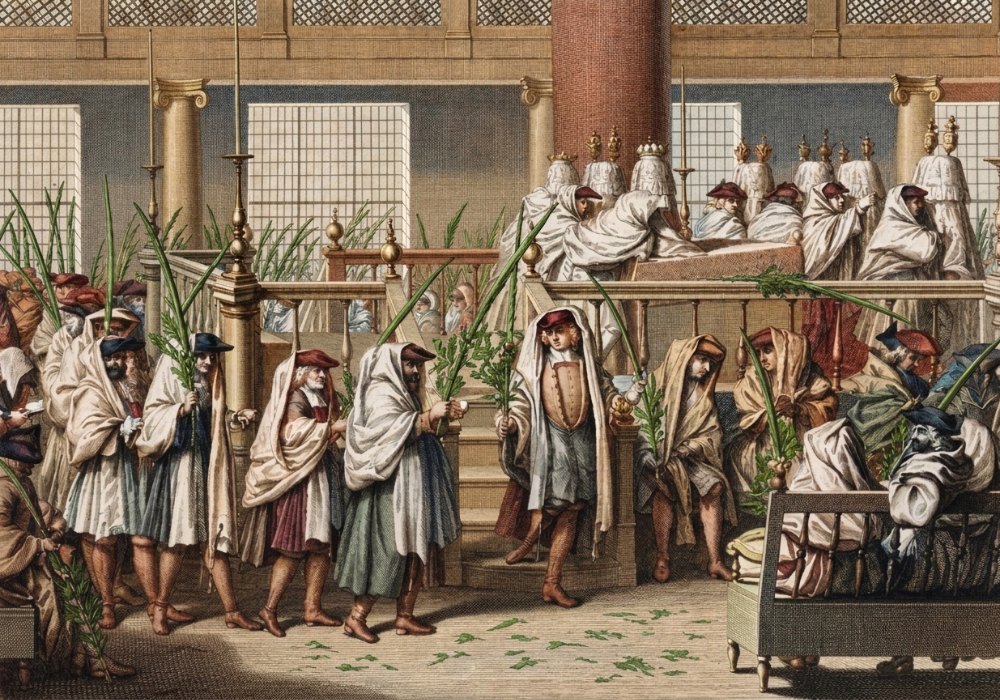
On Hoshana Rabbah, in Chassidic circles, people wish one another a gut kvitl—Yiddish for “a good note.” A kvitl is a slip of paper, like the one a Chassid hands his Rebbe with a request; here it is the slip, as it were, on which one’s verdict for the coming year is written. In the Aramaic of the Zohar the same wish is pitka tava. Either way, the meaning is: may your verdict be a good one!
But wait. Jewish tradition tells us that on Rosh HaShanah we are judged and on Yom Kippur the judgment is sealed.1 The liturgy of the Days of Awe says so in as many words: “On Rosh HaShanah it is written, and on the fast of Yom Kippur it is sealed.” What, then, is left to happen on Hoshana Rabbah, the seventh day of Sukkot, eleven days after the gates have closed? The mystical tradition adds a third stage: on Hoshana Rabbah the sealed verdict is delivered—that is, revealed. In the words of the Zohar, on the seventh day of the festival the judgment of the world is concluded and the notes go forth from the King’s house.2 Those notes—the pitkin—are the slips that give the kvitl its name.
This only sharpens the question. If the judgment was sealed on Yom Kippur, what good does it do to wish each other a good verdict on Hoshana Rabbah? Does one wish a defendant luck after the sentence has been signed? To understand, we need to turn first to the Talmud and then to… quantum physics.
As I discussed in my essay “Collapse and Revelation,” a Talmudic teaching sheds light on this.3 Rabbi Yitzchak says: “Blessing is found only in a thing hidden from the eye, as it is said, ‘The Lord will command the blessing upon you in your storehouses’ (Deuteronomy 28:8).”4 The storehouse is where the grain lies out of sight; indeed, the Sages hear in asamecha, “your storehouses,” an echo of samui, “hidden.” The school of Rabbi Yishmael taught the same idea: blessing is found only in a thing over which the eye has no dominion.
The Talmud then records the practical law that follows from this principle:
The Sages taught: One who goes to measure the grain on his threshing floor says, “May it be Your will, O Lord our G‑d, that You send blessing upon the work of our hands.” If he has begun to measure, he says, “Blessed is He who sends blessing upon this pile.” If he measured and only then recited the blessing, this is a prayer in vain, for blessing is found neither in a thing that is weighed, nor in a thing that is measured, nor in a thing that is counted, but only in a thing hidden from the eye, as it is said, “The Lord will command the blessing upon you in your storehouses.”
Note the sequence. Before the measuring begins, one may pray for blessing in full. Once the measuring has begun but is not yet complete, one still blesses, though the formula changes. Once the measuring is done, there is nothing left to ask for; to pray now is to pray in vain. The Mishnah states the general principle elsewhere: one who cries out over what has already happened utters a vain prayer.5
The teaching is profound. Before measurement, the pile of grain is in a state of blessed potential—a superposition, as it were, of “more or less.” The act of measuring collapses this potential into a fixed quantity. Once the grain is counted, it is what it is, and asking Heaven to make it more is futile. The Maharal explains why: whatever is measured and counted is thereby bounded, and blessing, which flows from the Infinite, does not rest upon what has been bounded.6
The Talmud, of course, does not speak the language of quantum mechanics. But the structural parallel is striking. In quantum physics, a system in a superposition of several possible values of some observable—the position of an electron, say, or the direction of its spin—does not possess a definite value of that observable at all. The theory tells us the probabilities of the various outcomes, and nothing more. Only when a measurement is made does one definite value emerge, and in the standard account, the state of the system changes abruptly to match it. This is the so-called collapse of the wavefunction: measurement turns indefinite potential into definite actuality.7 Before the measurement, the eye has no dominion. After it, the matter is counted.
Physicists even distinguish two stages within a measurement. In the analysis that goes back to John von Neumann, the system first becomes entangled with the measuring apparatus—each possible outcome paired with its own pointer reading—yet the combined state of system and apparatus is still a superposition, and no single reading has been singled out. Only in the second stage, the readout, does a definite result appear.8 The “quantum eraser” experiments show how much hangs on that second stage: a record of which path a photon took—a record already written into the apparatus—can be erased before it is read out, and the interference pattern that the record had destroyed reappears.9 A record that has been written but not yet read, it turns out, is not yet final.
Now we can return to Hoshana Rabbah. The judgment is sealed on Yom Kippur—but sealed is not the same as delivered. From Yom Kippur to Hoshana Rabbah the verdict exists, in the language of the Kabbalah, in the Alma d’Iskasya, the concealed world; it has not yet descended into the Alma d’Isgalya, the revealed world, where it is read out and takes effect. The Chassidic masters find this very idea in the verse “Sound the shofar at the new moon, at the time of concealment (bakeseh), for the day of our festival” (Psalm 81:4): what is concealed on Rosh HaShanah is revealed on the festival of Sukkot.10 The kvitl has been written and sealed, as it were, but the envelope is still closed, and the eye has no dominion over it. And where the eye has no dominion, the Talmud assures us, blessing can still be found.
This is why the all-night vigil of Hoshana Rabbah, the seven circuits with the lulav, the beating of the willows, and the humble wish of a gut kvitl are not prayers in vain. They belong to the second stage of the baraita: the measuring has begun, but it is not yet finished, and we may still say, “Blessed is He who sends blessing upon this pile.” In the language of physics, Yomim Naroim—Rosh HaShanah and Yom Kippur—are the first stage of the measurement: the verdict is written and sealed; the record is made, but Above, in the concealed world, where no single outcome has yet been read out. Hoshana Rabbah is the readout, when the pitka leaves the King’s house and the verdict collapses into a fact in our world.
And once it has? Then, like the farmer who has finished measuring, we stop asking. The day after Hoshana Rabbah is Shemini Atzeret, and then Simchat Torah—when the willows have been beaten and put away, and we take the Torah scrolls in our arms and dance. The verdict has been delivered, and we trust it is good. What remains is to rejoice in the One who inscribed it, trusting, as Rabbi Akiva taught, that whatever the Merciful One does, He does for the good.11
G’mar tov!
Gut kvitl!
Hag Samea’ch!
Footnotes:
- Talmud, Rosh HaShanah 16a (the view of Rabbi Meir; Rabbi Yehudah concurs with respect to man); cf. Mishnah Rosh HaShanah 1:2. The liturgical formulation is from Unetaneh Tokef. ↩︎
- Zohar III, 31b (Tzav): “On the seventh day of the festival the judgment of the world is concluded, and the notes (pitkin) go forth from the King’s house” (be-yoma shevi’a’ah de-chag hu siyuma de-dina de-alma, u-fitkin nafkin mi-bei malka). A parallel passage speaks of the notes being handed to the prosecutor: Zohar I, 220a–b (Vayechi). The halachic codes reflect the same view, prescribing Yom Kippur-like customs for the day: Shulchan Aruch, Orach Chaim 664, with Rema and Mishnah Berurah ad loc. ↩︎
- Alexander Poltorak, “Collapse and Revelation,” QuantumTorah.com, January 29, 2021, https://quantumtorah.com/collapse-and-revelation/ ↩︎
- Talmud, Bava Metzia 42a; the passage appears verbatim in Ta’anit 8b. On asamecha/samui, see Rashi ad loc. The translation is mine. ↩︎
- Mishnah Berachot 9:3 (Talmud, Berachot 54a): “One who cries out over the past—this is a vain prayer.” ↩︎
- Maharal of Prague, Chiddushei Aggadot on Bava Metzia 42a: the eye sets a limit on whatever it takes in, whereas blessing is without limit. ↩︎
- I use the standard textbook language of “collapse.” In the de Broglie–Bohm pilot wave theory, which I discussed in “The Pilot Wave of Righteousness”, there is no collapse as such: the outcome is fixed in advance by variables hidden from the observer, and the measurement only brings it to light. Strikingly, the Talmud’s phrase “hidden from the eye” sits comfortably with either reading. In both, before the readout, the eye has no dominion over the result. ↩︎
- John von Neumann, Mathematische Grundlagen der Quantenmechanik (Berlin: Springer, 1932), ch. VI; English translation: Mathematical Foundations of Quantum Mechanics, trans. Robert T. Beyer (Princeton: Princeton University Press, 1955). The first stage is now commonly called “premeasurement”; see Paul Busch, Pekka Lahti, and Peter Mittelstaedt, The Quantum Theory of Measurement, 2nd ed. (Berlin: Springer, 1996). ↩︎
- Marlan O. Scully and Kai Drühl, “Quantum Eraser: A Proposed Photon Correlation Experiment Concerning Observation and ‘Delayed Choice’ in Quantum Mechanics,” Physical Review A 25 (1982): 2208; Yoon-Ho Kim, Rong Yu, Sergei P. Kulik, Yanhua Shih, and Marlan O. Scully, “Delayed ‘Choice’ Quantum Eraser,” Physical Review Letters 84 (2000): 1. ↩︎
- Psalm 81:4 (81:3 in some English Bibles). That bakeseh, “at the time of concealment,” refers to Rosh HaShanah—the festival on which the moon is hidden—is the Talmud’s own reading: Rosh HaShanah 8a–b; Beitzah 16a. For the Chassidic extension of the verse, that what is concealed on Rosh HaShanah is revealed on Sukkot, see the Alter Rebbe, Likkutei Torah, Derushim le-Sukkot. ↩︎
- Talmud, Berachot 60b: kol de-avid Rachmana le-tav avid. ↩︎


