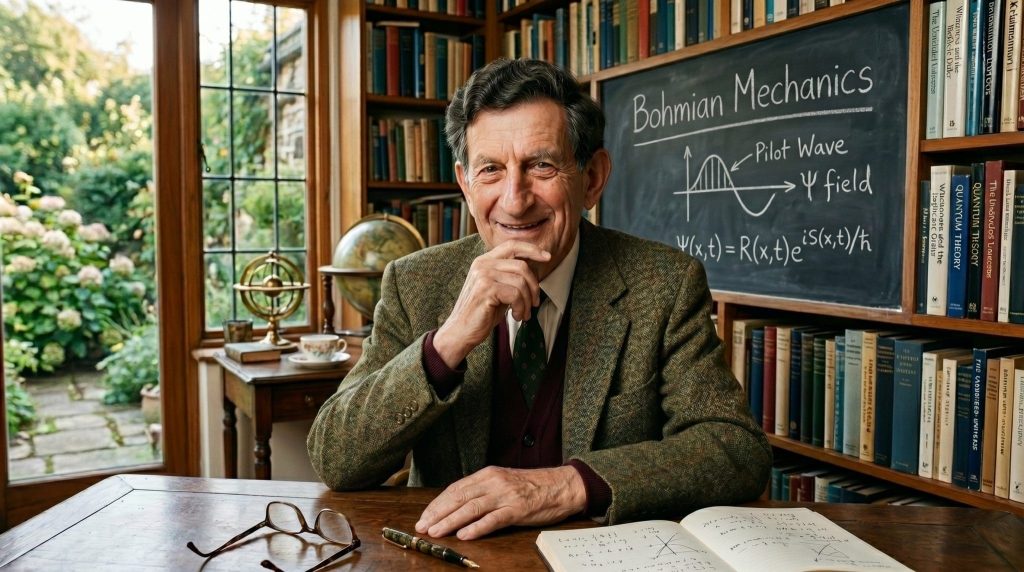
A Psalm and the guiding pilot wave of de Broglie and Bohm Interpretation of Quantum Mechanics
Synopsis:
Psalm 85 closes with a grammatical surprise: righteousness does not merely walk (yeilech) before the person—it conducts him (yehalech). In Iggeret HaKodesh, the Alter Rebbe hears in this causative form an entire theology of the deed: tzedakah does not remain behind the giver as a record of what he did; it goes before him—and within him—opening gates, awakening the innermost point of the heart, and setting his footsteps on the way. This essay traces a striking structural parallel between that teaching and de Broglie–Bohm pilot wave theory, in which a particle's real trajectory is not pushed from behind but guided by a wave whose influence depends on form rather than force. The parallels run deep: guidance without propulsion, the disproportionate power of small deeds, the gate as boundary condition, nonlocality and hashgachah pratit, and Bohm's implicate order echoed in the Kabbalistic Alma d'Iskasya, the concealed world. The essay also marks where the analogy breaks—the wavefunction is not moral, and it's determinism does not remove the free choice given to mankind. A metaphor is not evidence; it is a lens. But through this lens, an old verse and a strange physics illuminate one another: a deed begins as the person's action, and the person becomes the deed's.
I. Two texts, one paradigm of guidance
Sometimes a single letter carries a worldview. The verse in Psalms reads:
Tzedek (“righteousness”) shall go before him, and he shall set his footsteps on the way. (Psalms 85:14)
In Iggeret HaKodesh (Epistle 4), the Alter Rebbe, R. Schneur Zalman of Liadi, pauses on the word yehalekh (“shall go”). Grammatically, one would have expected the simple kal form, yelekh—“righteousness shall walk before him.” Instead, according to the Alter Rebbe, the verse uses the pi’el (causative) form of this verb, which carries a causative or transitive force: yehalekh means not merely “it will walk” but “it will conduct,” or “it will lead.” The subject of the walking is no longer only tzedek itself; tzedek becomes the agent that makes the person walk, drawing his footsteps onto the path in its wake, as if guiding the person acting with righteousness. The tzedakah1 a person gives does not trail behind him as a record of what he did; it travels out ahead of him, pulls him forward and guides him—“and sets his footsteps on the way.” To be sure, this is not the standard plain meaning (peshat) of the verse. However, in light of the closely parallel wording in Isaiah 58:8, “your righteousness shall go before you,” it is an acceptable reading of the verse.

In 1927, at the fifth Solvay Conference, Louis de Broglie, who had proposed the wave nature of material particles and would receive the 1929 Nobel Prize for the discovery of the wave nature of electrons, proposed that a quantum particle does not travel alone: it is accompanied by a real, physical wave—the onde pilote, the pilot wave that defines the guidance field through which the particle moves.2 The proposal met substantial resistance at the 1927 Solvay Conference. De Broglie subsequently set it aside for a period, although the history was more complicated than the familiar story of a single decisive objection by Pauli. The idea was revived and made rigorous by David Bohm in his 1952 papers.3 In what is now called the de Broglie–Bohm pilot wave interpretation of quantum mechanics, or simply Bohmian mechanics, the electron always has a definite position and follows a definite path—but that path is not self-determined. It is conducted by the wavefunction, which deterministically evolves according to the Schrödinger equation and guides the particle through what Bohm called the guidance equation.
An electron, in this picture, does not yelech—it does not simply walk on its own. Its wave yehalekh—the wave goes before it and guides it.
The parallel is not a proof of anything, and we describe clearly below where it breaks. But as a metaphor it is unusually rich. Let us walk through it slowly.
(A small wink from the footnotes of history: Bohm’s two 1952 papers appeared in volume 85 of Physical Review. The verse is from Psalms 85. Make of that what you will.)
II. The Alter Rebbe’s point: the deed that leads the doer
The verse says tzedek, “righteousness,” while the Alter Rebbe reads that righteousness concretely through the mitzvah of tzedakah. The plain religious intuition is that a person performs a mitzvah: I act, and the deed is my product, left behind me like a footprint. The Alter Rebbe’s grammatical observation inverts this. The verse says tzedek, “righteousness,” while the Alter Rebbe reads that righteousness concretely through the mitzvah of tzedakah.Because the verse says yehalekh and not yelekh, the tzedakah is not the footprint—it is the path-maker. In the epistle, the act of charity performed below goes out ahead of the giver, opening channels and drawing down hidden divine light (Ohr Sovev), a transcendent emanation from above, so that the person is then led—his mind and heart are carried to places his own unaided effort could not reach. The same epistle weaves in the verse:
Open for me the gates of Tzedek (“righteousness”). (Psalms 118:19)
The charity itself becomes the gate through which the light of the divine countenance enters, and through which the giver walks.
Three features of this picture are worth isolating, because each will find its counterpart in Bohmian mechanics:
- Precedence. The tzedek travels lefanav—before him. The effect of the deed is out in front, in territory the person has not yet reached.
- Conduction rather than propulsion. The person is not shoved from behind by his past merit; he is guided along a path that the deed has already shaped. The verb is causative, not mechanical.
- Disproportion. A finite sum, even a perutah (the smallest coin) given to a poor man, produces guidance utterly incommensurate with its material size—it “sets his footsteps,” reorients an entire life-trajectory.
III. The pilot wave in brief
For readers who know the Tanya better than the physics, here is the de Broglie–Bohm picture in five sentences.
In the familiar textbook or Copenhagen interpretation of quantum mechanics, the wavefunction ψ supplies probabilities for possible measurement outcomes, and a definite premeasurement particle trajectory is not assigned. Bohmian mechanics supplements the wave function with actual particle positions. The wave function evolves according to Schrödinger’s equation and determines the velocity field governing the configuration. Bohmian mechanics says instead: the particle is always somewhere, moving along a real trajectory, and ψ is a real field4 that guides it—the particle’s velocity at each moment is fixed by the local form (technically, the phase gradient) of the wave. In Bohm’s quantum Hamilton–Jacobi reformulation, the same dynamics can be expressed through a quantum “potential,” an addition to classical mechanics with a startling property: its influence depends on the form of the wave, and not on its amplitude or intensity. In the famous double-slit experiment, the wave passes through both slits—exploring paths the particle will never take—and the interference pattern it forms ahead of the particle then channels the particle’s single actual trajectory into the observed bands. And the wave is not consumed by guiding: it does not push the particle with transferred energy the way a river pushes a boat or a locomotive pulls a train; it informs the particle’s motion while remaining what it is.
Bohm and Basil Hiley, in The Undivided Universe (1993), offered an analogy: a ship on autopilot steered by radar signals. The radio waves carry negligible energy—nothing like what would be needed to physically push the ship—yet they determine its entire course, because the ship responds to their form, their information. They coined the term “active information” for this mode of causation: the wave does not drive the particle; it in-forms and guides it, gives form to its motion from within.
IV. The parallels, one by one
1. Yehalech, not yelech: guidance is not propulsion
This is the heart of the analogy, and it is exactly the Alter Rebbe’s grammatical point. In the familiar force-centered picture of classical mechanics, motion is explained through forces acting on bodies. Classical physics focuses on yelech-causation. Bohm and Hiley proposed a different explanatory language: the wave’s form informs the trajectory. The pilot wave introduces yehalech-causation into physics: the particle moves because something goes before it and guides it, responding to form rather than to force. Bohm and Hiley’s “active information” is almost a translation of the pi’el (causative verb form): the wave does not walk in the particle’s place, nor does it shove the particle—it makes the particle walk, causatively, the way a melody makes a dancer move.
So too tzedakah, in the Alter Rebbe’s reading. The mitzvah (“precept” or a good deed) does not mechanically reward the giver, depositing merit behind him. It restructures the field through which he will now move, so that his subsequent steps—his prayer, his Torah, his teshuvah (“return”)—are drawn along channels the deed has opened. It sets his footsteps: the deed configures the path, and the person, still genuinely walking, finds himself conducted.
2. “Before him”: the wave scouts territory the walker has not reached
In the double-slit experiment, the wave is always ahead of and around the particle, probing both slits, feeling out the whole landscape of possibility, while the particle threads one actual line through it. The guidance the particle receives at any point already encodes what the wave has “learned” about regions the particle never visited.
Tzedek lefanav yehalech—the righteousness goes before him. The Chassidic teaching is that the effect of charity is registered above and ahead before the giver experiences anything at all; the gates of righteousness (Sha’arei Tzedek) are opened in advance of his arrival. A person who gives tzedakah in the morning, prays differently—not because he feels different (he may not), but because the terrain has been reshaped ahead of him. Like the electron approaching the interference region, he walks into a landscape his own prior act has already patterned.
On the plain sense of the verse, the pronoun points upward: righteousness goes before Him. The Chassidic reading does not erase that sense; it turns it inward. To walk “before G-d” is to be led to the place where G-d is found within—the innermost point of the heart—so that the two readings name a single journey: the deed goes before Him precisely by going deeper into the one who walks toward Him. When this essay speaks of tzedakah going before the giver, it is this doubled lefanav that is meant.
3. Form over magnitude: the disproportion of small deeds
The quantum potential’s independence from amplitude is, physically, one of the strangest features of Bohm’s theory: multiplying the wave function by an overall constant does not change the Bohmian velocity field. What matters is its phase and spatial structure, rather than its overall normalization. Bohm saw in this a new category—causation by information.
Compare the halachic and Chassidic insistence that the guiding power of tzedakah is not proportional to the sum. A poor person’s small coin, the Talmud teaches, can outweigh great fortunes, because the deed’s form—to whom, how, with what face and what heart—is what counts. The radar signal does not need the energy of the ocean to turn the ship; the perutah (the smallest coin) does not need the mass of a fortune to turn a life. In both systems, magnitude is the wrong variable; form is the causal currency.
4. The wave is not spent by guiding
A classical force pays for its effect: energy flows from the pusher to the object pushed. The pilot wave, guiding by form, is not depleted by the particle it steers. Something of this appears in the paradoxical economics of tzedakah—“tithe so that you become wealthy” (Talmud, Ta’anit 9a). Giving, in the Torah’s accounting, is not a transfer that diminishes the giver but an act that configures reality around him; the “wave” of the deed guides without being consumed, and the giver is enriched rather than emptied.
5. Nonlocality: the deed below, the effect elsewhere
Bohmian mechanics is famously, unapologetically nonlocal: the wavefunction lives in configuration space, and a change involving one particle can instantaneously reshape the guidance of another far away. Bohm regarded this not as a defect but as a disclosure—the universe is an “undivided whole.”
Ḥassidut says the same of a mitzvah, and of tzedakah above all: the coin passes from hand to hand in one small room in this world, and the effect—in the Alter Rebbe’s language, the drawing down of divine kindness, the arousal above answering the arousal below—is registered in “regions” that share no locality with the deed at all. The mitzvah’s true field, like ψ, does not live in the three-dimensional space where the act occurred; the physical deed is one point of a configuration whose reshaping is everywhere at once.
6. Hidden variables: chance that is not chance
Hidden variables
Bohm’s theory belongs to a family of theories physicists call hidden-variables theories, and the name itself is telling. Standard quantum mechanics declares the electron’s behavior irreducibly random—no fact of the matter, only probabilities. Bohm’s reply: the randomness is real to us but not real in itself. Beneath the statistics there is a definite position and a definite guiding wave at every instant; the particle always “knows“ exactly where it is going. What we call “quantum chance” is, in his account, only our ignorance of the hidden variable—the outcomes look random because we cannot access the underlying determination (what Bohmians call “quantum equilibrium”). Einstein’s famous protest that “G-d does not play dice” (letter to Max Born, 1926) is, structurally, a hidden-variables intuition: apparent dice, underlying direction.
Implicate order vs explicate order
In his later work on what he called the “implicate order” signals that this belongs to Wholeness and the Implicate Order (1980), Bohm himself offered an image of such concealment. Place a droplet of ink into glycerin held between two concentric cylinders, and turn the outer cylinder slowly. The viscous fluid does not mix turbulently; its flow is laminar. It draws the droplet out into a thread so fine that it disappears, leaving only a featureless gray—to every appearance, the ink and the glycerine have mixed completely—a perfect randomness. Now turn the cylinder back the same number of turns, and the droplet reassembles before one’s eyes. Bohm calls it the “explicate order.” The order was never destroyed. It was enfolded, present in the gray all along, waiting to be unfolded. The eye reported chance, but the fluid retained a structure. The demonstration trains the imagination in the one distinction this section requires: that a surface may be genuinely unreadable and yet conceal a complete order—and that what looks like dispersal may be a form of hiddenness rather than a form of loss. The hester panim (“concealment of the face,” that is, concealment of divine providence) is in the reading, not in the world.
Hidden world and revealed world
There is a direct and rather precise parallel to the Bohmian implicate order and explicate order in the Jewish mystical traditions of Kabbalah and Chassidut. They are called respectively:
- Alma d’Iskasya (עלמא דאתכסיא): the “concealed world”5 ; and
- Alma d’Isgalya (עלמא דאתגליא): the “revealed world”.6
The parallel is immediately recognizable: Alma d’Iskasya (the “concealed world”) corresponds to Bohm’s implicate order, whereas Alma d’Isgalya (the “revealed world”) corresponds to Bohm’s explicate order.
In my essay, “Collapse and Revelation,”7 I already discussed the relevance of Alma d’Iskasya and Alma d’Isgalya to quantum mechanics in general and to the collapse of the wavefunction in particular, and I refer the reader for details there. But I would be remiss if I hadn’t pointed out this profound parallel, not only in language but in substance. This parallel runs deep. As will be discussed later, Bohm’s implicate order is non-local. And so is Alma d’Iskasya.
In Kabbalah, these two worlds correspond to the letters of the proper divine name, the Tetragrammaton (Y-H-W-H): Alma d’Iskasya to the first two letters (Y-H), and Alma d’Isgalya to the last two (W-H). This division is rooted in the biblical verse:
The concealed things belong to the L-rd our G-d, and the revealed things to us and our children” — which Kabbalistic sources read onto the Name’s two halves. (Deuteronomy 29:28)
In turn, the first two letters (Y-H) correspond to the hidden light—Ohr Sovev Kol Almin, the “surrounding light,” the transcendent revelation of divinity—while the last two letters (W-H) correspond to the revealed light—Ohr Memale Kol Almin, the “inner light,” the immanent revelation. Putting the two correspondences together: Alma d’Iskasya, the concealed world, aligns with Ohr Sovev, the concealed light. And it is called Sovev, “surrounding,” precisely because it is non-local: in the language of Chassidut, this light does not clothe itself within worlds, at a place and to a measure (as Ohr Pnimi does), but encompasses all of them equally and at once. The implicate order, too, is nowhere in particular because it is enfolded everywhere.
The world that conceals: Olam as he’elem
Physics studies nature, the universe, the physical world. Jewish thought often gathers these synonyms into a single word: olam (“world”). And the masters of Kabbalah note that the word olam is cognate with the word he’elem (“concealment”)—these two words share the root ע-ל-ם (ayin–lamed–mem). This teaching is a staple of Chabad Chassidut (it appears throughout the Likkutei Torah and the ma’amarim). Here, one might say, is Bohm’s implicate order in the language of Kabbalah: an order not absent from the gray, but enfolded within it.
Divine providence — hashgachah pratit
This is very nearly a physicist’s paraphrase of hashgachah pratit ([divine] “providence in details”) as the Baal Shem Tov radicalized it. Earlier authorities, such as Maimonides, had confined individual providence largely to human beings; the Baal Shem Tov taught—in the teaching made famous through Chabad sources—that even a leaf turning over in the wind, even the direction a wisp of straw is blown, is individually directed by divine providence. Nothing is left to chance. The world presents a statistical face—winds, markets, encounters, the coin that happens to reach this pauper and not that one—and the Torah’s claim is precisely the hidden-variables claim: the randomness is epistemic, not ontic. There is a variable hidden from every observer, and it determines each outcome singly.
Quantum mechanics as an effective theory
The hidden-variables idea resonates with me beyond the de Broglie-Bohmian setting — and here I speak for myself, not for Bohm. On my own view, quantum mechanics may be an effective, coarse-grained theory, much as thermodynamics is a coarse-grained theory of molecular motion. Thermodynamics does not track the coordinates and momenta of individual molecules; it describes the gas through emergent quantities such as temperature and pressure. So too, perhaps, quantum mechanics does not track the underlying variables and confines itself to an emergent quantity—the wavefunction. On this account, quantum randomness is an epistemic limitation, not an ontic property of nature. Einstein hoped for something of the kind, and the hope survives in serious research programs today. Although Bell’s theorem shows that any such deeper level must be nonlocal—unlike the molecules beneath a gas—and the Pusey–Barrett–Rudolph theorem constrains how far the wavefunction can be demoted to mere bookkeeping, a deeper order remains possible (a comfortable, classical one does not). Perhaps that, too, is fitting: olam conceals more stubbornly than a gas conceals its molecules.
Bell’s theorem and hidden variables
Bell’s theorem adds a sharpened footnote: any hidden variable that reproduces quantum statistics must be nonlocal; the hidden determination cannot be a little local mechanism riding inside each particle—it must, in some sense, take the whole configuration into account at once. Providence was never claimed to be local either. The hashgachah directing the leaf is not a “spring” inside the leaf; it is the Whole (klal) attending to the part (prat).
Recall that Alma d’Isgalya—the hedden world of Kabbalah, corresponding to Bohm’s implicate order–is also distinctly non-local.
And here, one disanalogy is actually the essay’s point rather than its problem: Bohm’s hidden variable is a position—mute, impersonal. The hidden variable of hashgachah pratit is a Ratzon ha-Eliyon (the “Supernal Will”). Bohm shows that a world can look perfectly random on its surface while being perfectly directed underneath; Emunah (“faith”) names what, or rather Who, is doing the directing.
V. Where the analogy breaks
Intellectual honesty demands that we mark the limits.
First, determinism versus bechirah. Bohmian mechanics is fully deterministic: given the wave and the initial position, the particle’s trajectory is fixed. The electron is conducted whether it “wants” to be or not. Tzedek’s guidance is precisely the opposite in this respect—the person chooses to give, and remains free at every step. The verse itself preserves this: the second clause can be read as the person setting his own footsteps onto the way that tzedek has opened. The wave guides an object; tzedakah guides a subject with agency. If anything, the disanalogy sharpens the teaching: the pilot wave shows that guidance-by-form is physically coherent, and free will shows what such guidance looks like when the guided one can say yes.
Second, ψ is not moral. The wavefunction guides toward interference bands, not toward the good. To read moral direction into physics would be a category error; the parallel is structural, not ethical.
Third, Bohm’s theory is an interpretation, not an established fact. It reproduces the predictions of standard quantum mechanics and is taken seriously by serious physicists (John Bell was among its most eloquent defenders), but it is one reading of the quantum formalism among several.8 Our metaphor borrows its imagery, and would survive even if physics one day discards it.
A metaphor is not evidence; it is a lens. The world doesn’t prove Torah, but that the world, looked at with open eyes, keeps rhyming with it.
VI. Conclusion: walking a guided path
The Alter Rebbe heard, in the shift from yelech to yehalech, an entire theology of the deed: what you give does not stay behind you; it goes out in front of you and conducts you. Two centuries later, physicists groping toward the foundations of matter found themselves forced to describe the electron in nearly the same language: not a self-propelled walker, but a walker walked—led by an unseen wave that goes before it, that responds to form and not to force, that is everywhere at once and is never spent.
Whether or not the electron really has a pilot wave, the person does. Every coin dropped into a pushke (tzedakah box) sends something out ahead—scouting the slits, opening the gates, patterning the interference bands of the day to come—so that when the giver takes his next step, he finds, mysteriously, that the way has already been set for his feet.
צֶדֶק לְפָנָיו יְהַלֵּךְ — וְיָשֵׂם לְדֶרֶךְ פְּעָמָיו.
Sources
- Psalms 85:14; Psalms 118:19
- Tanya, Iggeret HaKodesh, Epistle 4 (the yehalech/yelech comment; cited from memory — please confirm the epistle number in your edition)
- Ta’anit 9a (“עשר בשביל שתתעשר”)
- L. de Broglie, remarks at the Fifth Solvay Conference (1927), the original onde pilote proposal
- D. Bohm, “A Suggested Interpretation of the Quantum Theory in Terms of ‘Hidden’ Variables I & II,” Physical Review 85, 166–193 (1952)
- D. Bohm & B. J. Hiley, The Undivided Universe: An Ontological Interpretation of Quantum Theory (Routledge, 1993) — the “active information” concept and the ship-and-radar analogy (paraphrased, not quoted verbatim)
- A. Einstein, letter to Max Born (December 1926) — the “G-d does not play dice” remark (commonly paraphrased)
- J. S. Bell, “On the Einstein Podolsky Rosen Paradox,” Physics 1, 195–200 (1964) — the nonlocality of hidden variables
- Maimonides, Guide for the Perplexed III:17–18 — individual providence extending, among earthly creatures, to human beings alone
- The Baal Shem Tov’s doctrine of hashgachah pratit extending to all creation (the turning leaf), as transmitted in Chabad sources (e.g., Keter Shem Tov, Hosafot — cited from memory, please verify)
- Einstein’s ensemble view can be found in his “Reply to Criticisms” in Schilpp’s Albert Einstein: Philosopher-Scientist (1949); PBR is Pusey, Barrett & Rudolph, “On the reality of the quantum state,” Nature Physics 8, 475–478 (2012).
Endnotes:
- The word tzedakah is often incorrectly translated as “charity.” Charity is chesed, not tzedakah. Tzedakah literally means “righteousness.” It is right to share what we have with those who have not, because G-d, to whom all wealth belongs, uses us as his agents to provide for those who cannot provide for themselves. If we don’t share, G-d can easily find more cooperative agents to fulfill this role. ↩︎
- The popular way of describing the pilot wave as “spreading” ahead of the particle is not entirely correct. The pilot wave, which is essentially the wavefunction, is not simply a crest located spatially in front of the particle; in multiparticle Bohmian mechanics, it is defined on multi-dimensional configuration space, rather thant the ordinary physical space. ↩︎
- D. Bohm, “A Suggested Interpretation of the Quantum Theory in Terms of ‘Hidden’ Variables,” Physical Review 85, 166 and 180 ↩︎
- Bohmian authors disagree about the ontological status of the universal wavefunction: physical field, law-like object, dispositional structure, or something else. Moreover, for a many-particle system it is a function on configuration space, not an ordinary field in three-dimensional physical space. Bohm and Hiley interpreted this guidance in terms of active information. ↩︎
- The Zohar refers to the Partzuf Leah (sub-partzuf of Nukva d’Z”A) as Alma d’Iskasya, because Leah symbolizes the World of Thought (Olam HaMachshavah), which is the concealed world. After all, thoughts are not revealed until spoken. ↩︎
- Partzuf Rachel (another sub-partzuf of Nukva d’Z”A) is referred to in the Zohar as Alma d’Isgalya, because Rachel symbolizes the World of Speech (Olam HaDibur), which reveals hidden thoughts. ↩︎
- A. Poltorak, “Collapse and Revelation,” QuantumTorah.com. Jan. 1, 2021, https://quantumtorah.com/collapse-and-revelation/. ↩︎
- De Broglie-Bohm Pilot Wave Theory, albeit undeniably elegant, is facing a serious challenge—so far, all attempts to make this theory compatible with the special theory of relativity have proved unsuccessful. However, the proponents of this theory remain hopeful, and such generalization is a subject of an ongoing research program. ↩︎


