Bereshit, the Event Horizon, and the Geometry of Concealment
Now the earth was astonishingly empty, and darkness was on the face of the deep, and the spirit of G‑d was hovering over the face of the water. (Genesis 1:2)
A Physicist’s Puzzle
As a physicist, I was taught that darkness is nothing. More precisely, ordinary darkness is nothing in itself: it is the absence of visible light. A dark room is a room into which light has not been admitted. Night is the shadow the Earth casts upon itself. Switch on a lamp and the darkness does not retreat somewhere else; it simply disappears, because there was no positive stuff called ‘darkness’ to push aside. In ordinary physics, darkness is a privation, not a substance. In philosophy, we call it steresis, that is “absence.”
The Torah says differently. Isaiah spoke of darkness as something G‑d creates:
I form light and create darkness (yotzer ohr u’vore choshech). (Isaiah 45:7)
Isaiah deliberately uses the same divine-creation verb used at the opening of Genesis.1 The Sages go further, counting darkness among the ten things created on the first day, side by side with light.2 Genesis itself does the same thing narratively: darkness is already there in verse 2, “on the face of the deep,” while “Let there be light” waits for verse 3. Darkness is not merely the background behind creation. In the language of the text and its rabbinic reading, it is a creation itself.
So which should I believe, my physics or my Torah? I no longer think I have to choose. The darkness of Genesis 1:2 need not be the darkness of a dark room. Physics itself gives us a rigorously defined kind of ‘darkness’ that is not a local shortage of photons at all, but a feature of causal structure: a boundary in spacetime beyond which signals cannot reach a certain class of observers. We call such a boundary a horizon. I am not suggesting that Genesis anticipated Einstein’s theory of relativity. I am suggesting something narrower, and to me more interesting: biblical and rabbinic language about created, bounded, concealing darkness has a striking structural parallel with the physics of horizons.3
Darkness Has a Place
Read the verse once more. It does not say that darkness filled the deep, or that darkness was in the deep. It says darkness was al pnei tehom, “over” or “upon the face of the deep.” Panim, “face,” names what presents itself outward. And in biblical idiom al pnei can mean over or upon the surface. At the very least, then, the verse places darkness in relation to the “face” of a depth. What happens if we take that spatial language seriously?4
Three other verses in Tanach make the pattern hard to dismiss.
The Book of Job asks:
Where is the way to where light dwells, and darkness—where is its place (mekomo)? That you might take it to its boundary (gevulo), and that you might know the paths to its house. (Job 38:19–20)
Darkness here has a place and a boundary. It even has a house. Whatever these poetic images finally mean, the language is unmistakably spatial.
The Book of Proverbs, speaking in the voice of the primordial Wisdom present at creation, says:
When He established the heavens, I was there; when He inscribed a circle on the face of the deep (b’chuko chug al pnei tehom). (Proverbs 8:27)
Here is the very phrase of Genesis 1:2—al pnei tehom, “on the face of the deep”—and now there is a circle inscribed on it.
And Job once more, in a verse that could serve as the epigraph to everything that follows:
He inscribed a circle on the face of the waters, at the boundary of light with darkness (chok chag al pnei mayim ad tachlit or im choshech). (Job 26:10)
A circle inscribed on the face of the waters, defined as the boundary where light meets darkness. If I were asked to define “horizon” poetically without using the word, I could hardly do better. The English word itself comes from the Greek horizein (“to bound”); again and again the biblical language puts darkness, boundary or circle, and the face of the deep or waters into the same picture. This is not physics, yet. It is a remarkably persistent vocabulary of bounded concealment.
The Sages’ Geometry
The Sages made the geometry explicit. The Talmud, expounding the words tohu (“chaos” or “bewilderment”) and bohu (“void”) of our verse, teaches:
Tohu is a green line (kav yarok) that encircles the entire world, from which darkness issues, as it is said, “He made darkness His hiding place round about Him” (Psalms 18:12). Bohu—these are the damp stones submerged in the deep, from which water issues.5
Consider what the Gemara is describing: an encircling line, from which darkness comes forth, concealing what lies within. This idea is anchored in a verse in which darkness is a hiding place, a seter. On this reading, the darkness of verse 2 is not a shortage of light. It is a boundary that hides.
The Midrash is doing something quite different. It reads the four phrases of the verse as the four kingdoms destined to oppress Israel, and of the last it says: “on the face of the deep—this is the wicked kingdom, which cannot be fathomed, just as the deep cannot be fathomed.”6 Is it alluding to a causal horizon? I can’t be sure. But, in the very least, it contributes another motif that matters here: the deep is unfathomable from the standpoint of the one who faces it. That phrase will return when we reach the physics.
The Zohar opens with an even stranger image: botzina d’kardinuta, rendered as the “lamp of darkness” and, in Daniel Matt’s interpretation, a “spark of impenetrable darkness.” It “engraved engravings in the supernal radiance” and functions there as an instrument of measure.7 A lamp of darkness. Darkness not merely as what a lamp dispels, but as something involved in revelation and measurement. That paradox will matter below.
Finally, two sources that state the principle underneath all of this. The Psalmist says:
Even darkness is not dark to You; night shines like the day; darkness and light are alike. (Psalms 139:12)
And the Tanya, discussing tzimtzum—the primordial contraction by which the infinite light of the Ein Sof makes room, as it were, for finite worlds—insists that the tzimtzum is not literal (lo kipshuto). The light did not depart in any spatial sense. The concealment is from the vantage point of created beings; from G‑d’s side, as it were, nothing has changed.8 That gives us the distinction we need. Darkness, in this Chassidic sense, is not he’eder (“absence”). It is hester (“concealment”). The difference between the two is the subject of this essay.
What a Horizon Is
A few words of physics.
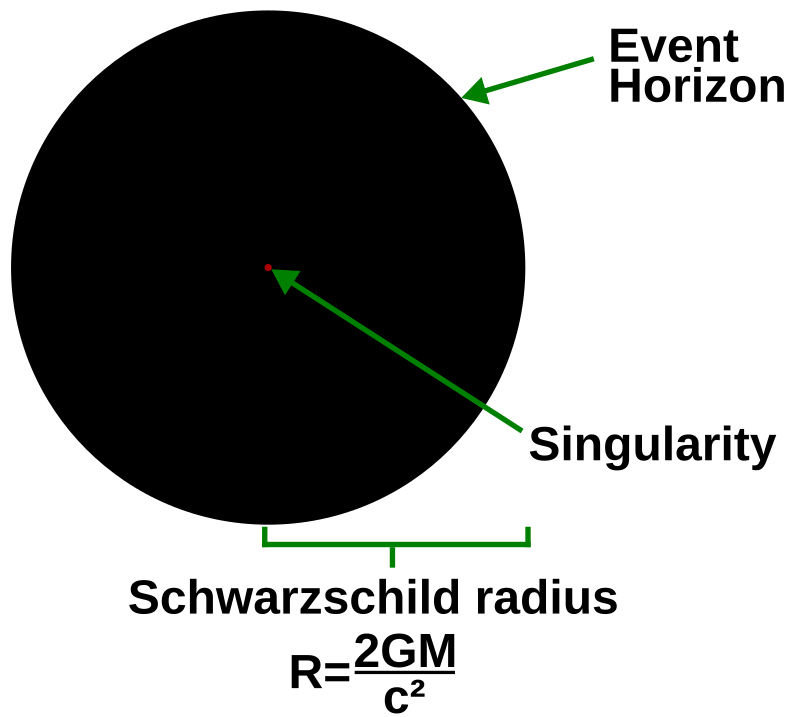
In 1916, only months after Einstein published general relativity, Karl Schwarzschild found the exact solution of Einstein’s equations for the gravitational field outside a spherical mass.9 His solution contains a special radius, now called the Schwarzschild radius, rₛ = 2GM/c². For a mass equal to the Sun’s, it is about three kilometers; for the Earth’s mass, about nine millimeters. The actual Sun and Earth are enormously larger than those radii. For decades, the physical meaning of r = rₛ remained obscure.
Credit: By Sandstorm de – CC BY-SA 4.0
Today we understand r = rₛ, for a Schwarzschild black hole, as an event horizon—a one-way causal boundary. Light and matter can cross inward, but no future-directed signal from inside can cross back out and reach future null infinity. The modern definition is global and causal: the event horizon is the boundary of the region from which signals can never escape to distant infinity.10 It is a surface in spacetime defined by causal accessibility—by what can, in principle, communicate with the exterior.
Eight Features of Horizons—and Their Counterparts in the Metaphor
1. A horizon is geometric. An event horizon is a null hypersurface generated by null geodesics—lightlike trajectories that remain on the horizon. Nothing material need sit there. For a sufficiently large black hole, spacetime curvature at the horizon can be modest, and a freely falling observer can cross without meeting any local wall or singularity.11 So the “darkness” of a black hole, as seen from outside, is not a lack of photons. It is a statement about causal structure: which events can send signals to which observers. Darkness need be neither privation nor substance. It can be geometric structure—a bounded concealment whose boundary is itself null, lightlike.
2. It is relational. An observer who falls through the horizon still sees light: her flashlight, light that fell in with her, light arriving from the external universe. The interior is “dark” to the outside not because photons are absent, but because no signal from inside can return across the horizon. Usually, when you light a match or turn the flash light on in a dark room, light disperses darkness. However, if you carry a lamp inside the event horizon, you do not abolish that darkness.
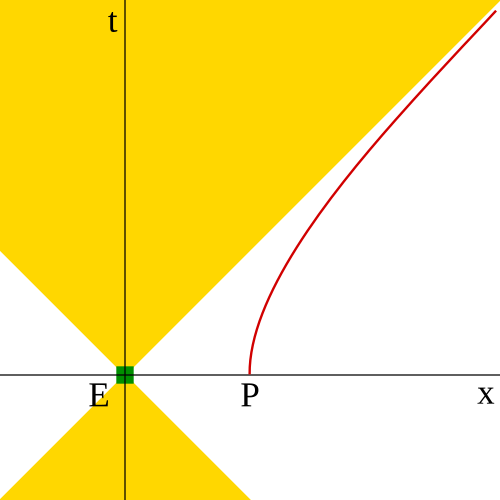
More strangely still, a uniformly accelerating observer in flat Minkowski spacetime has a Rindler horizon, though there is no black hole and no material surface behind it.12 A horizon can therefore depend on the observer’s worldline. Suddenly Psalm 139:12 sounds less metaphorically remote: darkness need not be darkness in itself; it can be darkness from a standpoint. And that recalls the Chassidic teaching that the concealment of tzimtzum is not literal—it only seems a concealment from the eyes of the created being—not from G‑d’s side.13
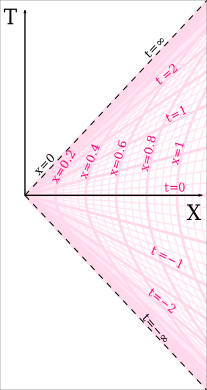
3. It hides detail from the exterior. Once an isolated black hole has settled into a stationary state in Einstein-Maxwell theory, the classical no-hair results tell us that its exterior is characterized by only a few conserved parameters—mass, electric charge, and angular momentum.14 Almost all the detailed structure of the matter that formed it is no longer readable in the stationary exterior field. From far away, one cannot tell whether the same mass and charge came from hydrogen or iron. This does not yet mean that the information has been destroyed. It means that ordinary exterior observables have lost access to almost all of it. In the Midrash’s language, the deep has become unfathomable from this side of the boundary.
4. The information paradox: concealment or destruction? Hawking raised this question in 1976. If a black hole evaporates completely into exactly thermal radiation, the information about what fell in appears not merely hidden but destroyed, in contradiction with unitary quantum evolution.15 That is the paradox. Don Page later showed what unitary evaporation would require: the entropy of the Hawking radiation should first rise and then fall—the Page curve.16 Beginning in 2019, calculations using quantum extremal surfaces, islands, and replica wormholes reproduced the Page-curve behavior in controlled semiclassical and holographic models.17 These results are powerful evidence that gravity can be consistent with information preservation, but they are not a complete microscopic account of realistic astrophysical black holes.18 We do not need to settle that debate here. The point for this essay is that modern physics itself poses the problem as concealment versus destruction. If evaporation is unitary, what crosses the horizon is not annihilated from reality, even though the information becomes fantastically hard to recover and is encoded in ways we do not yet fully understand.
5. Its entropy scales with its face. Here the phrase “on the face of the deep” becomes hard to ignore. Bekenstein argued in 1973, and Hawking’s work developed it further, that a black hole carries an entropy proportional to the area of its horizon, not to the volume of the region behind it.19 Ordinary extensive systems often have entropy that scales with volume; a black hole instead gives us an area law. In that precise thermodynamic sense, something about what is hidden is counted at the boundary. In this sense, the phrase “on the face of the deep” takes on a new meaning.
6. The holographic principle pushes the idea further. ’t Hooft and Susskind drew from black-hole thermodynamics the proposal that, in quantum gravity, the information capacity of a spatial region is fundamentally constrained by its boundary area rather than by an independent degree of freedom at every point of its volume.20 Maldacena’s AdS/CFT correspondence gives a precise realization of holographic encoding in a particular class of spacetimes.21 That does not mean every physical region is literally a two-dimensional hologram. But the connection between bulk physics and boundary data is real. Read as metaphor, “darkness on the face of the deep” becomes eerily apt: the hidden depth is, in a profound sense, accounted for at its face.
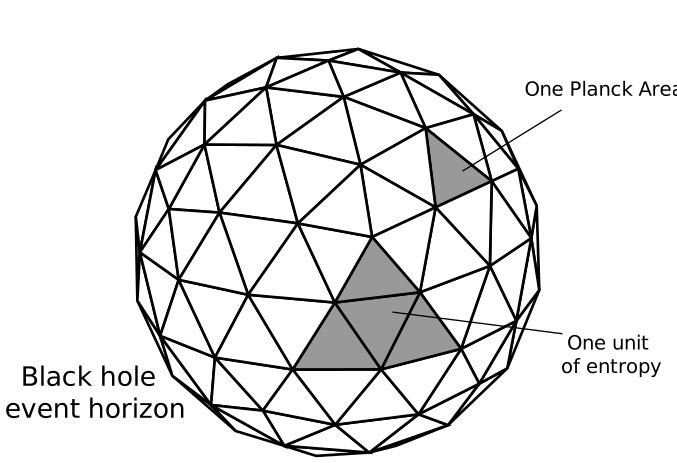
7. It radiates. Quantum mechanically, black holes are not perfectly black. Hawking showed that a black hole emits thermal radiation with a temperature inversely proportional to its mass. For a one-solar-mass black hole, the Hawking temperature is only about 6 × 10⁻⁸ K—roughly sixty nanokelvin—utterly negligible astrophysically but conceptually critical.22 Hawking radiation is not light leaking out from behind the horizon. It arises from quantum fields in the curved black-hole spacetime; the familiar particle-pair story is only a heuristic.23 Still, the blackest object in classical relativity turns out, quantum mechanically, to glow. Isaiah’s “I form light and create darkness,” and the Chassidic reading of Ecclesiastes 2:13, the higher quality of light that emerges “from darkness”—acquire a striking physical analogue.24
8. It is defined globally—and, in that sense, by the future. This may be the strangest property of all. An event horizon is teleological in the technical sense: to know exactly where the event horizon is now, one must know the entire future causal history of the spacetime—whether outward-directed light rays emitted here will ever reach future null infinity.25 Physics does not often let the future define a present boundary. Jewish sources, however, are comfortable with images in which end and beginning interconnected. Sefer Yetzirah says of the ten sefirot, “their end is wedged in their beginning, and their beginning in their end.”26 Lecha Dodi says of Shabbat that she is “last in deed, first in thought.”27 The parallel is poetic, not evidentiary. Still, it is a beautiful one: a present boundary whose exact identity is fixed only by the spacetime’s ultimate causal fate.
The Image
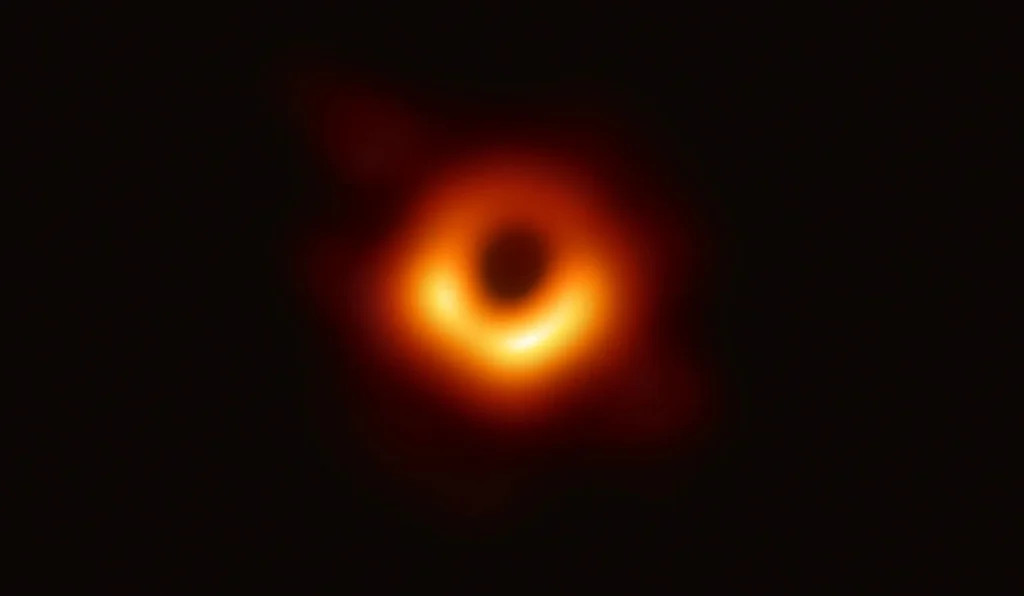
And then there is the image. In April 2019, the Event Horizon Telescope Collaboration released the first horizon-scale image of M87*. At its center lay the brightness depression associated with the black hole’s shadow, surrounded by a bright emission ring. In May 2022 came the corresponding image of Sagittarius A*, the black hole at the center of our own galaxy. The figure below comes from a later comparison of the 2017 and 2018 M87* observing campaigns with general-relativistic magnetohydrodynamic simulations.28 I know that dark center is not literally the horizon.29 But the visual resonance is impossible to miss: “darkness ringed by light, when He inscribed a circle on the face of the deep.” (Proverbs 8:27)
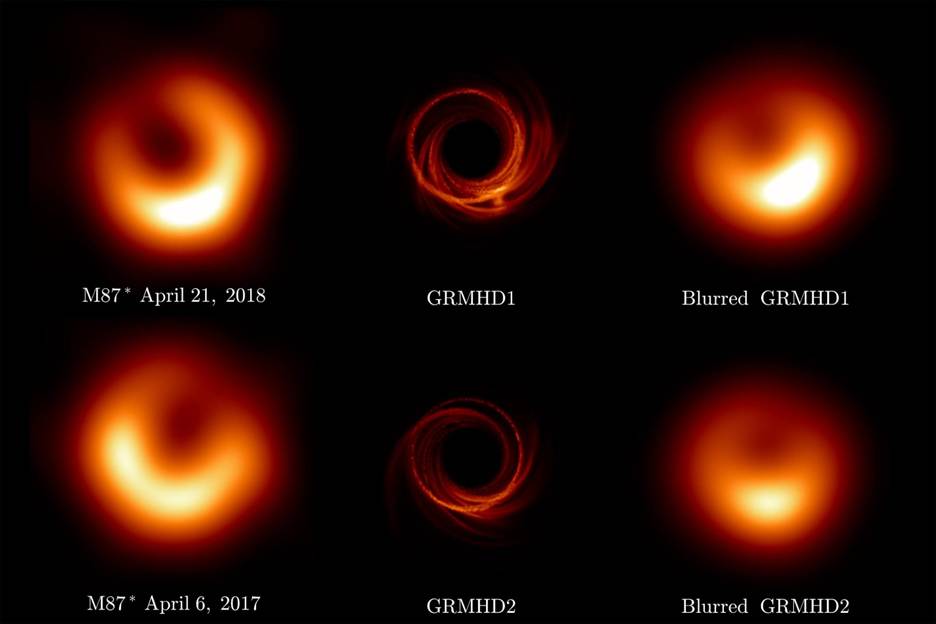
Figure 1. EHT reconstructions of M87* from the 2018 (top left) and 2017 (bottom left) observing campaigns. Center: representative GRMHD simulation images at two different times. Right: the same simulations blurred to the EHT’s observational resolution. Source: Event Horizon Telescope Collaboration, Astronomy & Astrophysics 693 (2025), A265. Credit: EHT Collaboration; CC BY 4.0.
Two Horizons, One Darkness
Black holes are not the only places where relativity gives us horizons. Cosmology gives us another kind, defined relative to an observer’s worldline.
Why is the night sky dark? The question sounds childish, but Kepler, Halley, and Olbers all worried about it, and for good reason. In an infinite, eternal, static universe uniformly filled with stars, every line of sight would eventually strike a stellar surface and the sky would blaze. It does not. The finite age of the luminous universe is the principal resolution of Olbers’ paradox.30 Modern cosmology then gives the geometry of that limitation. Our past light cone is bounded by a particle horizon, now roughly 46 billion light-years away in comoving distance: beyond it, light has not had time to reach us since the beginning of the hot Big Bang. Accelerated expansion gives us a second boundary, a cosmic event horizon. In standard ΛCDM, light emitted today by sufficiently distant comoving sources beyond a present proper distance of roughly sixteen billion light-years will never reach us, even given unlimited future time. This is not simply because those galaxies are “receding faster than light”; the horizon is a global property of the expanding spacetime.31 In de Sitter space—and approximately in the asymptotic de Sitter future of a Λ-dominated cosmology—that horizon carries a temperature and an entropy proportional to its area.32 On the largest scale we know, visibility again has a geometry.
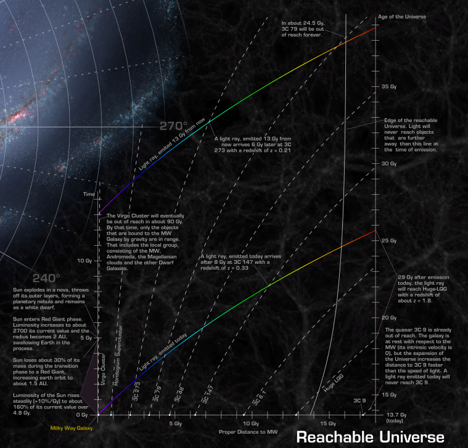
The two horizons face opposite ways. A black-hole event horizon hides an interior from observers who remain outside. A cosmological event horizon limits what an observer inside an expanding universe can ever receive from sufficiently distant regions. One blocks communication outward to us; the other blocks communication inward to us. The geometries are not literally the same. But they are two orientations of one causal idea: bounded visibility.
That, I think, helps with a difficulty in the tzimtzum analogy. In the Lurianic image, the infinite light is concealed from within the chalal, (the “vacated space”) so that finite worlds can appear. The orientation is closer to the cosmological-horizon metaphor: we are inside a bounded field of visibility, and what transcends it is concealed from our standpoint. The black-hole image runs the other way: the hidden region lies within, while the observer remains outside. Each catches one aspect of concealment. Taken together, they show that bounded concealment can have two faces. And the traditional images themselves point both ways: the Gemara’s green line of tohu “encircles the entire world,” while the Psalmist’s “darkness His hiding place round about Him” places the hidden presence, as it were, within the darkness. Relativity gives us precise causal structures with which to think about both.
Tohu and Tikkun
I want to push the analogy one step further. Here the Kabbalistic analogy, not the physics, is doing the work.
In the Lurianic account, our verse’s tohu (“chaos”) is not merely a description of astonishingly desolate void. It names a world: Olam HaTohu (the “World of Chaos”), which preceded Olam HaTikkun (the “World of Rectification”). In the World of Tohu, the lights were too intense for their vessels. The vessels could not contain them and shattered—shevirat hakelim (the “breaking of the vessels”). Sparks of holiness remained with the fallen fragments and became entangled in the kelipot, (the “shells” or “husks”) that conceal them. The work of tikkun includes birur: extracting and elevating those sparks.33
Now put beside that the birth of a black hole. A star makes a tempting metaphorical vessel because its structure depends on a balance between inward gravity and outward pressure support. Chandrasekhar showed that electron degeneracy cannot support a white dwarf above a limiting mass; Oppenheimer and Volkoff developed the relativistic theory of neutron-star support; and Oppenheimer and Snyder gave the classic early model of continued gravitational collapse.34 The physics does not give us one universal “vessel limit” independent of the equation of state, and it would be wrong to say literally that the light becomes too great for the vessel. What fails is pressure support against gravity. But the rhyme remains: a supporting structure fails, collapse proceeds, and an event horizon can form, causally hiding the interior from the exterior. Classical general relativity then predicts, under broad conditions, geodesic incompleteness—a singularity in the technical sense, a sign that the classical description has reached its limit. Outside, by contrast, a settled black hole approaches extraordinary simplicity: in classical electrovacuum its stationary exterior is characterized by mass, charge, and angular momentum. Disorder, concealment, and astonishing exterior order meet at a single boundary. That is the point of the analogy.
Is there a birur? Hawking radiation carries energy outward. If black-hole evaporation is unitary, as the Page-curve and island calculations support in controlled models, the information is encoded in the radiation rather than destroyed. For an idealized one-solar-mass Schwarzschild black hole, the evaporation time is of order 10⁶⁷ years.35 Nothing in that statement says that books, particles, or memories come back out intact; only that, in principle, the quantum information would be recoverable from correlations in the full radiation state. Still, as metaphor, the sequence is striking: collapse, concealment, and an almost unimaginably slow return of what seemed lost.
Readers of my earlier essays will recognize another pairing: the horizon as a metaphorical boundary between the hidden world, alma d’iskasya, and the revealed world, alma d’isgalya. I have used that concealed/revealed distinction repeatedly in earlier QuantumTorah essays, including in connection with ohr sovev and ohr memale.36
Let There Be Light
Now we can return to the verse with which we began.
“And darkness was on the face of the deep.” After all of this, I no longer hear that line as an empty absence waiting for light. I hear a boundary of concealment, set in relation to a depth that cannot be fully revealed from our side. Again, I do not insist that the biblical darkness is literally an event horizon. The point is that physics has given us a modern example of something the biblical language already makes conceptually possible: darkness as structure rather than absence. In the Lurianic doctrine of creation, concealment must precede a finite world, because unbounded revelation of the Ein Sof would leave no room for finitude to appear as such.
Only then: “And G‑d said, Let there be light.” The light of the first day enters a world in which concealment is already in place. In the Lurianic picture this is the kav, the measured line of light that enters the chalal (“void”) after tzimtzum. And then, in the fourth verse, “G‑d separated between the light and between the darkness.” The separation can now be read not simply as a contrast between a thing and its absence, but as a contrast between revelation and concealment—between what reaches a created standpoint and what remains hidden beyond its horizon of disclosure.
Physics does not prove this reading. What physics does give us a novel metaphor, a new vocabulary, a deeper meaning. General relativity and quantum field theory show that “darkness” need not mean a local absence of photons: causal structure can make a region inaccessible even while light exists there, and quantum gravity hints that the boundary of that inaccessibility may carry thermodynamic and informational significance. It lets us take the biblical language of created, placed, bounded darkness seriously without treating it as primitive physics. There is darkness as privation. And there is darkness as concealment—a horizon-like limit on what can be revealed from where we stand.
“Even darkness is not dark to You.” That, in the end, is the point to which the horizon keeps returning me. What is inaccessible from one standpoint is not thereby absent from reality. Concealment belongs to the relation between the hidden and the observer, not necessarily to the hidden thing itself. And the prophet promises a day, “one day, known to the L‑rd, neither day nor night,” when at evening time there shall be light. (Zechariah 14:7)
- The morning Yotzer Or blessing echoes Isaiah’s language but replaces the verse’s final phrase ‘creates evil’ with ‘creates all things’: Berakhot 11b. Classical Jewish exegesis often reads Genesis 1:1 as creation ex nihilo; see, e.g., Ramban on Genesis 1:1. The narrower philological point made in the text is that the Hebrew verb bara does not, by itself, lexically mean ‘create out of nothing.’ ↩︎
- Chagigah 12a: ‘Ten things were created on the first day … heaven and earth; tohu and vohu; light and darkness; wind and water; the measure of day and the measure of night.’ The order follows the Gemara’s list. ↩︎
- One caution before I go further. Genesis 1:2 is not a description of a black hole; tehom is not a gravitational singularity; the Torah is not a physics textbook written in code. The creation narrative is not a cosmology paper, and I do not read it as one. My claim is structural. The darkness described by the biblical and rabbinic sources—created, placed, bounded, concealing, and prior to light—shares a family of formal features with the darkness associated with horizons. When two descriptions share a structure, each can illuminate the other. That, after all, is what a metaphor is for. ↩︎
- Hebrew tehom is related to Akkadian terms for the sea/deep and is often discussed alongside Tiamat, but it is not best treated as a simple Hebrew borrowing of the goddess’s name. Both are generally traced to a common Semitic root associated with the sea or deep. See David Toshio Tsumura, The Earth and the Waters in Genesis 1 and 2: A Linguistic Investigation (JSOT Supplement Series 83; Sheffield Academic Press, 1989), esp. the discussion of the waters in Genesis 1. The literary relationship between Genesis and Mesopotamian cosmogony is a separate, debated question. ↩︎
- Chagigah 12a. The Gemara describes tohu as a ‘green line’ encircling the entire world ‘from which darkness emerges’ and bohu as avanim mefulamot submerged in the deep, from which water emerges. English renderings of mefulamot vary; ‘damp’ is the Sefaria/Koren rendering. The Psalms citation follows Hebrew verse numbering; in many English Bibles it is Psalms 18:11. ↩︎
- Bereishit Rabbah 2:4. In the Midrash’s reading of the four kingdoms, ‘upon the face of the deep’ refers to the final wicked kingdom, which ‘cannot be calculated/fathomed, like the deep.’ The exact English rendering varies because the Hebrew phrase emphasizes lack of measure or inquiry rather than a technical notion of causal inaccessibility. ↩︎
- Zohar I:15a. Daniel C. Matt renders botzina d’kardinuta as ‘a spark of impenetrable darkness’; other translations have ‘lamp of darkness.’ See The Zohar: Pritzker Edition, vol. 1, trans. Daniel C. Matt (Stanford University Press, 2004), 107–109. See also Sefer HaBahir §2, which glosses tohu as that which confounds or astonishes and bohu as ‘a thing that has substance in it’—bo hu, ‘it is in it.’ Ramban on Genesis 1:1 explicitly cites this passage as the Midrash of Rabbi Nechunya ben HaKanah. ↩︎
- Rabbi Shneur Zalman of Liadi, Tanya, Shaar HaYichud VeHaEmunah, ch. 7, where the literal-spatial reading of tzimtzum is rejected and the apparent withdrawal is explained as concealment from the perspective of created beings. ↩︎
- K. Schwarzschild, “Über das Gravitationsfeld eines Massenpunktes nach der Einsteinschen Theorie,” Sitzungsberichte der Königlich Preussischen Akademie der Wissenschaften (1916), 189–196. ↩︎
- S. W. Hawking and G. F. R. Ellis, The Large Scale Structure of Space-Time (Cambridge University Press, 1973), ch. 9; R. Penrose, “Gravitational Collapse and Space-Time Singularities,” Physical Review Letters 14 (1965), 57–59. Formally, the event horizon is the boundary of the causal past of future null infinity. ↩︎
- Near a Schwarzschild horizon, the characteristic tidal acceleration per unit separation scales as M⁻². For stellar-mass black holes the tidal field at or near the horizon can be lethal; for supermassive holes it can be extremely small. The EHT mass estimate for M87* is about 6.5 × 10⁹ solar masses: Event Horizon Telescope Collaboration, Astrophysical Journal Letters 875 (2019), L1. ↩︎
- W. Rindler, “Kruskal Space and the Uniformly Accelerated Frame,” American Journal of Physics 34 (1966), 1174–1178. An accelerating observer in flat spacetime not only has a horizon; she detects thermal radiation from it, the Unruh effect: W. G. Unruh, “Notes on Black-Hole Evaporation,” Physical Review D 14 (1976), 870–892. ↩︎
- To be precise, the geometry of the tzimtzum is inverted relative to that of the black hole: in the Lurianic account the light withdraws from the inside, leaving a dark chalal, whereas in a black hole the light is trapped inside and darkness is seen from outside. I return to this inversion, and resolve it, in the section “Two Horizons, One Darkness” below. ↩︎
- The standard uniqueness/no-hair results concern stationary, asymptotically flat black holes under specific classical field assumptions, especially Einstein-Maxwell theory. Foundational papers include W. Israel, ‘Event Horizons in Static Vacuum Space-Times,’ Physical Review 164 (1967), 1776–1779; B. Carter, ‘Axisymmetric Black Hole Has Only Two Degrees of Freedom,’ Physical Review Letters 26 (1971), 331–333; S. W. Hawking, ‘Black Holes in General Relativity,’ Communications in Mathematical Physics 25 (1972), 152–166; and D. C. Robinson, ‘Uniqueness of the Kerr Black Hole,’ Physical Review Letters 34 (1975), 905–906. The slogan ‘black holes have no hair’ is associated with John Wheeler. ↩︎
- S. W. Hawking, “Breakdown of Predictability in Gravitational Collapse,” Physical Review D 14 (1976), 2460–2473. ↩︎
- D. N. Page, “Information in Black Hole Radiation,” Physical Review Letters 71 (1993), 3743–3746. ↩︎
- G. Penington, ‘Entanglement Wedge Reconstruction and the Information Paradox,’ Journal of High Energy Physics 2020:9 (2020), article 002, doi:10.1007/JHEP09(2020)002; A. Almheiri, N. Engelhardt, D. Marolf, and H. Maxfield, ‘The Entropy of Bulk Quantum Fields and the Entanglement Wedge of an Evaporating Black Hole,’ Journal of High Energy Physics 2019:12 (2019), article 063, doi:10.1007/JHEP12(2019)063; A. Almheiri, T. Hartman, J. Maldacena, E. Shaghoulian, and A. Tajdini, ‘Replica Wormholes and the Entropy of Hawking Radiation,’ Journal of High Energy Physics 2020:5 (2020), article 013, doi:10.1007/JHEP05(2020)013; G. Penington, S. H. Shenker, D. Stanford, and Z. Yang, ‘Replica Wormholes and the Black Hole Interior,’ Journal of High Energy Physics 2022:3 (2022), article 205, doi:10.1007/JHEP03(2022)205. For a review, see A. Almheiri et al., ‘The Entropy of Hawking Radiation,’ Reviews of Modern Physics 93 (2021), 035002. ↩︎
- The island/Page-curve results are strongest in controlled semiclassical and holographic models, many of them low-dimensional or asymptotically anti-de Sitter. They demonstrate how gravitational entropy calculations can reproduce the Page curve expected from unitarity, but they do not yet provide a universally accepted microscopic mechanism for realistic four-dimensional evaporating black holes. For the continuing tension among unitarity, locality, and a smooth horizon, see A. Almheiri, D. Marolf, J. Polchinski, and J. Sully, ‘Black Holes: Complementarity or Firewalls?,’ Journal of High Energy Physics 2013:2 (2013), article 062; for a dissenting view on information loss, see W. G. Unruh and R. M. Wald, ‘Information Loss,’ Reports on Progress in Physics 80 (2017), 092002. ↩︎
- J. D. Bekenstein, ‘Black Holes and Entropy,’ Physical Review D 7 (1973), 2333–2346; S. W. Hawking, ‘Particle Creation by Black Holes,’ Communications in Mathematical Physics 43 (1975), 199–220. The Bekenstein-Hawking entropy is S = k_B c³A/(4Għ), one quarter of the horizon area in Planck units. For a one-solar-mass Schwarzschild black hole it is of order 10⁷⁷ k_B, roughly twenty orders of magnitude larger than the thermodynamic entropy of the Sun. ↩︎
- G. ’t Hooft, “Dimensional Reduction in Quantum Gravity,” in Salamfestschrift, ed. A. Ali, J. Ellis, and S. Randjbar-Daemi (World Scientific, 1993), arXiv:gr-qc/9310026; L. Susskind, “The World as a Hologram,” Journal of Mathematical Physics 36 (1995), 6377–6396. For a review, R. Bousso, “The Holographic Principle,” Reviews of Modern Physics 74 (2002), 825–874. ↩︎
- J. Maldacena, “The Large N Limit of Superconformal Field Theories and Supergravity,” Advances in Theoretical and Mathematical Physics 2 (1998), 231–252, arXiv:hep-th/9711200. ↩︎
- S. W. Hawking, ‘Black Hole Explosions?,’ Nature 248 (1974), 30–31, and ‘Particle Creation by Black Holes,’ Communications in Mathematical Physics 43 (1975), 199–220. For a Schwarzschild black hole, T_H = ħc³/(8πGMk_B), about 6 × 10⁻⁸ K for one solar mass. Since this is far below the 2.725 K cosmic microwave background, an isolated stellar-mass black hole in today’s universe absorbs more ambient radiation than it emits. ↩︎
- The popular picture of a particle–antiparticle pair created at the horizon, one member falling in and the other escaping, is a heuristic and should not be taken literally. In Hawking’s actual derivation, the vacuum state defined by observers in the distant past is not the vacuum state for observers in the distant future, because the collapse geometry mixes positive- and negative-frequency modes of the quantum field. The mismatch is expressed by a Bogoliubov transformation, and the late-time observers see a thermal flux of particles. Darkness emits light, in this derivation, because the vacuum itself is not the same on the two sides of the collapse. ↩︎
- Ecclesiastes 2:13 reads, in its plain sense, of the advantage of light over darkness. Chassidic texts also read the phrase yitron ha’or min hachoshech as a higher quality of light elicited ‘from darkness,’ including through the transformation of darkness into light. See Likkutei Torah, Devarim 81a (citing Zohar III:47b), and Likkutei Sichos, vol. 10, Vayechi 1. For the associated idea that teshuvah motivated by love can transform transgressions into merits, see Yoma 86b. ↩︎
- Event horizons are global objects: in numerical relativity their exact location is generally reconstructed only after the spacetime evolution is known. Apparent horizons are quasi-local alternatives that can be located on individual spacelike slices. See J. Thornburg, ‘Event and Apparent Horizon Finders for 3+1 Numerical Relativity,’ Living Reviews in Relativity 10 (2007), article 3, doi:10.12942/lrr-2007-3. ↩︎
- Sefer Yetzirah 1:7 in a common numbering: na’utz sofan bitchilatan v’tchilatan b’sofan, ‘their end is embedded in their beginning and their beginning in their end.’ Numbering varies among recensions and editions. ↩︎
- Lecha Dodi, by Rabbi Shlomo HaLevi Alkabetz (Safed, sixteenth century): sof ma’aseh b’machshavah techilah, “last in deed, first in thought.” ↩︎
- Event Horizon Telescope Collaboration, ‘First M87 Event Horizon Telescope Results. I. The Shadow of the Supermassive Black Hole,’ Astrophysical Journal Letters 875 (2019), L1, doi:10.3847/2041-8213/ab0ec7; Event Horizon Telescope Collaboration, ‘First Sagittarius A* Event Horizon Telescope Results. I. The Shadow of the Supermassive Black Hole in the Center of the Milky Way,’ Astrophysical Journal Letters 930 (2022), L12. The figure reproduced here is from Event Horizon Telescope Collaboration, ‘The Persistent Shadow of the Supermassive Black Hole of M87. II. Model Comparisons and Theoretical Interpretations,’ Astronomy & Astrophysics 693 (2025), A265, doi:10.1051/0004-6361/202451296. That article is distributed under the Creative Commons Attribution 4.0 license; credit to the EHT Collaboration is retained in the caption. ↩︎
- A technical correction matters here. The dark region in an EHT image is not the event horizon itself but the black hole’s ‘shadow’: the set of directions from which light rays are captured rather than returned to the observer. For a non-rotating Schwarzschild black hole, the apparent shadow radius for a distant observer is 3√3 GM/c², about 2.6 times the horizon radius 2GM/c². For a non-rotating (Schwarzschild) black hole the shadow is bounded by the critical impact parameter b = 3√3 GM/c² ≈ 5.2 GM/c², compared with the horizon radius of 2 GM/c². The bright ring in the image is light from the hot gas orbiting the black hole, bent around it by its gravity; some of that light has circled the black hole more than once before escaping toward us. Even ‘shadow’ is a slightly imperfect word, since there is no opaque body casting it in the ordinary sense. The image shows darkness produced by relativistic light propagation and photon capture. The metaphor survives the correction, but only if shadow and horizon remain distinct. ↩︎
- H. W. M. Olbers raised the question in 1823, though it had been noticed by Kepler two centuries earlier. Edgar Allan Poe proposed the finite-age solution in Eureka (1848). The definitive history is E. R. Harrison, Darkness at Night: A Riddle of the Universe (Harvard University Press, 1987), which argues that the finite age of the universe, rather than the redshift of expansion, is the principal reason the night sky is dark. ↩︎
- The quoted horizon scales are order-of-magnitude present-day values in standard ΛCDM and depend somewhat on the cosmological parameters and on the distance convention. The particle horizon is the boundary of what can have influenced us since the early universe; the cosmic event horizon is the boundary of events whose signals can ever reach a given observer in the infinite future. The event horizon should not be confused with the Hubble sphere, and superluminal recession by itself does not determine observability. See T. M. Davis and C. H. Lineweaver, ‘Expanding Confusion: Common Misconceptions of Cosmological Horizons and the Superluminal Expansion of the Universe,’ Publications of the Astronomical Society of Australia 21 (2004), 97–109, doi:10.1071/AS03040. ↩︎
- G. W. Gibbons and S. W. Hawking, ‘Cosmological Event Horizons, Thermodynamics, and Particle Creation,’ Physical Review D 15 (1977), 2738–2751. The clean thermal result is for de Sitter spacetime; a Λ-dominated universe such as ours approaches de Sitter behavior asymptotically rather than being exactly de Sitter today. ↩︎
- Rabbi Chaim Vital, Sefer Etz Chaim, Shaar HaKlalim, ch. 1, describes Olam HaTohu, the inability of the vessels to bear the lights, shevirat hakelim, the descent of holy sparks with the shattered vessels, the formation of kelipot, and the subsequent work of raising the sparks. On the human task of elevating sparks through embodied mitzvah-life, see Tanya, Likutei Amarim, ch. 37; see also Etz Chaim, Portal 26, cited there. ↩︎
- S. Chandrasekhar, ‘The Maximum Mass of Ideal White Dwarfs,’ Astrophysical Journal 74 (1931), 81–82; J. R. Oppenheimer and G. M. Volkoff, ‘On Massive Neutron Cores,’ Physical Review 55 (1939), 374–381; J. R. Oppenheimer and H. Snyder, ‘On Continued Gravitational Contraction,’ Physical Review 56 (1939), 455–459. These are limits and collapse models for specific forms of matter, not a single equation-of-state-independent maximum mass for every possible star. Oppenheimer-Snyder is the classic early relativistic model of continued gravitational collapse later understood in horizon language. ↩︎
- In the simplest semiclassical treatment of an isolated Schwarzschild black hole, the evaporation time scales as M³: t ≈ 5120πG²M³/(ħc⁴), about 2 × 10⁶⁷ years for one solar mass. Using the EHT estimate M ≈ 6.5 × 10⁹ M☉ for M87*, the same idealized scaling gives an evaporation time of order 6 × 10⁹⁶ years (about 10⁹⁷ years), not 10⁹⁴ years. These estimates neglect accretion, spin, environmental effects, and details of the particle spectrum. The present age of the universe is about 1.38 × 10¹⁰ years. ↩︎
- See Alexander Poltorak, ‘Collapse and Revelation,’ QuantumTorah.com (January 29, 2021), and ‘On Hidden and Revealed Aspects of Reality,’ QuantumTorah.com (April 21, 2022), for earlier uses of alma d’iskasya and alma d’isgalya. For the explicit pairing of alma d’iskasya with ohr sovev and alma d’isgalya with ohr memale, see ‘The Pilot Wave of Righteousness,’ QuantumTorah.com (July 30, 2026). ↩︎


