Let There Be Light, the Decoupling of the Universe, and Creation by Separation
Synopsis
Why does the Torah say that G‑d separated light from darkness when the two are already distinct? Rashi offers a surprising answer: initially, they existed in a state of mixture and confusion, b’irbuvya. Modern cosmology offers an intriguing parallel. For hundreds of thousands of years, light and matter were tightly coupled in the primordial plasma, until the universe cooled and light was released. That ancient light survives today as the cosmic microwave background, invisible to our eyes yet preserving a record of the early universe. Drawing on Rashi, Midrash, and the physics of symmetry breaking, this essay examines creation as a process of separation—havdalah—through which an undifferentiated world acquires order and distinction.
Why Separate What Is Already Distinct?
And G‑d said, “Let there be light,” and there was light. And G‑d saw the light, that it was good, and G‑d separated between the light and between the darkness. And G‑d called the light day, and the darkness He called night, and it was evening and it was morning, one day. (Genesis 1:3–5)
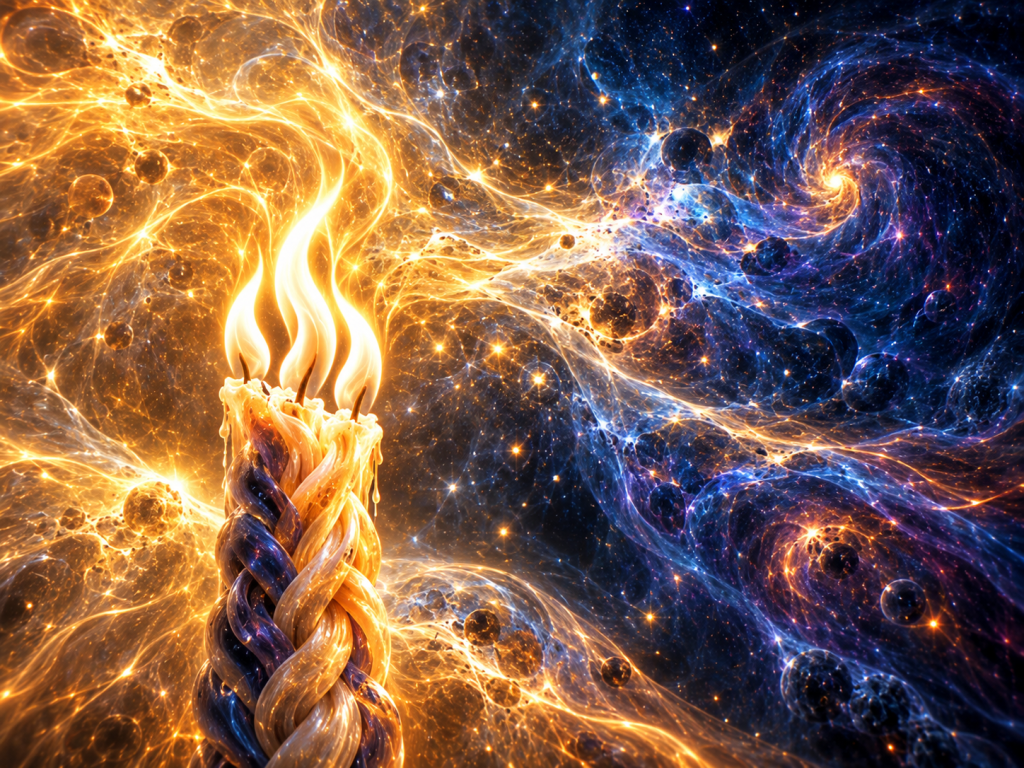
This evening, as every Saturday night, as the Shabbat departs, we lit a braided candle and blessed G‑d “Who separates between holy and profane, between light and darkness…”[1] The blessing is called Havdalah, “separation,” and the first separation it names after the holy and the profane is the one in our verse. I have recited this blessing more times than I can count, and for most of those times I did not pay attention to how strange the verse it quotes really is. Having heard the verse this morning as we read the Torah portion of Bereshit in the Synagogue, this time, it gave me a pause.
Here is what’s strange about it. Light and darkness, surely, need no separating. If darkness is simply the absence of light, then wherever there is light there is no darkness, and wherever there is darkness there is no light. The two are separate by definition, as a full glass is separate from an empty one. One does not need to separate a full glass from an empty glass; one needs only to look. What, then, did G‑d do when He “separated between the light and between the darkness”? And why does the verse place the seeing before the separating—“G‑d saw the light, that it was good”—as though the separation were the consequence of a judgment?
In my earlier essay I argued that the darkness of the second verse, “darkness on the face of the deep,” is not an absence of light at all but a horizon: a boundary of concealment, with a geometry of its own.[2] In the subsequent essay, I explored the reshimu through the analogy of a holographic universe.[3] Here I want to return to those verses and consider a structural parallel between the first day of creation and the opening chapter of modern cosmology. The parallel turns on a single word of Rashi’s.
Rashi saw the problem in the verse and gave two answers. The first is the Midrash: G‑d saw that the light was too good for the wicked to use, and so He separated it, setting it aside for the righteous in the time to come.[4] But then Rashi offers the plain meaning, and this is the sentence I want the reader to hold in mind: “He saw that it was good, and that it was not fitting for it and for the darkness to function together in a mixture (b’irbuvya); so He fixed for this one its domain by day, and for that one its domain by night.”[5]
Irbuvya: a jumble, a confusion, a mixture. Rashi pictures light and darkness functioning together, mixed up before either has its proper domain. The separation gives each its place.
To a nineteenth-century physicist, mixing light with darkness might have sounded odd, like mixing sound with silence. Quantum mechanics at least gives us a way to picture such a thing: a coherent superposition can involve alternatives that classical intuition treats as mutually exclusive. The world could be in a state of “Light” or in a state or “Darkness,” or in a superposition of these two state, when Light and Darkness are mixed up together. The quantum-mechanical analogy would be an electron in a state of superposition of spin Up and spin Down, or a Schrödinger cat that is in a superposition of been alive and dead.
There is another analogy, and this one comes from cosmology.
For hundreds of thousands of years, radiation and ordinary matter were coupled in a hot plasma; as the universe cooled, that coupling weakened and primordial light began to travel freely. We have mapped this light across the sky. It fills the room in which you are reading this. What interests me is how closely it resembles two features the Sages attributed to the light of the first day. A third Midrashic theme, creation through discernment, will matter as well.
What the Sages Saw
Let me lay out these three motifs before turning to the physics, so that the reader can judge the parallel rather than take my word for it.
First, the light was mixed with darkness before it was separated. That is Rashi’s irbuvya, and I have already quoted it. Ramban (Rabbi Moshe ben Naḥman, the Nachmanides) reads the separation somewhat differently, as an apportioning of time—the light was given its measure and the darkness its measure, and the first alternation of the two was the first full cycle—day one.[6] Ramban makes one further distinction: the darkness of this verse is an absence of light, whereas the darkness of Genesis 1:2 is something different. We will need that distinction when we turn to cosmology.
Second, the first light is not the light of the sun. The Torah tells us that G‑d created light on the first day and the luminaries—sun, moon, and stars—on the fourth, and the Sages were as puzzled by this as any modern reader. The Talmud records a debate. Rabbi Elazar taught that the light created on the first day was a different light altogether: a light by which “Adam could see from one end of the world to the other,” which G‑d hid away when He foresaw the corruption of later generations, reserving it for the righteous in the world to come. The Sages, on the other hand, held that the light of the first day is the light of the luminaries, created on the first day but not hung in the firmament until the fourth.[7] Rashi, commenting on the fourth day, follows the Sages.[8] I will suggest that modern cosmology offers a curious parallel to Rabbi Elazar’s view: light older than the stars, invisible to ordinary sight, by which we can map the farthest reaches of electromagnetic vision.
Third, there is the matter of discernment in creation. The Midrash, commenting on the words “and it was evening,” records a remarkable teaching of Rabbi Abahu: that the Holy One “kept creating worlds and destroying them, until He created these, and said: these please Me; those did not please Me.”[9] Rabbi Pinchas connects this teaching to the verdict at the close of creation, “and behold, it was very good” (Genesis 1:31), rather than directly to the light of the first day. It leaves us with a thought worth carrying back to the first day: the Midrash describes creation as a judgment among possibilities, a thought worth remembering when we read that G‑d saw the light and found it good.
And one more detail, which will matter at the end. The Torah does not say “the first day,” as it says “a second day” and “a third day.” It says yom echad, “one day.” Rashi, following the Midrash, explains that on this day G‑d was alone in His world—yachid, one—since the angels were not created until the second day.[10]
A Universe of Fog
Now the physics. I will try to keep it accessible, with the technicalities in the Endnotes.
The universe began hot and dense and has been expanding and cooling ever since. For its first several hundred thousand years it was far too hot for atoms to exist. Matter was a plasma: bare nuclei of hydrogen and helium, and free electrons, all immersed in a sea of light. Photons outnumbered baryons by roughly a billion to one. For approximately the first fifty thousand years, radiation dominated the universe; matter then became dominant, but photons and ordinary matter remained tightly coupled for hundreds of thousands of years. The universe was flooded with light, yet that light could not carry images freely across space.[11]
There was, then, light in abundance. “Let there be light, and there was light.” But nothing could see by it. Free electrons scatter light extremely efficiently—the process is called Thomson scattering—and the early universe was full of them. A photon could travel only a tiny fraction of the distance across the universe of that time before an electron deflected it in a new direction.[12] The universe was a fog: every direction equally bright, nothing distinguishable in any direction. Physicists call this a “tightly coupled photon–baryon fluid,” and for good reason. Photons and baryons exchanged momentum so rapidly that, for many purposes, they behaved like one fluid at nearly the same temperature. The photons supplied the pressure, the baryons the inertia; when disturbed, the two moved together. The fluid even had a sound: pressure waves rang through it like sound through a bell, and we shall see that the sound was recorded.[13]
Now recall Rashi’s irbuvya. What brings it to mind is the coupling: light and matter so closely linked that their motions largely followed one another. Photons were abundant, yet scattered too often to convey a distant image. Radiation pressure, meanwhile, resisted the gravitational collapse of ordinary matter on important scales. Dark matter was already forming the gravitational wells into which baryons would later fall. The light and matter were mixed up together. The universe was filled with light, yet opaque. It was foggy.
I note in passing a feature of the verse that I once found puzzling and now find exact. “G‑d saw the light, that it was good.” Who could see the light in a universe in which light could not be seen by? Only an observer who does not need light to see. As the Psalmist says:
Even darkness is not dark to You” (Psalms 139:12)
The Separation
The fog did lift, although it took a relatively short stretch of cosmic history.
The expanding universe cooled. At about three thousand kelvin—comparable to the surface temperature of a cool red star—electrons increasingly remained bound to nuclei, forming neutral atoms, chiefly hydrogen. Cosmologists call this recombination. Earlier, atoms had formed only to be ionized again. Now neutral hydrogen could persist.[14] Neutral hydrogen scatters the background light far less efficiently than free electrons. Over tens of thousands of years, the free-electron fraction fell sharply, and the photon-scattering rate declined to roughly the rate of cosmic expansion. That is approximately the condition for photon decoupling: radiation can no longer exchange momentum with baryons fast enough to remain a tightly bound fluid.[15] The light went its way, and the matter went its own.
By current cosmological estimates, this happened about three hundred and eighty thousand years after the Big Bang, when the universe was a thousandth of its present size.[16] From that moment the light has traveled freely, almost entirely unscattered, through a universe that had become transparent. The surface from which it last scattered—the inner surface of the fog, as seen from where we now stand—is called the surface of last scattering. It is the photosphere of the universe, the same kind of surface we see when we look at the Sun: not a solid boundary but the depth at which a glowing gas becomes clear.
Consider what kind of separation this is. In the cosmological parallel, separation means release from coupling: what had behaved as one effective fluid acquired different freedoms. In Rashi’s words, “He fixed for this one its domain (techumo), and for that one its domain.” After decoupling, the light had its domain: it streamed outward in every direction, filling the universe uniformly, carrying the imprint of the fog from which it came. And the matter had its domain: released from the light’s pressure, it could fall more readily into the gravitational wells that dark matter had been quietly digging all along, gathering into clouds that would eventually become stars and galaxies. The light’s business is to travel; the matter’s business is to clump. Before decoupling, mutual interaction constrained their motions. Afterward, their histories diverged.
The freed light is the cosmic microwave background. Its existence was predicted in 1948, found by accident in 1965 by two radio engineers at Bell Laboratories, Penzias and Wilson, who at first blamed the signal on pigeons, and measured with exquisite precision by three generations of satellites.[17] It is the most perfect blackbody spectrum ever observed in nature, which is to say that it carries, intact, the thermal equilibrium of the mixture from which it was released.[18] It has cooled, in the expansion, from three thousand kelvin to 2.7 degrees above absolute zero. And it is everywhere. There are about four hundred of its photons in every cubic centimeter of space, in the deepest void and in the room you are sitting in; they vastly outnumber the photons produced by stars.[19] They are also invisible to the eye, for reasons to which I shall return.
“G‑d saw the light, that it was good.” The cosmic background is, by a wide margin, the most uniform thing ever measured: nearly the same temperature in every direction, to about one part in a hundred thousand after the dipole from our motion is removed.[20] That uniformity is the thermal equilibrium of the fog, frozen into the light at the instant of separation. Those tiny variations trace the primordial density perturbations that gravity would, in time, amplify into galaxies, stars, and planets. The frozen sound of the photon–baryon fluid is in those ripples too, as a pattern of preferred sizes that the satellites have measured.[21] The whole future of the universe was written, as it were, on the first light.
A Light Without Luminaries
The cosmic background is unlike familiar starlight in one remarkable respect. No star and no other localized luminary is its source.
Starlight comes from stars; the glow of a nebula comes from the stars that heat it; even the faint light of the night sky between the stars is, in the end, scattered starlight and the airglow of our own atmosphere. The cosmic background came from the hot primordial plasma itself. Its photons last scattered when the universe became transparent; they were not emitted by a star or a galaxy. That is the sense in which I call it light without luminaries.
The Torah places light on the first day and the sun, moon, and stars on the fourth. The Talmud debated whether the first light was the light of the luminaries or something different. Cosmology gives us an intriguing physical parallel: a primordial radiation field preceded the stars by a vast interval, and starlight has a different origin. The parallel is clear: Rabbi Elazar’s teaching aligns with modern cosmology.
Rabbi Elazar’s image of seeing “from one end of the world to the other” brings us to another curious parallel with astrophysics. The cosmic microwave background is the earliest electromagnetic surface we can image directly. To look toward it is to look back almost as far as photons can take us. Before last scattering, the plasma was opaque, although the universe extended beyond that surface and carried other forms of information. When cosmologists map the background, they make an image of the sky in every direction as it was at that ancient epoch. In this limited sense, primordial light lets us look toward the limits of the visible cosmos.
At release, the radiation had a thermal spectrum characteristic of roughly three thousand kelvin, with a visible red component. The expansion of the universe has since stretched every one of its waves a thousandfold, from visible light to microwaves—a part of the spectrum the eye cannot see. Within a few million years of the separation the glow had faded below the threshold of vision; it became invisible.[22] For the whole of human history, people have stood under a sky that was flooded, from every direction, with the first light, and have seen nothing. And the Torah says, “He hid it.” It took an instrument built for another purpose, in 1965, to find it. The Sages gave us an image: a primordial light hidden from ordinary use, to be revealed in the distant future. The cosmic background provides a physical counterpart to that picture.
What followed the separation has a name too. After the first light was released and faded from view, there were no stars to light the darkness. Astronomers call this period the Dark Ages.[23] It lasted something like a hundred million years—darkness, with the hidden light passing through it. Then the first stars ignited, and the period in which they did so astronomers call Cosmic Dawn. Only then did the universe contain luminaries: sources of light, which lit some regions and left others dark, and thereby separated, for the first time, lit from unlit space. And listen to the Torah’s words for the fourth day: the luminaries are made “to separate between the day and between the night” (Genesis 1:14). The first separation uncoupled light from matter; the second, by the luminaries, divided the now-transparent universe into bright places and dark ones.[24]
Evening and Morning
Set the sequence side by side.
The Torah’s first day: light; separation; “and it was evening and it was morning, one day.” Darkness first, then dawn.
The universe’s first epoch: the fog; the separation that released the first light; then the Dark Ages; then Cosmic Dawn. Darkness first, then dawn.
I did not make these terms up—“Dark Ages” and “Cosmic Dawn” are the terms of art, chosen by people who were not thinking about Genesis. I am struck by the sequence those names suggest: the Jewish day begins in darkness and moves toward dawn, and so does the universe.
There is a deeper point in Ramban’s reading of the separation as an apportioning of time. Before recombination there were no days in the terrestrial sense: no sunrise, sunset, or alternating illumination of a planet. Yet cosmic time was already meaningful, measured by expansion and cooling. The Midrash, indeed, speaks of an “order of time before this”[25]—and Ramban explicitly allows for time before the alternation of light and darkness. The separation made a new observational distinction possible. Radiation could cross space while matter pursued its gravitational evolution. The verse moves from separation to naming, and only then to counting. That sequence invites comparison with the successive epochs cosmologists distinguish. The redshift of the cosmic background is one of our strongest measures of expansion, though it is hardly the only cosmic clock. Decoupling made the universe transparent to a new record of time; time itself had already begun.
Symmetry Breaking, or Why the Separation Was Good
There is another way to think about separation, one that comes from the physics I now use in my neuroscience research: Landau’s phenomenology of phase transitions.
In 1937, Lev Landau proposed a way to think about the states of matter that has since entered the common language of physics. The phases of a substance—its liquid and solid forms, its magnetized and unmagnetized forms, its superconducting and normal forms—differ, Landau said, in their symmetry. A liquid looks the same from every direction and every position; a crystal does not. A hot piece of iron has no preferred direction; a cold magnet points. Above a certain temperature the symmetric phase is stable; below it, the system must give up the symmetry and choose: a direction for the magnet, a lattice for the crystal, a phase for the superconductor. In Landau’s description, the order parameter distinguishes phases with different symmetries. In the symmetric phase it is zero. In the broken phase it takes a nonzero value, and that value tells us which choice the system made.[26]
Think of a highly symmetric phase with no preferred direction and no ordered pattern; it is tempting to compare that condition with a world before differentiation. Physical symmetry, of course, does not imply that matter or structure is literally absent. The verse before ours describes the earth as tohu vavohu, which Rashi renders as “astonishing emptiness”: tohu is that which astonishes, bohu is that which is empty.[27] I mean the parallel as a literary one. In both descriptions, the absence of a chosen order can bewilder, even where there is no absence of being.
As the early universe cooled, distinctions among forces and particles became manifest. Electroweak physics is well established; grand unification with the strong interaction remains conjectural. These changes involve symmetry and interactions, though not every one is a sharp phase transition.[28] One of these changes particularly interests me, because it helps explain how the familiar photon became distinguishable from the weak neutral boson.
In the very hot, electroweak-symmetric regime, the familiar distinction between electromagnetism and the weak interaction had not yet emerged. The theory contains neutral gauge fields called B and W³. In the low-temperature regime, the photon field and the neutral Z field are different linear combinations of them, related by the weak mixing angle.[29] Across the electroweak crossover, the Higgs field acquired a nonzero expectation value in a conventional gauge description. The electromagnetic combination remains massless; the Z boson becomes massive and mediates a very short-range interaction. The two neutral fields are distinguished mathematically by diagonalizing their mass matrix. To me, the emergence of the familiar distinction between photon and Z makes an arresting counterpart to “Let there be light.”[30]
We have, then, two different separations in the physics. The electroweak crossover brings the familiar photon and Z fields into distinct roles; much later, recombination allows photons to stream freely through a transparent universe. The first involves field mixing and the Higgs mechanism; the second, atomic recombination and the transport of radiation. In the same broad order as the verses, we find two images of distinction: light becomes identifiable, and light becomes free. Rashi’s irbuvya gave us the starting point, not a physical equation.
Consider the first three days again, this time with Landau in mind. Day one: light separated from darkness. Day two: the waters above separated from the waters below. Day three: the dry land separated from the seas. Three days, three separations. But notice something about the refrain “that it was good”: it is spoken over the light on day one, omitted on day two, and spoken twice on day three. The Torah draws distinctions and then judges their unfolding order; it does not pronounce every separation good immediately. Havdalah runs through the account of creation. Physics, too, tells a history of emerging distinctions, sometimes through symmetry breaking, sometimes through changes in interaction. The accounts differ in chronology, mechanism, and purpose. Both nevertheless describe a world in which differences come into view.
“He Saw That It Was Good”
I want to end with the place where the two accounts do not agree, because it is more instructive than the places where they do.
Cool a ferromagnet through its transition and it may acquire a magnetization pointing in any of several equivalent directions, none of which the symmetric equations privilege. In an actual sample, fluctuations, boundaries, and stray fields influence which way the magnet points. Physicists call this spontaneous symmetry breaking. Here “spontaneous” means that the symmetric description supplies no preferred orientation. It says nothing about the outcome being causeless, and physics can still explain the mechanisms involved.[31]
The Torah takes the question somewhere else. “G‑d saw the light, that it was good.” Rabbi Abahu imagines worlds created and set aside until one is pleasing. The Midrash asks about judgment and purpose; spontaneous symmetry breaking describes a physical process. This brings us to a question no symmetry argument alone can answer: what makes this ordered world good?
I do not think physics can adjudicate that question, and I do not ask it to. Physics can explain how an orientation arises under particular conditions; that explanation, by itself, cannot tell us whether the resulting world carries purpose or value. Where physics describes possibilities and outcomes, the Torah speaks of judgment. They meet at the question of order, though their methods—and their limits—remain different.[32]
Rabbi Abahu’s unchosen worlds; the directions in which the magnet might have pointed; the plasma releasing its light. Different stories, certainly, and different kinds of possibility. Yet in each, something distinguishable emerges from what preceded it. The Torah adds one word the equations of physics cannot supply: good.
The Light Is Not Gone
Let me return to Saturday night.
The Sages teach that fire was first made at the close of the first Shabbat: that G‑d gave Adam the understanding to strike two stones together, and that the blessing over the Havdalah candle, “Who creates the lights of fire,” commemorates that first kindling.[33] Havdalah, then, is a reenactment—of the first separation, and of the first light made by human hands in a world from which the first light had been hidden. We bless the One who separated light from darkness, and we do it by lighting a candle, because the light we live by is not the light He first made. Ours is the light of the luminaries, and of the fires we kindle.
But the radiation I have been comparing to the first light is still here. That is what moves me most about this story, and it is pure physics. Around us, each cubic centimeter of space contains roughly four hundred cosmic-background photons. They last scattered when the universe was about a thousandth of its present scale. Most have traveled almost unimpeded ever since. Their faint variations preserve a record of the cosmos before there were stars or galaxies. Our eyes cannot see them. And yet we have learned to read in them the age of the universe, its shape, its contents, and the seeds of its later structure—almost to the limit of what light can reveal.
“Even darkness is not dark to You.” In these essays I have explored darkness as concealment and the first light as a reality apart from the luminaries. Physics cannot establish that the cosmic microwave background is the Sages’ hidden light. But it does show us a remarkable parallel: primordial radiation older than the stars, visible to our instruments near the limit of electromagnetic sight, invisible to the eye, and still present throughout the cosmos.
[1] The four separations named in the Havdalah blessing are enumerated in the Talmud, tr. Pesachim 103b–104a, where the Talmud discusses how many havdalot (“separations”) one should mention. The verse “and G‑d separated between the light and between the darkness” is the scriptural source for the second of them.
[2] “Darkness on the Face of the Deep: Bereshit, the Event Horizon, and the Geometry of Concealment,” QuantumTorah.com, October 7, 2026, https://quantumtorah.com/darkness-on-the-face-of-the-deep. The argument there was that a privation of light borrows its place and boundary from whatever excludes the light, whereas the darkness of Genesis 1:2 owns its boundary, is unmarked by anything local, and cannot be dispelled by bringing light into it—the three properties of a horizon in general relativity.
[3] “The Reshimu: A Hologram of Creation,” QuantumTorah.com, October 8, 2026, https://quantumtorah.com/the-reshimu-a-hologram-of-creation.
[4]Rashi on Genesis 1:4, presenting the Aggadah and citing Chagigah 12a.
[5]Rashi on Genesis 1:4, explaining b’irbuvya as the light and darkness functioning together “in a confused manner” before each is assigned its domain. Translation adapted from M. Rosenbaum and A. M. Silbermann (1929-1934); compare Bereshit Rabbah 3:6.
[6]Ramban on Genesis 1:4-5. Ramban distinguishes the absence of light in verse 4 from the darkness described in verse 2, assigns measured periods to light and darkness, and explains that time existed from the beginning of created substance.
[7]Chagigah 12a, with the views of Rabbi Elazar and the Rabbis on the primordial light and the fourth-day luminaries.
[8] Rashi on Genesis 1:14: “They were created on the first day, and on the fourth He commanded them to be suspended in the firmament.”
[9]Bereshit Rabbah 3:7. Rabbi Abahu teaches that G‑d created and destroyed worlds until this world pleased Him. Rabbi Pinchas locates the textual basis in Genesis 1:31, “and behold, it was very good.”
[10] Rashi on Genesis 1:5, following Bereishit Rabbah 3:8: “According to the order of the language of the passage it should have written ‘the first day,’ as it writes for the other days, ‘second,’ ‘third,’ ‘fourth.’ Why did it write ‘one’? Because the Holy One, blessed be He, was alone in His world, for the angels were not created until the second day.”
[11]The baryon-to-photon ratio is about 6 × 10⁻¹⁰: roughly 1.6 billion photons for each baryon. Radiation dominated the energy density until matter-radiation equality, about 50,000 years after the Big Bang; tight photon-baryon coupling persisted until recombination, about 380,000 years after the Big Bang. See Planck Collaboration, “Planck 2018 Results. VI. Cosmological Parameters,” Astronomy & Astrophysics 641 (2020), A6.
[12] The scattering of light by free electrons is Thomson scattering, with a cross-section of 6.65 × 10⁻²⁵ cm². In the plasma before recombination the mean free path of a photon between scatterings was a small fraction of the distance light could have traveled in the age of the universe at that time, which is the technical meaning of “opaque.”
[13] The sound waves in the photon–baryon fluid were first analyzed by P. J. E. Peebles and J. T. Yu, “Primeval Adiabatic Perturbation in an Expanding Universe,” Astrophysical Journal 162 (1970), 815–836, and R. A. Sunyaev and Ya. B. Zeldovich, “Small-Scale Fluctuations of Relic Radiation,” Astrophysics and Space Science 7 (1970), 3–19.
[14]The physics of recombination was analyzed by P. J. E. Peebles, “Recombination of the Primeval Plasma,” Astrophysical Journal 153 (1968), 1-11, and Ya. B. Zeldovich, V. G. Kurt, and R. A. Sunyaev, “Recombination of Hydrogen in the Hot Model of the Universe,” Soviet Physics JETP 28 (1969), 146-150. Recombination and last scattering occurred over an interval of tens of thousands of years, rather than at a single instant.
[15] The criterion is that the scattering rate per photon, Γ = neσTc, falls below the Hubble expansion rate H. The same criterion governs every decoupling in cosmic history. The neutrinos, for example, decoupled from the rest of the universe about one second after the beginning, and the universe is filled today with a cosmic neutrino background that is a separated “light” of its own, far more hidden than the microwaves; it has never been directly detected.
[16]Planck cosmological parameters put the redshift of photon last scattering near z = 1090, at an age of about 380,000 years and a temperature near 3,000 K. “A thousandth of its present size” refers to the cosmic scale factor: 1 + z is approximately 1,090.
[17] The prediction is R. A. Alpher and R. C. Herman, “Evolution of the Universe,” Nature 162 (1948), 774–775, following G. Gamow, “The Origin of Elements and the Separation of Galaxies,” Physical Review 74 (1948), 505–506. The discovery is A. A. Penzias and R. W. Wilson, “A Measurement of Excess Antenna Temperature at 4080 Mc/s,” Astrophysical Journal 142 (1965), 419–421, published alongside its interpretation by R. H. Dicke, P. J. E. Peebles, P. G. Roll, and D. T. Wilkinson, “Cosmic Black-Body Radiation,” Astrophysical Journal 142 (1965), 414–419. The three satellites are COBE (launched 1989), WMAP (2001), and Planck (2009). Penzias and Wilson received the Nobel Prize in 1978; John Mather and George Smoot, for COBE, in 2006; James Peebles in 2019. The pigeons are a matter of record: Penzias and Wilson removed a pair nesting in the horn antenna, and cleaned out what Penzias delicately called “a white dielectric material,” before concluding that the signal was real.
[18] J. C. Mather et al., “A Preliminary Measurement of the Cosmic Microwave Background Spectrum by the Cosmic Background Explorer (COBE) Satellite,” Astrophysical Journal 354 (1990), L37–L40; D. J. Fixsen, “The Temperature of the Cosmic Microwave Background,” Astrophysical Journal 707 (2009), 916–920, giving T = 2.7255 ± 0.0006 K. The COBE spectrum matches a blackbody to better than one part in ten thousand across the whole measured band; no laboratory blackbody is as good.
[19] About 411 photons per cubic centimeter, against an average of fewer than one baryon per four cubic meters. The photon density follows from the temperature alone: nγ ≈ 20.3 T³ cm⁻³ with T in kelvin.
[20] After removing the dipole caused by our own motion through the background, the temperature varies across the sky by about one part in 10⁵. The anisotropies were first detected by COBE: G. F. Smoot et al., “Structure in the COBE Differential Microwave Radiometer First-Year Maps,” Astrophysical Journal 396 (1992), L1–L5.
[21]Acoustic peaks in the angular power spectrum of the background record the compression and rarefaction phases of sound waves in the coupled photon-baryon plasma. The related baryon acoustic oscillation feature in the distribution of galaxies serves as a standard ruler in modern cosmology.
[22] The temperature of the background scales as 1 + z. It had fallen to about 1,000 K—roughly the temperature at which a heated object ceases to glow visibly—by a redshift of about 370, some two million years after the beginning. The glow was never bright by the standards of a lit room; at decoupling it had the surface brightness of a dull red star, filling the whole sky.
[23]For the physical Dark Ages and the emergence of the first stars, see R. Barkana and A. Loeb, “In the Beginning: The First Sources of Light and the Reionization of the Universe,” Physics Reports 349 (2001), 125-238. The earliest stars probably formed roughly 100-200 million years after the Big Bang; estimates depend on the astrophysical model.
[24] The ultraviolet light of the first stars and galaxies eventually re-ionized the hydrogen of the universe, freeing the electrons once more—but by then the universe had expanded so much that the free electrons were far too sparse to make it opaque again. The total probability that a background photon has been scattered since reionization, the “optical depth,” is only about five percent (Planck Collaboration 2020, note above). The second separation did not undo the first.
[25] Bereishit Rabbah 3:7, immediately before Rabbi Abahu’s teaching: “Rabbi Yehudah bar Simon said: It does not say ‘let there be evening’ but ‘and it was evening’; from here we learn that there was an order of time (seder zemanim) before this.”
[26] L. D. Landau, “On the Theory of Phase Transitions,” Zhurnal Eksperimental’noi i Teoreticheskoi Fiziki 7 (1937), 19–32 (in Russian; English translation in Collected Papers of L. D. Landau, ed. D. ter Haar, Pergamon, 1965); V. L. Ginzburg and L. D. Landau, “On the Theory of Superconductivity,” Zhurnal Eksperimental’noi i Teoreticheskoi Fiziki 20 (1950), 1064–1082. In the simplest version, the free energy near the transition is expanded in powers of the order parameter η as F = F₀ + a(T − Tc)η² + bη⁴. Above Tc the minimum is at η = 0; below it, at η ≠ 0, with every sign (or, for a continuous symmetry, every direction) of η equally favored.
[27] Rashi on Genesis 1:2: “Tohu is a term of astonishment and desolation, for a person is astonished and bewildered at the emptiness in it. Bohu is a term of emptiness and void.”
[28]The Standard Model electroweak change occurs around 160 GeV, and quark confinement becomes important at temperatures around 150 MeV. For the observed particle masses both are smooth crossovers, not sharp thermodynamic phase transitions. Earlier grand unification of strong and electroweak interactions remains conjectural. See D. A. Kirzhnits and A. D. Linde, “Macroscopic Consequences of the Weinberg Model,” Physics Letters B 42 (1972), 471-474.
[29]In the Standard Model the neutral fields can be written as A = B cos θW + W³ sin θW and Z = -B sin θW + W³ cos θW, with sin² θW approximately 0.23 at familiar electroweak scales. The photon remains massless; the Z boson is massive. The orientation of the Higgs field in gauge space is a matter of gauge description, not a physically observed choice among distinct universes. See S. Weinberg, “A Model of Leptons,” Physical Review Letters 19 (1967), 1264-1266.
[30]At the observed Higgs mass, electroweak evolution in the Standard Model is a smooth crossover. A local gauge orientation should not be treated as a physically selectable order-parameter direction in the same sense as a magnetization. See K. Kajantie et al., “Is There a Hot Electroweak Phase Transition at mH ≳ mW?,” Physical Review Letters 77 (1996), 2887-2890; M. D’Onofrio and K. Rummukainen, “Standard Model Cross-over on the Lattice,” Physical Review D 93 (2016), 025003.
[31]For a classic discussion of spontaneous symmetry breaking, see J. Goldstone, “Field Theories with Superconductor Solutions,” Nuovo Cimento 19 (1961), 154-164. In a laboratory ferromagnet, boundaries, stray fields, and fluctuations can influence the observed magnetization direction. Such a physical orientation should not be identified with a gauge-dependent orientation of the Higgs field.
[32]The string-theory landscape has been used to suggest many possible low-energy vacua; proposals in which different regions realize different vacua remain speculative. Such scenarios are separate from laboratory spontaneous symmetry breaking and from Rabbi Abahu’s theological account. See L. Susskind, “The Anthropic Landscape of String Theory,” arXiv:hep-th/0302219 (2003).
[33]Pesachim 54a and Bereshit Rabbah 11:2 describe Adam receiving the understanding to kindle fire at the close of the first Shabbat. The blessing borei me’orei ha’esh, “Who creates the lights of fire,” is recited over the Havdalah candle; the plural “lights” is reflected in the familiar custom of using multiple wicks.


