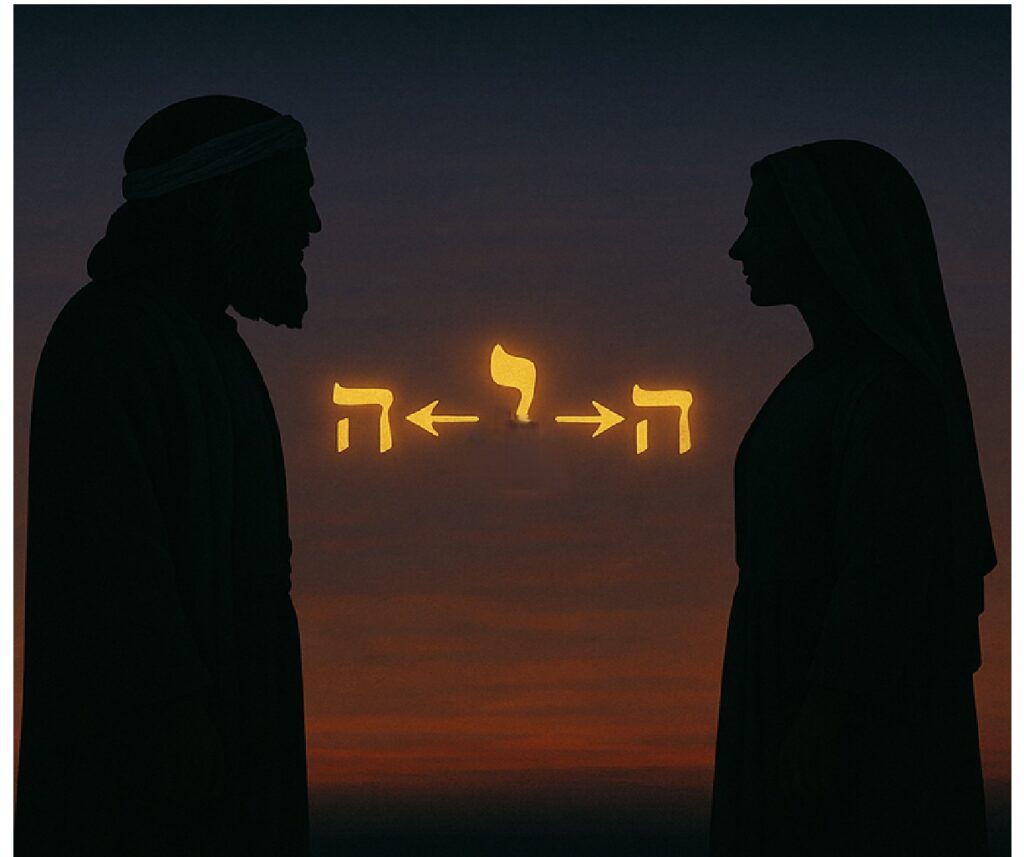
When G‑d promises great wealth to Abram, after Abram refuses the spoils of war offered by the King of Sodom, Abram retorts:
What can You give me, seeing that I shall die childless… Behold, You have given me no seed… (Genesis 17:2-3)
After promising Abram an heir, G‑d sets out to heal Abram from his infertility by performing a mystical procedure—a name change:
No longer shall your name be called Abram, but your name shall be Abraham; for I have made you the father of a multitude of nations. (Genesis 17:5)
It was not so much a name change as it was name augmentation—G‑d added a single letter to Abram’s name (אברם)—the letter hei, turning his name into Abraham (אברהם). But where did this letter come from? The Jerusalem Talmud and the Midrash offer an astounding explanation:
The yud that the Holy One took from our mother Sarah—half was given to Sarah and half to Abraham.[1]
Originally, Sarah’s name was Sarai (שרי). Chazal teach that Sarai’s closing yud (the gematria of י is 10) was transformed into two heis (the gematria of ה is 5), one added to Avram (אברם) to make Avraham (אברהם), one to Sarai (שרי) to make Sarah (שרה). This wasn’t merely a linguistic redistribution—it was a surgical rebalancing of spiritual forces.
In Kabbalah, yud (י) of the Tetragrammaton maps to ḥokhmah, the first hei (ה) maps to binah (expansive understanding), while the final hei maps to malkhut (manifestation, realization). Ḥokhmah is the male principle corresponding to partzuf[2] Aba (Father),[3] both binah and malkhut represent the female principle,[4] binah corresponding to partzuf Ima (Mother)[5] and malkhut corresponding to partzuf Nukva (female).[6]
Although I did not find this in any authoritative sources, here is how I understand this mystical procedure:
Sarai’s name lacks the letter hei, which maps to Nukva (malkhut)—the female principle. Instead, Sarai’s name ended with the letter yud, which maps to Aba (Father-ḥokhmah), the male principle. This spiritual imbalance skewed heavily toward the masculine principle, making Sarai infertile.
Abram also lacks the letter hei, which maps to Ima (binah), which made him infertile as well. At first glance, it seems counterintuitive. After all, Ima is a feminine principle; why should it make Abram infertile? First, the sages teach that masculine creative power requires knowledge (da’at) to function.[7] Second, as I recently wrote in “Noah’s Ark and the Architecture of Creation,” gender is a relational construct that can only be understood within the context of a specific relationship. Although Ima, as it relates to Aba, is a feminine principle, in a different context, as Ima relates to Nukva, it plays the masculine role—the lights of Ima transmitted through the yesod of the Zeir Anpin, inspire Nukvah.
With this in mind, we can now understand how removing letter yud (strictly masculine principle) from Sarai’s name and adding her the second (in the Tetragrammaton) letter hei (corresponding to Nukva-Malkhut—the female principle) made Sarai—now Sarah—fertile.[8] Similarly, we can understand how adding the first (in the Tetragrammaton) letter hei (corresponding to bina—in this case, playing a masculine role) made Abram—now Abraham—fertile too.
This spiritual dynamics maps perfectly onto human physiology. Human fertility depends on a delicate hormonal balance in both sexes, where male and female hormones play essential roles regardless of gender. Men require not only testosterone but also small amounts of estrogen for sperm development and hormonal regulation. At the same time, women need both estrogen and testosterone to support ovulation, follicle growth, and sexual health. Central to this system are regulatory hormones such as FSH and LH, which drive reproductive processes in both males and females, underscoring the interdependence of these hormones across sexes for successful reproduction.[9]
The Kabbalistic structure mirrors human biology with uncanny precision. Metaphorically speaking, FSH and LH can be seen as parallel to the first hei (Ima-binah) and the second hei (Nukva-malkhut) in the Tetragrammaton—both responsible for spiritual “fertility.”
The Talmud offers a final key to this mystery: this world was created with the letter hei—behibar’am read as be-hei bara’am.[10] The shift from a point-like yud (potential) to two heis (creation) signals potential turning into reality: conception, nationhood, history.
Conclusion
The mystical procedure performed on Abram and Sarai—splitting the concentrated masculine potential of yud into the creative duality of two heis—reveals a profound truth: fertility, whether physical or spiritual, requires precise balance. Just as reproductive endocrinology demonstrates that both sexes need masculine and feminine hormones in delicate proportion, the Kabbalistic architecture shows that spiritual fruitfulness depends on the proper configuration of divine letters, each carrying specific energetic signatures.
The transformation from yud to hei—from a dimensionless point to an expansive letter with a window (the opening in the letter ה)—mirrors the shift from potential to actualization, from promise to pregnancy, from barrenness to blessing. When G‑d “performed surgery” on their names, He didn’t merely prophesy their future—He restructured their spiritual DNA, making conception not just possible but inevitable.
This world was created with the letter hei. Abraham and Sarah, now properly balanced with the letters of creation itself, could finally participate in that creative act: not just receiving children, but becoming parents of multitudes. The power of letters isn’t metaphorical—it is the very mechanism through which potential becomes reality, promise transforms from divine decree into human destiny.
[1] Jerusalem Talmud, Sanhedrin 2:6; Bereishit Rabbah 47:1; see also Rabbeinu Baḥya (on Gen. 15:1) and Malbim on Gen. 17.
[2] Partzuf in Lurianic Kabbalah is literally [divine] “visage”—a dynamical configuration of interincluded sefirot.
[3] Aba ([Supernal] “Father”) is the sefirah of ḥokhmah, when it includes all ten sefirot, from ḥokhmah to malkhut: ḥokhmah of ḥokhmah, binah of ḥokhmah,… malkhut of ḥokhmah.
[4] Shaʿarei Orah (Gate Eight): “Both—Binah and Malkhut—are the secret of the two hei’s in the Tetragrammaton: the first hei is Binah; the final hei is Malkhut.”
[5] Imah ([Supernal] “Mother”) is the sefirah of binah, when it includes all ten sefirot, from ḥokhmah to malkhut: ḥokhmah of binah, binah of binah, . . . . malkhut of binah.
[6] Nukva (Female) is the sefirah of malkhut, when it includes all ten sefirot, from ḥokhmah to malkhut: ḥokhmah of malkhut, binah of malkhut,… malkhut of malkhut.
[7] Mitteler Rebbe (Admur Hanimzoi) writes: “There cannot be sexual arousal against his will and he cannot have an arousal without Da’at (‘knowledge’)” with a note to Yevamot 53b (ein kishui ela le-daʿat). Shaʿar HaYiḥud, vol. 2.
[8] I have heard from Rabbi Yehudah Beck, the Cherkas Rav, Shlita, that some tzadikim, when approached by an infertile woman, request a blessing for children, would either write the letter hei on a parchment for them or tell them to get a necklace with the letter hei to wear on the neck as a segula (spiritual remedy) for fertility.
[9] In greater detail, human fertility is governed by a finely tuned interplay of hormones regulated by the hypothalamic-pituitary-gonadal (HPG) axis. In both men and women, the hypothalamus secretes gonadotropin-releasing hormone (GnRH), which prompts the pituitary gland to release follicle-stimulating hormone (FSH) and luteinizing hormone (LH). These hormones are essential for reproductive function in both sexes. In men, FSH stimulates Sertoli cells to support sperm production, while LH triggers Leydig cells to produce testosterone. Although testosterone is the dominant male hormone, small amounts are converted into estradiol (a form of estrogen, a female hormone), which plays a crucial role in sperm maturation and maintaining hormonal balance. Prolactin also contributes by modulating testosterone levels and libido, while inhibin B provides feedback to regulate FSH. In women, FSH promotes the development of ovarian follicles and stimulates the production of estrogen, particularly estradiol, which prepares the uterine lining for potential implantation. LH is responsible for triggering ovulation and stimulating the corpus luteum to produce progesterone, which maintains the endometrium during early pregnancy. Interestingly, women also produce small amounts of testosterone, which supports follicular development and sexual health. Additional hormones, such as anti-Müllerian hormone (AMH), aid in assessing ovarian reserve, while thyroid hormones (TSH, T3, T4) play a crucial role in maintaining regular menstrual cycles and overall reproductive health. Thus, both sexes require a balance of male and female hormones for optimal fertility, underscoring the complexity and interdependence of human endocrine systems.
[10] Menachot 29b.


Wie uns der TaNaKh im Buch BöReSchIT informiert, wurde die Schöpfung vom ADoNaJ, gepriesen sei der HaScheM, mit dem Wort durchgeführt, indem er sprach! Die Kraft des göttlichen Wortes und „Die Fruchtbarkeit der Buchstaben“ wird dadurch sehr gut zum Ausdruck gebracht. In den heiligen Buchstaben des Hebräischen, was sich in der Vereinigung von ABhRaHaM und SsaRaH durch JiZChaQ manifestiert, verbinden sich das weibliche und das männliche Prinzip und sie werden im Rahmen des Werden (HaJaH) zu neuem Leben (ChaJaH). Und es ist eine Tatsache: „Die kabbalistische Struktur spiegelt die menschliche Biologie mit unheimlicher Präzision wider.“
I’ve always wondered about this name change state throughout Torah/Tanakh. A great post, thank you.
Very interesting