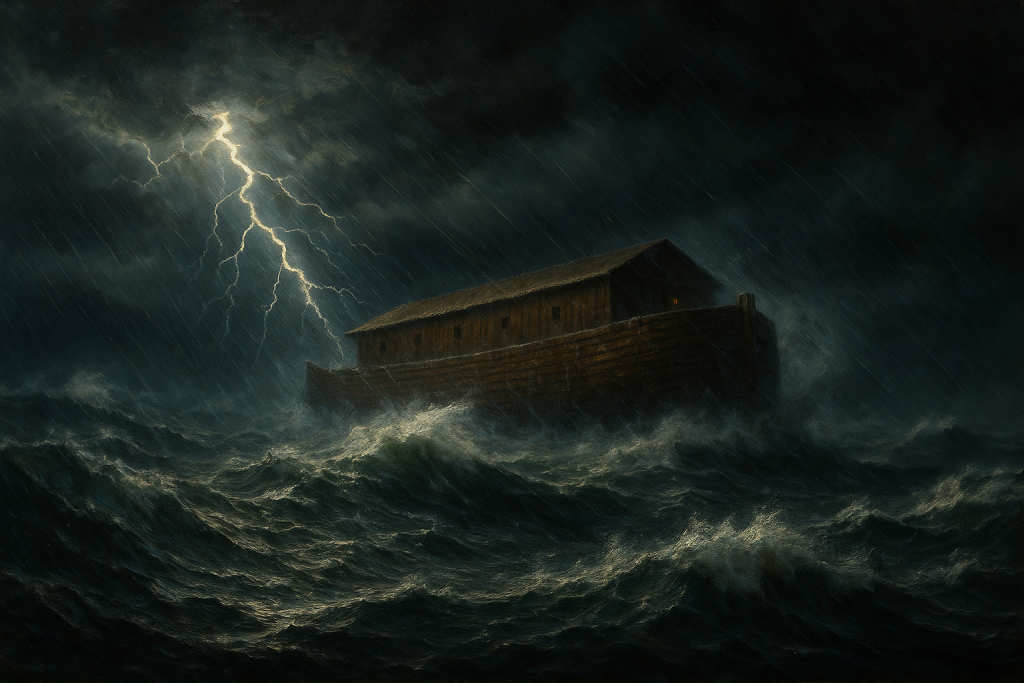
The Waters Above and Below
Introduction
At first glance, the Flood narrative reads like a stark morality tale: humanity sins; G‑d decrees destruction; one righteous family is preserved to repopulate the world. The story seems simple, almost mythological. Yet beneath this surface lie questions that have puzzled commentators for millennia.
People sinned long before Noah. From Adam and Eve eating the forbidden fruit, Cain’s fratricide, to the corrupt generations that followed, human wickedness was hardly a new phenomenon. So why did this generation trigger a deluge? What made their transgression uniquely catastrophic? And why did G‑d choose a flood specifically, rather than fire, plague, or any other form of divine judgment?
The Torah itself hints at the answer through its precision. The text does not merely describe punishment; it reveals that the punishment mirrors the crime—that the waters themselves are the language of the world’s breakdown and, paradoxically, of its repair. The flood is not an arbitrary divine wrath but a cosmic response encoded in the very structure of creation.
To understand this, we must return to the beginning—to the second day of creation, when G‑d first separated the waters.
I. The Separation: Upper Waters and Lower Waters
On the second day of creation, G‑d performed a fundamental act of differentiation:
And God said: “Let there be a firmament in the midst of the waters, and let it divide the waters from the waters.” And God made the firmament and divided the waters which were under the firmament from the waters which were above the firmament; and it was so. (Genesis 1:6–7)
This verse presents a puzzle. What does it mean to separate waters from waters? On a meteorological level, one might speak of atmospheric water vapor versus terrestrial oceans. But in the deeper registers of Torah—in Kabbalah and Ḥassidic thought—this separation encodes something far more fundamental about the architecture of reality itself.
The Zohar offers a startling formulation: “The upper waters are male, whereas the lower are female.”[1] This is not a statement about physical water but about the structure of existence. In Kabbalistic thought, “male” and “female” are not primarily biological categories but metaphysical principles—archetypal modes of being that operate on multiple planes simultaneously.
II. The Two Planes of Gender
In Kabbalah, “male” and “female” function on two interrelated dimensions:
1. Giving and Receiving. By definition, the male principle is characterized by giving, initiating, and emanating. The female principle is characterized by receiving, responding, and gestating. This applies first to the relationship between Creator and creation: G‑d—who obviously transcends gender—manifests through divine attributes (partzufim) that embody these roles. Thus Abba (“Father”) “couples” (that is, “interacts”) with Ima (“Mother”); on a lower plane, Zeir Anpin (“Small Face”) pairs with Nukva (“female”) or Shekhinah (“Divine Presence”). While, in essence, G-d transcends the notion of gender, in the relationship between Creator and creation, G‑d plays the role of the giver (creating and sustaining the world) while creation is on the receiving end of this relationship. This is the template inscribed into all of existence.
2. Inspiration and Realization. The male principle represents the abstract idea, the vision, the seed of potential. The female principle embodies the drive to actualize, to give form, to bring the idea into manifestation. This is not a hierarchy but a partnership of incompleteness: without the feminine, the masculine remains trapped in sterile abstraction—beautiful perhaps, but barren. Without the masculine, the feminine risks losing sight of transcendent purpose and becoming absorbed in the gravitational pull of pure materiality. The two require each other to generate life and to fulfil a purpose. Neither can fulfill its purpose alone.
The Zohar elaborates on this dynamic with striking imagery: the lower waters are “fed from the male,” and they call to the upper waters “like a female that receives the male,” pouring out to meet the waters of the male “to produce seed.”[2] This is the language of mutual desire, of reciprocal yearning. Commenting on the verse telling of the water separation (Genesis 1:6–7) The Tikkunei Zohar adds the emotional dimension: “The lower waters cry, ‘We too wish to stand before the King!’”[3] The feminine principle—the Shekhinah—yearns upward toward reunion with its masculine counterpart. This is not passive waiting but active longing, an ascent from below that calls forth the descent from above.
III. Water as the Element of Pleasure
Why use water as the symbol for all of this? In Kabbalah and Chassidic thought, water signifies pleasure—the essential experience of delight, satisfaction, and fulfillment. The Tanya teaches: “The appetite for pleasures derives from the element of water, because water makes all kinds of enjoyment grow.”[4] Water flows, fills, satisfies. It is the element of union and connection.
Thus, water naturally serves as a metaphor for sexuality—not in a crude sense, but within the framework of the giving-receiving and inspirational dynamic. The classic Kabbalistic terms capture this: mayin d’khurin (“male waters”) descend from above; mayin nukvin (“female waters”) ascend from below. This is the pattern of arousal and response, of invitation and answer, that culminates in a union of opposites and generation of a new concept; on a physical level, the conception of new life.
Read through this lens, the separation of upper and lower waters in Genesis 1 is not merely a meteorological detail. It is the archetypal differentiation of genders—male (upper waters) and female (lower waters)—whose proper alignment and union generate life itself. The structure of creation is inherently relational, inherently dynamic, and inherently fruitful when the masculine and feminine principles operate in harmony.
This brings us to the catastrophe of Noah’s generation.
IV. The Corruption: When Boundaries Dissolve
The Torah’s description of the pre-Flood world is unsparing:
…And they took for themselves wives from all that they chose.[5] (Genesis 6:2)
G‑d saw that the wickedness of man was great in the earth, and that all the impulse of the thoughts of his heart was only evil all day long. G‑d regretted that He had made man on the earth, and it grieved Him at His heart. And G‑d said: “I will obliterate man whom I have created from the face of the earth—man, beast, creeping things, and the birds of the sky—for I regret that I have made them.” (Genesis 6:5–7)
And God saw the earth, and behold, it had become corrupted, for all flesh had corrupted its way on the earth. (Genesis 6:12)
The phrase “all flesh” is striking. Not just humanity but “all flesh”—implying that the corruption had spread beyond human society into the animal kingdom itself.[6] The Midrash makes this explicit: “They too corrupted their way.”[7] Animals were punished, the rabbis teach, for engaging in prohibited unions—homosexuality and cross-species mating.[8]
For modern readers, this may sound bizarre. What could it possibly mean for animals to “sin”? And why would the Torah focus so intensely on sexual boundaries? The key lies in understanding that the rabbis are not offering a literalistic account of animal behavior but a profound diagnosis of the moral collapse of untedeluvian civilization.
The Midrashic sources are explicit about the nature of the corruption. The generation of the Flood, they tell us, institutionalized same-sex marriages, writing formal marriage contracts for males with males.[9] They engaged in bestiality.[10] They blurred and obliterated the natural boundaries that structure creation. Even the animals, according to these sources, followed suit—mating across species, violating their own created natures.
Why does the tradition locate the breakdown so specifically in the sexual domain? Because in the Kabbalistic framework, sexuality is never merely personal or private. It is the human enactment of cosmic dynamics. Sexual union, when aligned with its divine template, is a sacred act—a microcosm of the union between upper and lower waters, between masculine and feminine principles, between giver and receiver. It generates not only biological life but spiritual abundance, drawing down divine flow (shefa) into the world.
When this structure is inverted or dissolved—when the giving-receiving polarity is collapsed, when boundaries designed to channel creative energy are breached—the consequences are not merely moral but ontological. The spiritual ecology begins to fray. The flow of divine vitality becomes obstructed. Creation itself destabilizes because the pattern through which life enters the world has been corrupted.
This is why the Torah emphasizes that “all flesh” participated. The corruption was not confined to isolated individuals or even to humanity alone. It had become systemic, civilizational, a breakdown of the created order itself. When human society institutionalizes the dissolution of creative boundaries, the effects ripple outward, destabilizing the entire web of creation.
V. Why a Flood? Measure for Measure
Now we can understand why the punishment takes the specific form of a flood. The choreography is precise:
In the six-hundredth year of Noah’s life… all the fountains of the great deep burst forth, and the windows of heaven were opened. (Genesis 7:11)
Waters surge from below—from the “great deep,” the primordial abyss. Waters pour from above—from the “windows of heaven.” The lower waters and upper waters, so carefully separated on the second day of creation, now converge. Boundaries vanish. The Hebrew word for the Flood—Mabul—is cognate with the word “bilbul” (to “mix” or “confuse”), signifying a mixture of the upper waters and the lower waters. When the distinction between above and below, between masculine and feminine principles, is confused, the world dissolves into chaos.
This is mida k’neged mida—measure for measure, the principle that divine justice mirrors human action. If humanity corrupted the covenantal pattern of masculine descent and feminine ascent—if they dissolved the creative boundaries between giver and receiver, between male and female—then the cosmos responds with undifferentiated waters that drown distinction itself.
The very media of pleasure and union—waters from below and above—overwhelm the world that misused them. Water, which should flow in channels to bring life, becomes a deluge that destroys. The element of pleasure, unbound from its proper form, becomes the agent of annihilation.
The Flood is therefore not fire, not plague, not any generic punishment. It is a dramatized return to the pre-separation chaos—the tohu of undivided water that existed before the second day. Creation is, in effect, being rewound. The world reverts to the state before distinction, before form, before the masculine and feminine were separated. And in that undifferentiated state, nothing can live.
This is the Torah’s way of teaching that the dissolution of creative boundaries doesn’t lead to liberation or diversity, but to obliteration. When we erase the structures through which life enters the world, we do not transcend limitation—we return to chaos.
VI. Noah and the Ark: Restoring the Covenant
Against this backdrop of dissolution, Noah emerges. The Torah calls him a tzaddik—a righteous person. In Kabbalistic thought, the tzaddik is classically associated with the sefirah (divine emanation) of Yesod (“foundation”).
Yesod is a connector and the channel through which divine flow descends from the upper sefirot (Zeir Anpin) to Malkhut (Kingdom), also called Shekhinah (“Divine Presence”) or Nukva (“Female”). Yesod is the masculine principle that gives; Malkhut is the feminine principle that receives. Their union is the mystical source of all blessings and abundance in the world. In human terms, Yesod is mapped to the covenantal organ—the site of the physical covenant through which new life enters the world.
The Ark that Noah is commanded to build is also a vessel—a container, a receptacle. In Zoharic readings, the symbolism becomes explicit: Noah represents Yesod, the masculine principle; the Ark represents Malkhut—the feminine principle—and, in this context, a womb.[11] When G‑d commands Noah to “enter the Ark,” the language is not coincidental. This is the mystical language of union—the proper coupling of masculine and feminine, of giver and receiver, of the upper and lower waters in their right relationship.
The Zohar on the portion of Noach makes this explicit: Noah embodies Yesod; the Ark embodies Malkhut; their union restores the covenant and reopens the channel of fruitfulness. The very act of studying these sections of Zohar, the tradition teaches, is itself framed as bonding Malkhut and Yesod—participating in the repair (tikkun) of the very rupture that precipitated the Flood.
Thus, G‑d’s command, “Enter the Ark,” reads on the mystical plane as: re-enter the covenant; re-align the masculine-feminine circuit; re-inscribe the boundaries that make life possible. The Ark is not merely a lifeboat but a sacred space—a miniature cosmos where the proper order is preserved while chaos rages outside. Inside the Ark, species remain distinct, male and female remain differentiated, and the structure of creation is maintained.
As the waters recede and distinctions re-emerge—as the upper waters and lower waters return to their proper places—the world’s “genders” in the metaphysical sense are re-harmonized. Creation is not destroyed but renewed, rebuilt on the foundation (yesod) of proper boundaries and sacred union.
VII. Gender, Marriage, and the Cosmic Pattern
Our age grapples with profound questions about gender, sexuality, and identity—questions that provoke intense cultural and political conflict. We struggle not only with questions of behavior but with the very meaning of gender: What is it? Where does it reside? How does it relate to biological sex? To personhood? To freedom?
Kabbalah and Torah tradition do not offer culture-war slogans or simple answers. They offer something deeper: a grammar, a cosmological framework within which to understand why these categories exist and what they signify. This framework makes several distinct claims that are worth examining carefully:
1. Gender as Metaphysical Architecture
Gender is first a metaphysical construct; biological sex is derivative. In Kabbalah, “male” and “female” are not primarily biological categories but relational principles—archetypal modes of being that structure reality itself. They name relational roles: giving and receiving, initiating and responding, inspiration and realization, seed and womb.
This is evident even in language: every Hebrew noun has grammatical gender. A table is masculine, a chair is feminine—not because tables and chairs have biological sex but because reality itself is structured by these relational principles. We move through both roles constantly. When we speak, we act in a masculine mode (giving forth); when we listen, we operate in a feminine mode (receiving)—and then the roles reverse in the next moment.
The tradition warns against two opposite errors. The first error is collapsing the roles into sameness—denying that there are any meaningful distinctions between masculine and feminine principles. According to Kabbalistic thought, this erasure destroys the dynamism that produces life. Just as an electrical circuit requires positive and negative poles to generate power, the creative circuit of reality requires the differentiation and interplay of giving and receiving. Collapse the distinction, and the generative flow stops.
The second error is treating the principles as in conflict or in a hierarchy—treating masculine and feminine as opposing forces or ranking one above the other in value. This fractures the circuit just as surely. The masculine without the feminine is sterile abstraction; the feminine without the masculine is unmoored materiality. They are not competitors but complementary aspects of a unified whole, each incomplete without the other. Contraria sunt complementa — opposites are complementary.
2. Biological Sex and the Structure of Creation
Biological sex is not fluid; it is foundational to the created order. The Torah’s first explicit command to humanity is pru u’rvu—“be fruitful and multiply.” This is not merely a demographic suggestion but a covenantal imperative, the purpose for which human beings were created. And it requires a fundamental structure: the union of male and female.
Each person is born with a biological sex that assigns a specific role in the generative process. We do not choose our birth; we do not choose our sex; we do not choose the bodies through which we enter the world. These are given realities, part of the structure of creation itself. The Torah sanctions marriage as the covenantal union of a man and a woman—not as an arbitrary restriction but as an alignment with the cosmic pattern through which life enters the world.
The Midrashic sources identify the generation of the Flood as having been punished specifically for institutionalizing same-sex unions—for writing marriage contracts between males, for formalizing relationships that by their nature cannot generate new life. Why is this spiritually catastrophic in the Kabbalistic framework?
The answer lies in understanding the family as a microcosm. Just as the universe is structured by the relationship between Creator (giver) and creation (receiver), the human home is designed as a union of giver and receiver—masculine and feminine, in their embodied biological form. Marriage is not merely a legal arrangement or romantic partnership. It is, according to this tradition, a sacred vessel—a small-scale model of the cosmic structure through which divine abundance (shefa) flows into the world.
When this structure is systematically denied or inverted—when society institutionalizes unions that collapse the masculine-feminine polarity—the flow of shefa is obstructed. The life-force that sustains souls and worlds cannot flow properly. This is not because G‑d is angry or punitive, but because we have dismantled the very architecture through which blessing enters reality.
The Flood, in this reading, is less a punitive thunderbolt from an offended deity and more the causal consequence of a profound misalignment. When the pattern below—the human embodiment of masculine and feminine—is systematically corrupted, the pattern above responds: the upper (male) waters and lower (female) waters surge chaotically, erasing boundaries, drowning distinction. The cosmic order unravels because its human microcosm has been dissolved.
3. Nuance: Compassion, Complexity, and the Human Person
It is crucial to distinguish between cosmic principles and individual human lives. The tradition’s metaphysical claims about the structure of creation should not translate into simplistic judgments about people who experience same-sex attraction, gender dysphoria, or other forms of difference from the normative pattern. Every individual deserves compassion.
Jewish tradition has always recognized that individuals face struggles, inclinations, and circumstances that are often not of their own choosing. Not every person can fulfill every ideal. The tradition makes room for human struggle, for incompleteness, for the brokenness that characterizes all of human existence after Eden.
Moreover, the tradition draws a sharp distinction between individual struggle and societal institutionalization. What the Midrash condemns in the generation of the Flood is not private temptation or individual shortcomings but the formal recognition and celebration of unions that contradict the created order—the writing of marriage contracts, the establishment of these relationships as a legitimate alternative to the divinely ordained structure.
This distinction matters immensely. The Torah’s concern, particularly as understood through Kabbalistic thought, is with the structure of civilization—with what we collectively affirm as the norm, what we enshrine in law and custom, what we present to the next generation as the template for human flourishing. Individual compassion and collective standards are not mutually exclusive; the tradition insists on both.
VIII. Repair is Relational and Internal
“Morality and sexual purity are antidotes for destruction.”
The Torah’s response to the Flood is not merely a set of prohibitions but a path of sanctification. The Torah sanctifies embodied male or female biology and honors the covenantal channel through which life flows into the world. But the inner work—the avodah—is not simply about biological reproduction. It is about refining both poles within the self.
This means cultivating generous giving without domination or coercion, and receptive openness without passivity or self-erasure. It means learning to raise mayin nukvin (the feminine waters, the yearning upward) in holy desire. It means learning to draw mayin d’khurin (the masculine waters, the giving downward) in selfless generosity. It means inspiring others and being inspired.
Noah’s command to “enter the Ark” thus becomes a model of tikkun (repair) for every generation: create vessels; honor boundaries. Morality and sexual purity are antidotes for destruction. Pursue sanctified unions that generate life—in body, in emotion, in spirit. Align the microcosm of the self with the macrocosm of creation. This is not repression but channeling, not the denial of pleasure but its elevation and direction toward its highest purpose.
The tradition insists that the path to human flourishing lies not in dissolving all boundaries but in recognizing which boundaries are sacred—which distinctions make life possible, which structures channel divine abundance, which vessels can hold blessing without shattering.
IX. Coda: Water, Pleasure, and the Covenant of the Rainbow
Water is the element of pleasure, of desire, of all that flows and delights. If we dam it completely, life withers into arid sterility. If we smash all banks and let it run wild, life drowns in chaos. The wisdom of Torah, as revealed through Kabbalah, is neither ascetic rejection nor hedonistic abandon. It is the art of channeling—of creating sacred vessels that can hold the waters of pleasure and direct them toward life.
This is the deeper meaning of the rainbow covenant after the storm. G‑d promises never again to destroy the world by flood—never again to collapse the distinction between upper and lower waters. The rainbow itself, with its spectrum of differentiated colors arcing across the sky, becomes a sign of renewed boundaries, restored distinctions, reaffirmed structure. Each color remains itself yet contributes to a unified whole. Separation and unity coexist.
The tears of the lower waters, the Kabbalists teach, become rain from above. Yearning becomes union. Desire, properly channeled, becomes delight in covenant. Pleasure finds its home not in the dissolution of all form but in sacred form—in the union of masculine and feminine principles, marriage of a man and a woman in the dance of giving and receiving, in the eternal rhythm of upper and lower waters meeting to generate new life.
That is the rainbow’s promise: not the elimination of boundaries but their sanctification. Not the end of distinction but its consecration. Not the death of desire but its fulfillment in covenant. After the storm comes light, refracted through water into the full spectrum of existence—separate yet united, distinct yet harmonized, each element essential to the whole.
This is the path forward from every flood: to rebuild boundaries, restore vessels, and re-enter the covenant. To honor the structure through which blessing flows. To align what is below with what is above. And thereby to become, like Noah, builders of the Ark—creators of sacred space where life can flourish and the upper and lower waters can meet in their eternal interplay.
Endnotes:
[1] Zohar 1:17b.
[2] Zohar 1:30b.
[3] Tikkunei Zohar, Tikun 5 (19b); see also Zohar Chadash 10d, 11a.
[4] Rabbi Schneur Zalman of Liadi, Tanya, Likutei Amarim, ch. 1: “The appetite for pleasures derives from the element of water, because water makes all kinds of enjoyment grow.”
[5] “Even a married woman, even a male, even an animal!” Midrash Rabbah, Rashi.
[6] Rashi.
[7] Genesis Rabbah 28:8.
[8] Talmud, Sanhedrin 56b, 57a; Midrash Rabba; Rashi; Nachmanides.
[9] Vayikra Rabba 23:9.
[10] Midrash Rabba, Shach Al HaTorah.
[11] Zohar on Parashat Noach.


