
Synopsis
Rosh HaShanah is the day on which we crown G-d as King. Coronations usually mark a change of regime. Yet G-d does not change, so what changes? The Alter Rebbe gives a striking answer: the light of the outgoing year withdraws to its source, and through the shofar and our prayers a new and more sublime light is drawn down, one that has not shone before. The physics of phase transitions can help us picture that renewal. In a phase transition, long preparation can end in a sudden change; the new state often begins from a small seed that must survive and spread. That gives us a natural language for Elul: the daily shofar, selichot, repentance, and resolutions are seeds of the coming year, while the King in the field makes beginning easier. Rosh HaShanah is the transition; the Ten Days let the new order take hold; Yom Kippur seals it. The comparison is structural, not literal, but it illuminates an old question: how can the year be decided and yet still remain open to prayer and free choice?
1. The Coronation Puzzle
Rosh HaShanah is usually translated as the New Year. More precisely, it is the “Head of the Year.” But I want to ask a simpler question: what actually happens on this day?
Our sages tell us that this is the day on which we crown the King. In Musaf prayer we recite Malchuyot, Zichronot, and Shofarot—verses of Kingship, Remembrance, and Shofar. The Talmud provides the logic, as if G-d is saying: recite Kingship “so that you crown Me King over you,” Remembrance so that your memory rise before Me for good—“and with what? With the shofar.”[1]
Why the shofar? Because that is how kings are crowned. When Solomon was anointed, “they blew the shofar, and all the people said, ‘Long live King Solomon!’”[2] Rosh HaShanah presents itself not merely as a birthday of humanity and the world[3], but as an enthronement.
And here we run into a difficulty. Human coronations mark a change. The old king dies and an heir succeeds him; a dynasty falls; a new sovereign takes the throne. Yet Scripture says of G-d,
I, Havayah, have not changed (Malachi 3:6).
There is no old King to die, no heir to succeed, no rival to seize the throne. G-d is one and He does not change. So, what, exactly, changes?
The Kabbalistic answer is that the change is not in the Divine essence but in the relation between the Creator and the creation. The Alter Rebbe writes in Tanya that the light of each year withdraws to its source on the eve of Rosh HaShanah and that, through the shofar and the prayers, a new and more sublime light is drawn down—one that has not shone before.[4] It is renewed Kingship: the old year’s annual allotment has reached its end, a new Divine vitality entering a world.
Why should that renewal depend on us? Because “there is no king without a nation”.[5] Kingship is a relation. A king may possess every royal quality in himself, but the relation called kingship exists over subjects who recognize and accept it. Hence the distinctive service of Rosh HaShanah: kabbalat ol malchut shamayim—accepting the yoke of Heaven. We do not make the King; we make ourselves servants; thereby renewing the relation in which He is King for us.
But why is G-d’s sovereignty so essential specifically for the inauguration of the new year? Because on Rosh HaShanah the creation is renewed and G-d’s sovereignty is the very purpose of the creation, at least in some opinions. The question, why did G-d create the world, is often answered by appealing to sovereignty that is impossible without subjects other than the king. Rabbeinu Bechaye writes, ein melech b’lo am—“There is no king without a nation.”[6] It is the subjects who accept a ruler as their king who make him a king. Therefore, without people accepting the sovereignty of G‑d and the yoke of the kingdom of heaven, G‑d would be lacking, as it were, the title of King (Melech).[7] Consequently, when G‑d renews the creation on Rosh HaShanah, the original motivation for the creation must be renewed as well. Moreover, since creation is continuous (creatio continua),[8] a Kingship not renewed means not a lesser year but no year at all.
I find one Elul (the month preceding Rosh HaShanah) custom especially striking. Throughout Elul the shofar is sounded on weekday mornings, but on the eve of Rosh HaShanah it falls silent.[9] There is simple halachic rationale for that. Yet the silence also has a powerful symbolic meaning: preparation has stopped, while the commanded coronation has not yet begun. For one day, the instrument of both preparation and enthronement is absent, marking an abrupt transition from the old year into a new year.
The Jerusalem Talmud gives another image of human participation. The heavenly calendar follows the sanctification declared by the terrestrial court; a later midrash dramatizes the point by sending the ministering angels to ask the court below when Rosh HaShanah will be.[10] The renewal is not staged as a one-sided event. Heaven grants the possibility of Kingship; human beings must answer to actualize this possibility.
2. A Change of Phase
So far, the theology. Now the physics.
Physicists who model collective human behavior—a field that goes by the name of sociophysics—have borrowed the language of phase transitions to describe revolutions and regime changes.[11] The framework we use is that of Lev Landau, who introduced it in 1937, and of Landau and Vitaly Ginzburg, who extended it in 1950—the Landau–Ginzburg phenomenology.[12] I explained this theory elsewhere.[13]
Some changes happen gradually; in thermodynamics these are called second-order, or continuous, transitions. Others prepare gradually and then happen all at once; these are first-order transitions. Water may cool degree by degree, yet remain liquid until freezing begins; once ice takes hold, the substance has entered a different state.[14],[15]
The most important idea for us is this: the old state can persist even when the new one has become possible. Supercooled water can remain liquid below its normal freezing point because ice has not yet found a place to nucleate. There is, so to speak, a barrier between “ready to freeze” and “freezing.” The system has been prepared for change, but preparation is not yet transformation.
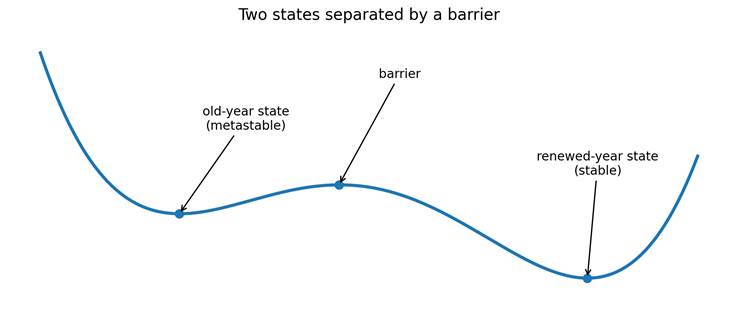
Figure 1. A simple picture of a first-order transition: the old state can persist until the barrier is crossed, after which the renewed state becomes stable.
That structure is enough for the analogy. A year can grow old day-by-day; even Elul can help us prepare one day after another; yet Rosh HaShanah can still mark a genuine change of state. The preparation is gradual; the coronation is not.
3. Why Rosh HaShanah Is a First-Order Transition
Start with the light. The Alter Rebbe does not say that last year’s light is simply made a little brighter. It withdraws, and a new light is drawn down. The coming year is not merely the old year one day later; it receives a vitality that, in his words, has not appeared before.
Coronation has the same character. One may prepare for a wedding for months, study for years before ordination, or deliberate for days before a verdict. Preparation can be continuous. Status is not. One is not half married, half ordained, or half crowned. Rosh HaShanah belongs to that family of thresholds where gradual preparation is followed by an abrupt transition.
Teshuvah gives us a third parallel. It is often gradual—that is one reason Elul exists—but the tradition also knows moments in which a life reorganizes at once. After hearing the story of Elazar ben Durdayya, Rabbi Yehuda HaNasi says that one person acquires his world in many years and another “in one hour.” Indeed, Maimonides describes the penitent as changing his name, as if to say: I am another person; I am no longer the person who did those deeds.[16] Months of work can culminate in a discontinuous self-description.
Another proof is that in the Biblical times, the New Year was not when the calendar said so, but when the witnesses saw the new moon. The Court justices sat patiently waiting for the witnesses to testify. Today, we might say metaphorically, “They looked, and they saw the new moon—the moon’s wavefunction is now collapsed!” Only then the Court would proclaim the New Year.
And then there is the barrier. A better state may already be visible and still fail to happen by itself. Habit, self-conception, unfinished obligations, and the reluctance to accept sovereignty over oneself can hold the old state in place. That is the spiritual analogue of metastability: the new state is possible, but the old one still has inertia.
4. Elul: Nucleating the New Year
A first-order transition usually begins locally. A tiny patch of the new phase appears inside the old. If it is too small, it disappears. If it becomes large and stable enough, it grows.[17] This is nucleation, and it gives Elul its most fruitful physical parallel.
Water makes the point vivid. Very clean water can remain liquid below its freezing point because there is no good place for an ice crystal to start. Give it a suitable surface or a seed, and freezing begins.[18] The new phase was already possible; what was missing was a viable beginning—nucleation.[19]
Nucleation
The customary daily shofar of Elul now takes on a natural role. It is not yet the Torah-commanded shofar of Rosh HaShanah; it is preparation, awakening.[20] Each morning we plant a small seed of the coming coronation inside the outgoing year. Selichot do the same. So do apology, restitution, cheshbon ha-nefesh—taking stock of one’s deeds—and resolutions. The flaws we repent of are the nucleation sites (physics nucleates at defects, and “where the penitents stand, the perfectly righteous cannot stand”[21]). The seeds are planted in the old year, where they grow the new one.
A seed, however, has to survive. Anyone who has made a New Year’s resolution knows how easily a sincere inspiration melts back into ordinary habit. Maimonides asks for something more substantial: a resolution so serious that the Knower of hidden things can testify that the person will not return to the sin.[22] Elul is not only for having a good thought. It is for giving that thought enough structure to live.
King Is in the field
This is where the Alter Rebbe’s parable of the King in the field becomes especially powerful. During Elul anyone may approach the King; He receives all graciously and shows a smiling countenance. In the palace, access is restricted. The Rebbe emphasizes that this revelation reaches even those who are far away, but it does not do their work for them. It makes approach possible; the person must still walk out to meet the King.[23]
Nucleation says something similar in physical language. A transition becomes easier when the new phase has a favorable place to begin. The King in the field does not carry us into the new year. He lowers the “barrier”—the difficulty of beginning. The Thirteen Attributes of Mercy deepen the same thought: mercy does not erase the need for teshuvah; it makes return possible precisely where ordinary merit has failed.[24] In phase-transition language, Elul changes the conditions of approach by flattening a bit the “energy landscape,” before the year itself changes.
And there is one more consequence. A kingdom cannot consist of isolated beginnings. Ein melech belo am: there is no king without a people. The many local acts of Elul—one person apologizing, another resolving, another more inspired by the sounds of shofar this morning—must finally join in a communal act of coronation. The new year is nucleated in individuals, but Kingship is crowned by a people.
Psalm 27
If the shofar is a seed, Psalm 27, I think, is something slightly different: a seed crystal, a template. A seed crystal does more than trigger crystallization; it can help select which crystal form grows. The psalm enters the liturgy in Elul and remains through Hoshana Rabbah. Midrash reads “the Lord is my light” as Rosh HaShanah and “my salvation” as Yom Kippur; later commentators connect “He will shelter me in His sukkah” with Sukkot.[25] The sequence of the coming season is already present in miniature.[26] It is less like a spark that disappears once ignition occurs than like a pattern held against the growing crystal while the structure takes shape. If a seed says “begin,” a crystal says, “grow like this.”
And then comes the last verse:
Hope in the Lord; be strong and let your heart take courage; and hope in the Lord. (Psalm 27:14)
Why twice? The Talmud says that if a person prayed and was not answered, let him pray again.[27] Nucleation is a statistics of repeated attempts. Most microscopic fluctuations die. The transition occurs because the system keeps trying until one fluctuation becomes self-sustaining. Elul does not require the first awakening to be perfect. It asks us to keep trying until the awakening acquires structure.
5. From Inscription to Sealing
A transition is not always finished at the instant it begins. Once a new phase appears, it has to spread. That gives us a natural way to read the days from Rosh HaShanah to Yom Kippur.
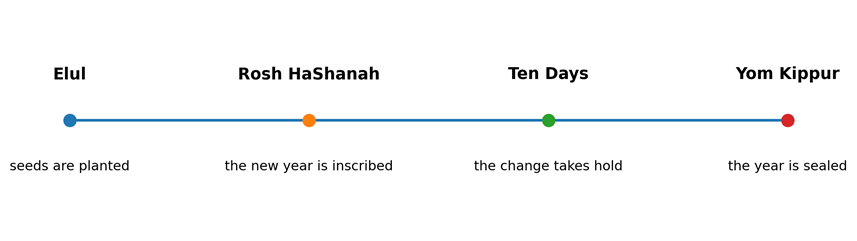
Figure 2. The season as a process: Elul prepares the change; Rosh HaShanah inscribes the new year; the Ten Days let it take hold; Yom Kippur seals it.
Rosh HaShanah is the moment of inscription: the new year is established. The two days, treated in halakhah as one long day, belong to a single transition.[28] But inscription is not sealing. The Ten Days of Teshuvah are the interval in which the decision is worked into parts of life that have not yet changed. Yom Kippur is the seal.
Anyone who has made a sincere Rosh HaShanah resolution knows the experience. One can crown the King in earnest and discover on the third of Tishrei that an old resentment, an unpaid debt, or a stubborn habit is still exactly where it was. The old hurts and pains are still there too. The year is new, but we are not. And we bring the heavy baggage from old year into the new. That does not make the resolution unreal. It means that a decision made at the center still has to reach the edges. From a theoretical resolution it has to become real.
6. What Is Fixed—and What Remains Open
Here is the theological question that makes us pause and think. If life, sustenance, and other features of the year are judged and decided around Rosh HaShanah and Yom Kippur, what is the rest of the year for? Why pray on Rosh Chodesh (New Moon)? Why pray daily at all? The Talmud says that a person’s sustenance is allotted from Rosh HaShanah to Yom Kippur.[29] Elsewhere the sages speak of judgment on different timetables—yearly, seasonally, daily, even hourly.[30] The tradition itself refuses to turn the year into a frozen script.
Chabad teachings describe a hierarchy. A general vitality is drawn down on Rosh HaShanah and solidified on Yom Kippur. But it still exists in the undifferentiated form of general allotment of the vitality and blessing. It is sort of like undifferentiated pluripotent stem cells. They can differentiate into neurons, muscle, skin, or bone cells. So too the undifferentiated energy allotted on Rosh HaShanah is then particularized through the service of each Rosh Chodesh, and from there through days and hours when it can be channeled into health, children, or sustenance.[31] The whole is given first; its details unfold later. Or, you might say, the quantity is given first, but it takes form later, shaped by our prayers on Rosh Chodesh and daily prayers.
Physics offers a simple picture of how that can happen. When water freezes, the crystal acquires an overall order, but that does not determine every microscopic detail. Ordinary ice still admits many different arrangements of its hydrogen atoms within the same crystalline framework. Pauling showed in 1935 how to count this surviving freedom, and measurement confirmed his count.[32] The large-scale state can be settled while many small-scale possibilities remain open.
That, I think, is enough to dissolve the apparent contradiction. Rosh HaShanah can be the “head” of the year without being a screenplay for every day that follows. The annual decree may set the broad conditions, opportunities, constraints, and measure of vitality, while the lived history remains to be shaped through prayer, choices we make, action, and the monthly unfolding of that blessing. Determined does not mean fully specified.[33]
7. The First Coronation
Let me end where creation begins. According to Vayikra Rabbah, the world was created on the twenty-fifth of Elul and Adam and Eve on the first of Tishrei, Rosh HaShanah; Adam and Eve were judged in the eleventh hour and pardoned in the twelfth.[34]
For five days there was already an ordered cosmos, but no creature capable of recognizing sovereignty and choosing to proclaim it. Chasidic teaching therefore reads Adam’s first act of worship as the first coronation.[35] He calls creation:
Come, let us bow down … before the Lord, our Maker. (Psalms 95:6)
He does not create G-d’s sovereignty; he brings creation into a relation in which that sovereignty is consciously acknowledged.
Here the nucleation metaphor reaches its deepest point. Adam is one local beginning, but his recognition does not stay local: he calls the rest of creation with him. The first five days were a world waiting for that relation. Adam was its nucleus.
That is why the liturgy can call Rosh HaShanah “the beginning of Your works, a remembrance of the first day” even though Adam was created on the sixth.[36] The beginning is relational, not merely chronological. For the first time, the world can answer its Creator.
Elul asks us to do the same. The new year begins inside the old one—in the daily shofar, selichot, reciting daily Psalm 27, a resolution given enough substance to survive. The King is in the field; mercy makes return possible; we supply the beginnings.
Then comes Rosh HaShanah, when the relation is renewed and the year receives its new head. The Ten Days let that decision take hold; Yom Kippur seals it. Even then, the future is not a script. The broad form of the year has been given, but the year itself still has to be lived.
So, before this Rosh HaShanah, let us plant seeds. Let us make them strong enough to survive the return to ordinary life. Let us go out to the field while the King is there. And when the shofar sounds, let the many private beginnings join in what a coronation requires—not isolated subjects, but a people.
Ketivah vachatimah tovah l’shanah tovah u’metukah—may you and yours be inscribed and sealed for a good and sweet year, a blessed year, and a year of redemption!
Technical Addendum: The Mathematics Behind the Metaphor
The essay above deliberately keeps the mathematics out of the main argument. For readers who want the formal backbone, the three pieces of physics used in the analogy are summarized here.
Landau theory. A minimal expansion that can describe both continuous and first-order behavior is:
where F is the free energy and φ is the order parameter. For b > 0, varying a through zero gives a continuous transition. For b < 0, competing minima can appear and the transition becomes first-order. The point a = b = 0, where the two kinds of phase boundary meet, is called tricritical.[37]
Classical nucleation. For a spherical nucleus of radius r, classical capillarity theory writes the free-energy cost as:
The first term is the cost of creating an interface; the second is the bulk gain from forming the more stable phase. The critical radius is
r* = 2σ/Δg,
and the barrier height is
ΔG* = 16πσ³/(3Δg²).[38]
The body of the essay translates only the qualitative result: small nuclei tend to disappear, while sufficiently large ones grow.
Order without complete specification. In ordinary ice, oxygen atoms form an ordered lattice while many proton arrangements remain compatible with the Bernal-Fowler ice rules. Pauling’s simple counting gives a residual entropy of approximately R ln(3/2). The point used in the essay is not the numerical value but the distinction it makes vivid: fixing a macroscopic state does not require fixing a unique microscopic history.
[1] Mishnah, Rosh HaShanah 4:5-6; Babylonian Talmud, Rosh HaShanah 16a. The Gemara explains Malchuyot as recited “so that you crown Me as King over you,” Zichronot so that remembrance rise for good, “and with what? With the shofar.”
[2] 1 Kings 1:39. Compare 2 Kings 9:13 and 11:14, where trumpet blasts and public acclamation accompany royal enthronement.
[3] The liturgic text we recite on this day says, “This is the birthday of the world.” In fact, according to the tradition, this is a day on which Adam and Eve were created, so it is the birth day of humanity. However, explain the sages, since the world was created only for the sake of humanity, it is not wrong to call it the birthday of the world.
[4] Rabbi Schneur Zalman of Liadi, Tanya, Igeret HaKodesh, epistle 14. The passage states that the light of each year withdraws on the eve of Rosh HaShanah and that, through shofar and prayer, “a new, supernal light” is elicited, one that had not shone before.
[5] Rabbi Schneur Zalman of Liadi, Tanya, Shaar HaYichud VehaEmunah, ch. 7, on Malchut and the principle ein melech belo am, “there is no king without a nation.” See also Rabbeinu Bachya ben Asher on Genesis 38:30 for an earlier use of the maxim.
[6] Rabbeinu Bechaye on Bereshit 38:30; Vayeishev 38:30; beginning of Balak; and Kad HaKemach.
[7] This begs the question: G-d is perfect and lacks nothing. To say that G-d lacks something is to contradict our essential understanding of who G-d is—an infinite and perfect being. This question is addressed at length in my recent essay, “Why Did G-d Create the World?” QuantumTorah.com, August 17, 2026, https://quantumtorah.com/why-did-g-d-create-the-world/.
[8] Rabbi Schneur Zalman of Liadi, Tanya, Sha’ar HaYichud ch. 1.
[9] Rema, Orach Chaim 581:3, records that the shofar is not blown on the eve of Rosh HaShanah. Traditional reasons include distinguishing the voluntary Elul blasts from the obligatory festival blasts and “confusing the Satan”; see Magen Avraham ad loc. The interregnum imagery developed in the text is a homiletic reading of the silence.
[10] Jerusalem Talmud, Rosh HaShanah 1:3, makes the heavenly calendar dependent on the earthly court. A more vivid later formulation in which G-d directs the angels to consult the court below appears in Yalkut Shimoni, Torah 191.
[11] See, for example, Serge Galam, Sociophysics: A Physicist’s Modeling of Psycho-political Phenomena (New York: Springer, 2012); Wolfgang Weidlich, Sociodynamics: A Systematic Approach to Mathematical Modelling in the Social Sciences (Amsterdam: Harwood, 2000); Poltorak, Alexander, Thermodynamics of Revolution: Iran at the Tipping Point (February 27, 2026). Available at SSRN: https://ssrn.com/abstract=6326298 or http://dx.doi.org/10.2139/ssrn.6326298.
[12] L. D. Landau, “On the Theory of Phase Transitions,” Zhurnal Eksperimental’noi i Teoreticheskoi Fiziki 7 (1937): 19–32, reprinted in Collected Papers of L. D. Landau, ed. D. ter Haar (Oxford: Pergamon, 1965); V. L. Ginzburg and L. D. Landau, “On the Theory of Superconductivity,” Zhurnal Eksperimental’noi i Teoreticheskoi Fiziki 20 (1950): 1064–82.
[13] I previously wrote several essay applying this methodology to Jewish history and Ge’ulah. See Poltorak, A. “G‑d Who Dreams: Creation, Companionship, and the Entropic Imagination,” QuantumTorah.com, December 5, 2025, https://quantumtorah.com/g-d-who-dreams-creation-companionship-and-the-entropic-imagination/; “Phase Transitions I: Sleep Architecture of Joseph’s Dreams,” December 17, 2025, https://quantumtorah.com/phase-transitions-i-sleep-architecture-of-josephs-dreams/; “Phase Transitions II: Galut as Dream, Geulah as Awakening,” December 24, 2025, https://quantumtorah.com/phase-transitions-ii-galut-as-dream-geulah-as-awakening/; “Phase Transitions in Human History.” December 26, 2025 https://quantumtorah.com/phase-transitions-in-human-history/; “Phase Transition: How Close Are We to the Geulah?” January 1, 2026, https://quantumtorah.com/phase-transition-how-close-are-we-to-the-geulah/; “Exodus as a First-Order Phase Transition”, January 31, 2026, https://quantumtorah.com/exodus-as-a-first-order-phase-transition/; “Erasing the Memory of Amalek: Hysteresis, System-Memory, and the Thermodynamics of Redemption.” March 3, 2026, https://quantumtorah.com/erasing-the-memory-of-amalek-hysteresis-system-memory-and-the-thermodynamics-of-redemption/; “The Golden Calf as Hysteresis.” March 8, 2026, https://quantumtorah.com/the-golden-calf-as-hysteresis/.
[14] For the modern thermodynamic definition, see IUPAC Gold Book, s.v. “first-order phase transition,” DOI 10.1351/goldbook.F02390. For the Landau framework, see L. D. Landau, “On the Theory of Phase Transitions,” Zh. Eksp. Teor. Fiz. 7 (1937): 19-32, reprinted in Collected Papers of L. D. Landau, ed. D. ter Haar (Pergamon, 1965).
[15] A first-order transition driven by temperature generally has a latent heat when entropy is discontinuous; for field-driven transitions, discontinuity and phase coexistence are the more general defining features. The essay therefore uses “latent heat” only where the thermal analogy is explicit.
[16] Babylonian Talmud, Avodah Zarah 17a, on Elazar ben Durdayya: “There is one who acquires his world in many years, and there is one who acquires his world in one hour.” Maimonides, Mishneh Torah, Hilchot Teshuvah 2:4, includes changing one’s name as if to say, “I am another person; I am not the person who did those deeds.”
[17] Classical nucleation theory: M. Volmer and A. Weber, “Keimbildung in ubersattigten Gebilden,” Zeitschrift fur Physikalische Chemie 119 (1926): 277-301, DOI 10.1515/zpch-1926-11927; R. Becker and W. Doring, “Kinetische Behandlung der Keimbildung in ubersattigten Dampfen,” Annalen der Physik 416 (1935): 719-752, DOI 10.1002/andp.19354160806.
[18] The homogeneous freezing limit of very pure micrometre-scale water droplets is typically near -38 to -42 C, whereas heterogeneous nucleation on surfaces or impurities occurs much more readily. See H. R. Pruppacher and J. D. Klett, Microphysics of Clouds and Precipitation, 2nd ed. (Kluwer, 1997), and modern reviews of homogeneous ice nucleation.
[19] Before the war with Iran started I wrote a paper, “Thermodynamics of Revolution: Iran at the Tipping Point,” 2026, where I argued that a regime change is a first-order phase transition, which required nucleation. I predicted that no amount of bombing will lead to a regime change because Iran lacked nucleation. Sadly, history proved me right.
[20] Pirkei de-Rabbi Eliezer, ch. 46, as cited by Tur, Orach Chaim 581, connects the first of Elul with Moses’ ascent and a shofar sounded in the camp. Shulchan Aruch and Rema, Orach Chaim 581:1, record the differing Elul and selichot customs.
[21] Talmud, Berachot 34b.
[22] Maimonides, Mishneh Torah, Hilchot Teshuvah 2:2: genuine teshuvah includes resolving not to return to the sin, to the point that the Knower of hidden things can testify that the person will not return to it.
[23] Rabbi Schneur Zalman of Liadi, Likkutei Torah, Reeh 32b, ma’amar Ani LeDodi, for the King-in-the-field parable. See also Rabbi Menachem M. Schneerson, Ani LeDodi 5726 (1966), sec. 3, which emphasizes that the Elul revelation reaches even the distant yet, in the first instance, enables rather than compels their service.
[24] Exodus 34:6-7; Babylonian Talmud, Rosh HaShanah 17b: “A covenant was made with the Thirteen Attributes that they do not return empty-handed.” The Elul association is developed in Likkutei Torah, Reeh 32b and the Elul maamarim built on it.
[25] Midrash Tehillim 27:1 reads “the Lord is my light” as Rosh HaShanah and “my salvation” as Yom Kippur. The Sukkot association through “He will shelter me in His sukkah” is a later extension used by commentators such as Elef LaMateh on Mateh Efraim 581:6. The custom of reciting Psalm 27 through the season varies by rite; Chabad practice continues through Hoshana Rabbah.
[26] The distinction matters. In the Czochralski process used to grow semiconductor crystals, a small seed crystal is dipped into the melt and slowly withdrawn, and the growing solid copies the orientation of the seed rather than choosing a new orientation at random. The seed therefore does not merely trigger growth and disappear; it remains the pattern from which the larger crystal develops. Pharmaceutical chemists exploit the same logic when they seed a crystallization to favor one crystal form rather than another.
[27] Babylonian Talmud, Berakhot 32b, citing Psalm 27:14: if a person prayed and was not answered, let the person pray again.
[28] Babylonian Talmud, Beitzah 4b-5a, treats the two days of Rosh HaShanah as one sanctity (the later idiom is yoma arichta, “one long day”). Babylonian Talmud, Rosh HaShanah 18a, identifies the Ten Days between Rosh HaShanah and Yom Kippur as a uniquely near period for the individual and distinguishes communal decrees that may still be torn up.
[29] Babylonian Talmud, Beitzah 16a: a person’s sustenance is allocated from Rosh HaShanah to Yom Kippur, with stated exceptions for Shabbat, festivals, and children’s Torah education.
[30] Babylonian Talmud, Rosh HaShanah 16a records multiple temporal models of judgment: Rabbi Yose says a person is judged daily; Rabbi Natan, every hour; other tannaitic formulations place judgment at Rosh HaShanah with sealing at later times.
[31] For the annual-to-monthly hierarchy, see Likkutei Torah, Derushim le-Rosh HaShanah, 58a; compare Derech Mitzvotecha, Mitzvas Haamanas Elokus, sec. 12, which describes one inclusive light for the year as subsequently divided through the twelve Rashei Chodashim, then days and hours.
[32] Linus Pauling, “The Structure and Entropy of Ice and of Other Crystals with Some Randomness of Atomic Arrangement,” Journal of the American Chemical Society 57 (1935): 2680–2684, DOI 10.1021/ja01315a102; W. F. Giauque and J. W. Stout, “The Entropy of Water and the Third Law of Thermodynamics,” JACS 58 (1936): 1144–1150, DOI 10.1021/ja01298a023.
[33] See, Rebbe Rashab, “Kuntres Uma’ayon,” Kehos, 1944.
[34] Vayikra Rabbah 29:1 places creation on 25 Elul, Adam on Rosh HaShanah, and Adam’s judgment and pardon in the eleventh and twelfth hours; cf. Babylonian Talmud, Rosh HaShanah 10b-11a.
[35] On Adam’s call to creation as the first coronation, see Pirkei de-Rabbi Eliezer, ch. 11. See also Rabbi Menachem M. Schneerson, Rosh HaShanah in “Discourses and Talks.”
[36] Rosh HaShanah Musaf: “This day is the beginning of Your works, a remembrance of the first day”; cf. Babylonian Talmud, Rosh HaShanah 27a.
[37] See I. D. Lawrie and S. Sarbach, “Theory of Tricritical Points,” in Phase Transitions and Critical Phenomena, vol. 9, ed. C. Domb and J. L. Lebowitz (Academic Press, 1984), 1–161; E. K. Riedel and F. J. Wegner, “Tricritical Exponents and Scaling Fields,” Physical Review Letters 29 (1972): 349–352, DOI 10.1103/PhysRevLett.29.349.
[38] For classical nucleation theory, see M. Volmer and A. Weber, “Keimbildung in übersättigten Gebilden,” Zeitschrift für Physikalische Chemie 119 (1926): 277–301; R. Becker and W. Döring, “Kinetische Behandlung der Keimbildung in übersättigten Dämpfen,” Annalen der Physik 416 (1935): 719–752, DOI 10.1002/andp.19354160806.


