Synopsis
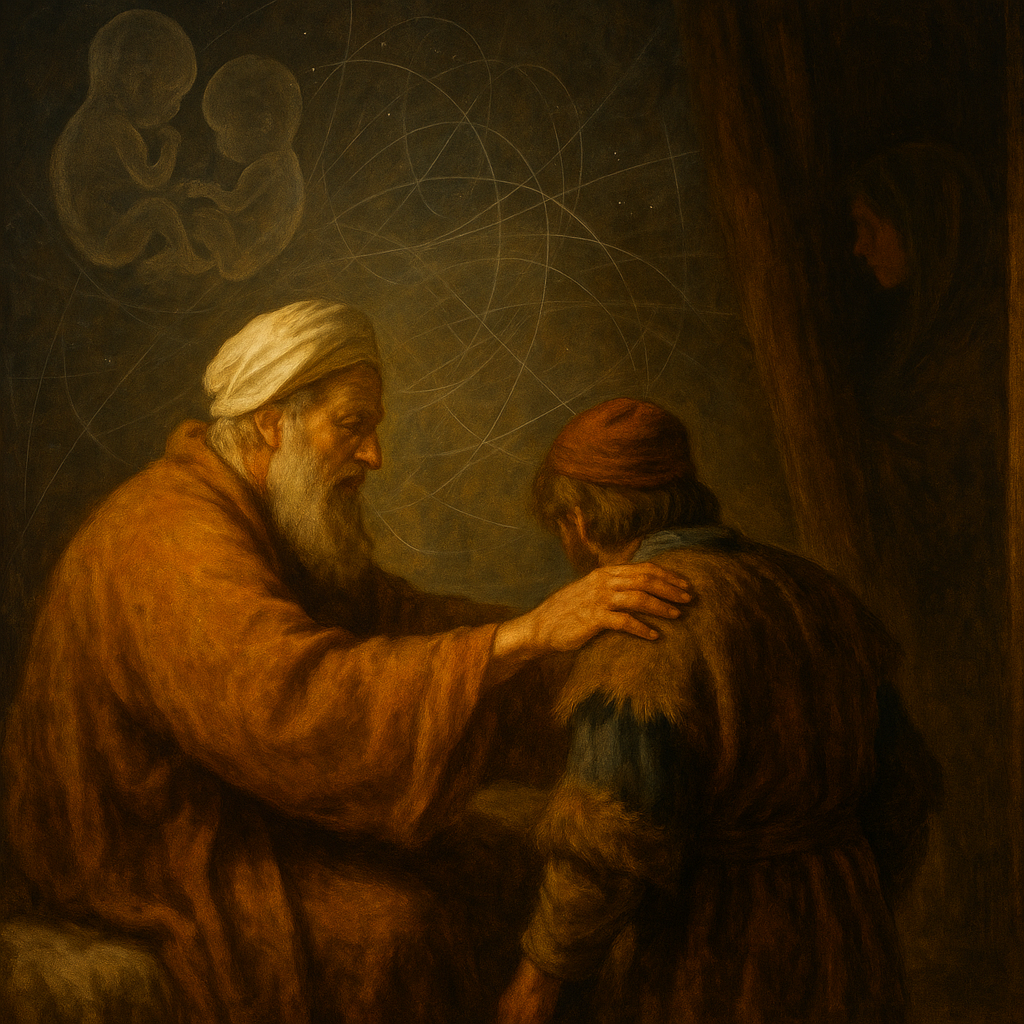
The narrative of the “stolen blessings” in Parashat Toldot presents a profound moral paradox: How could Rebecca, a righteous prophetess, and Jacob, the archetype of Truth (Emet), engage in what appears to be deceit against Isaac? This essay proposes a novel resolution by synthesizing modern medical theory with quantum mechanics. First, the physical disparity between the twins—Esau being “red and hairy” and Jacob “smooth”—is explained not by fraternal origins, but by Twin-to-Twin Transfusion Syndrome (TTTS) in identical (monozygotic) twins. This medical diagnosis explains how twins can be genetically identical yet physically distinct, and that their shared amniotic sac enabled the physical “entanglement” of holding the heel. Second, the essay reframes the narrative using Wigner’s Friend Paradox. In this quantum thought experiment, two observers can hold different valid realities regarding the state of a system. Rebecca, armed with prophecy and sight, acted as the “Friend” inside the laboratory; for her, the wave function had collapsed, and Jacob was the identified heir. Isaac, however, was blind and unaware of the prophecy. As an isolated observer unable to measure the system, he perceived the twins as remaining in a state of superposition. Thus, Rebecca did not deceive Isaac; she merely operated within a “collapsed” reality while Isaac interacted with an “uncollapsed” probability distribution.
Introduction
The Torah portion of Toldot presents perhaps the most morally challenging narrative in the entire Torah.
The first question: How are we to understand the apparent conspiracy between Rebecca (Rivkah) and Jacob (Yaakov) to deceive Isaac (Yitzḥak)? Rebecca is the revered Matriarch of the Jewish people. She was a righteous woman, “a rose among the thorns.” [1] She was a prophetess.[2] The Kabbalah teaches that Rebecca was a reincarnation of Eve (Chavah), who (along with Sarah, Rachel, and Leah) rectified the primordial sin of Eve.[3] Rebecca was Isaac’s devoted wife. How could we imagine that she would have conspired to deceive her beloved husband?
An even bigger question is: how can we say that Jacob went along and deceived his father? After all, Jacob was also a revered Patriarch, a chariot (merkavah), and a great Tzadik. He was a reincarnation of Adam, who finally rectified Adam’s primordial sin.[4] The Zohar states that the image of Jacob is engraved on the throne of G‑d![5] In Kabbalah, Jacob embodies the sefirah of Tiferet—the sefirah of compassion, harmony, and truth.[6] The verse says, “You give Truth to Jacob…” (Micah 7:20).” Jacob personified truth. How could he be said to deceive his father?
And what about the father himself? How could Isaac allow himself to be deceived? A Patriarch of the Jewish nation, a great prophet, a chariot (merkavah) of G-d, didn’t he see through the ruse? Moreover, why, after finally realizing that he was deceived, did he not curse Jacob, but, to the contrary, reaffirmed his blessing? I have previously addressed some of these challenges in my essay, “Steering Isaac’s Blessing.” [7]
These are difficult and perplexing questions. However, before we can address these critical questions, we must first understand the difference between Jacob and his twin brother, Esau (Eisav), the meaning of the struggle in utero, and why Isaac favored Esau, whereas Rebecca favored Jacob.
Entangled Twins
The story of Jacob and Esau begins with their struggle in utero:
And the children struggled together within her; and she said: “If it be so, wherefore do I live?” And she went to inquire of the Eternal. And the Eternal said unto her: “Two nations are in thy womb, And two peoples shall be separated from thy bowels; And the one people shall be stronger than the other people; And the elder shall serve the younger.” (Genesis 25:22-23)
Thus, Rebecca received the prophecy, “Two nations are in thy womb…. And the elder shall serve the younger.” Isaac did not get the memo.
Even the wording of the prophecy itself supports this quantum reading. As several commentators and modern scholars note, the clause וְרַב יַעֲבֹד צָעִיר (Genesis 25:23) is syntactically ambiguous: in Biblical Hebrew, subject and object can precede or follow the verb, so the phrase can mean either “the elder shall serve the younger” or “the elder, the younger shall serve.” Both branches are grammatically available. The prophecy thus functions like a superposed state with two classically incompatible outcomes encoded in one utterance. Rebecca, who received the prophecy, must interpret it; her later actions effectively “select” the branch where the elder serves the younger, whereas Isaac, never privy to the words, continues to live as though the alternative branch is viable.
A cursory reading of the Torah suggests Jacob and Esau were fraternal (dizygotic) twins. After all, the text explicitly highlights their physical differences: Esau was “red and hairy like a garment,” while Jacob was “smooth.” Surprisingly, some modern medical and rabbinic writers have suggested that they might have been identical (monozygotic) twins.[8],[9],[10]
Several modern medical and rabbinic writers have suggested that Jacob and Esau were identical twins suffering from Twin-to-Twin Transfusion Syndrome (TTTS).[11] This creates a scientific basis for how twins can be genetically identical yet physically distinct at birth. Of course, this is a retroactive medical reading, not a diagnosis; the Torah is not a clinical chart. But it shows that the text is remarkably compatible with a condition we now recognize. In TTTS, identical twins share a placenta, and blood flow is unevenly distributed between them. One twin (the recipient) gets too much blood, while the other (the donor) gets too little. The recipient twin is born larger, plethoric, and extremely red (due to excess red blood cells/polycythemia). This matches the description of Esau (“Edom”—ruddy/red). The donor twin is usually born smaller, anemic, and very pale. This matches the description of Jacob (often described as “smooth,” or implicitly paler/weaker in contrast to the robust Esau). The biblical description of the “struggling” in the womb (Genesis 25:22) is consistent with the hemodynamic imbalance and physical discomfort caused by TTTS.[12] Genesis 25:26 (“And after that came his brother out, and his hand took hold on Esau’s heel”) is at least suggestive of the TTTS diagnosis. In a healthy twin birth, there are usually membranes separating the babies. TTTS is a complication of monochorionic twin pregnancies (most commonly monochorionic diamniotic;[13] monoamniotic—MoMo—is rarer[14]), or of cases where the dividing membrane is very thin or ruptured. TTTS seems a plausible diagnosis for Jacob and Esau. This would allow physical contact in the womb (perceived by Rebecca as a “struggle,”) enabling Jacob to literally grasp Esau’s heel during delivery—something far less natural to explain if they were in completely separate sacs (as fraternal twins usually are).[15]
If Jacob and Esau were identical twins, that would imply that they were (metaphorically) entangled. Just as two particles originating from the decay of a common “mother” particle are described as an entangled pair, so too monozygotic twins emerging from a single zygote can serve as an analogue of entanglement. However, even if Jacob and Esau were fraternal (dizygotic) twins, their struggle in utero leads to the same conclusion: in quantum theory, particles that do not share a common origin can still become entangled through interaction or collision. The Torah’s emphasis that “the children struggled together within her” invites precisely such an interaction picture. Thus, whether Jacob and Esau were fraternal (dizygotic) twins or identical (monozygotic) twins, they were entangled (metaphorically speaking) either way. As if the Torah does not want us to miss this fact, it describes the moment of birth of the twins:
And after that came forth his brother, and his hand had hold on Esau’s heel; and his name was called Jacob. (Genesis 25:26)
One brother holding the other by the heel is a clear metaphor for their entanglement. I describe the entanglement of Jacob and Esau in greater detail in my earlier post, “The Entangled Twins.” [16]
Twins in a State of Superposition
Another uniquely quantum phenomenon is the state of superposition, which was made famous by the Schrödinger Cat thought experiment. (See, for example, my earlier essay, “Suspected Adulteress as a Schrödinger Cat.” [17]) Quantum mechanics allows the cat to be in a state of superposition, described mathematically as a coherent combination of ‘alive’ and ‘dead’ states (more precisely, the cat is neither simply alive nor simply dead, nor both, but in a distinct quantum state that only yields one of those outcomes upon measurement). During Rebecca’s pregnancy, there were two twins in her womb. The prophecy she received was that, “Two nations are in thy womb, And two peoples shall be separated from thy bowels; And the one people shall be stronger than the other people.” But which one of the two twins will be the progenitor of the stronger people? The verse does not specify. Each of the twins, so to speak, remains in a state of superposition—both are live candidates to found the ‘stronger’ nation. However, the next verse in that prophecy predicts that the elder shall serve the younger. Rebecca knew that, but Isaac did not.
Tikkun vs Tohu
Kabbalah and ḥasidut offer a deeper reason why Isaac favored Esau. Esau’s soul-root, we are told, comes from Olam haTohu, the primordial “universe of chaos,” characterized by “great lights and small vessels”: immense, undiluted spiritual energy with fragile capacity to contain it.[18] Jacob, by contrast, is rooted in Olam haTikkun, the ordered universe of rectification, where “small lights and great vessels” dominate and whose whole strength lies in stability and integration. In the quantum language we have been using, Esau behaves like a dangerously excited eigenstate of the “intensity” operator: huge amplitude, but inherently unstable. Jacob is closer to the ground state of a different observable, the one that measures ordered structure and vessel capacity. Isaac, whose own soul is gevurah, tunes his “detector” to Tohu; he loves Esau[19] because, in that measurement basis, Esau is the maximal eigenstate—the mode with the largest “nuclear” potential. His mistake is not that he misreads Esau’s power, but that he assumes that pouring more blessing-energy into that state will harness it, rather than drive it to another catastrophic shattering.
Rebecca’s insight, grounded in prophecy, is different. She knows that the Tohu-energies in Esau cannot be rectified by blessing them directly. Kabbalistic sources stress that the shattered lights of Tohu can only be elevated within the broad, harmonizing vessels of Tikkun.[20] In quantum terms, “Tohu-intensity” and “Tikkun-order” are like two non-commuting observables of the entangled Jacob–Esau system: you cannot diagonalize both at once. Isaac instinctively chooses to measure in the Tohu basis, where Esau looks ideal. Rebecca understands that the covenant requires the Tikkun basis, in which Jacob alone is a stable eigenstate. By orchestrating the scene so that Jacob stands before Isaac in Esau’s garments, she effectively changes the measurement the system undergoes: the blessing now projects the entangled pair onto the Jacob/Tikkun eigenstate. Esau’s raw Tohu power is not discarded; it is now encoded, more safely, as a component within Jacob’s history, to be slowly elevated through the long, often painful interaction between Israel and Edom.
The Participating Observer
A crucial detail unlocks the entire narrative:
And it came to pass, that when Isaac was old, and his eyes were dim… (Genesis 27:1)
Isaac’s blindness is the key.
In quantum mechanics, the evolution of a physical system is described by the wave function that obeys the Schrödinger equation. Until the system is measured, it is in a superposition of all possible states. The wave function (or, more precisely, the square amplitude of the wave function) only tells the probability of finding the system in one state or another, but not in what state it will be found. Only measurement collapses the plurality of possible states, revealing a single state. Measurement, however, requires an observer who collapses the wave function. Physicist John Archibald Wheeler coined the term “participating observer,” implying that an observer creates reality by observing the physical system. (For a more detailed explanation, see my paper, “Towards Reconciliation of Biblical and Cosmological Ages of the Universe.” [21])
Being blind, Isaac’s visual channel was gone, so he had only partial data, limiting him to partial, “weak” measurements[22] that never fully resolved the Jacob/Esau ambiguity. Deprived both of sight and of the prophetic information Rebecca had, he could not fully ‘diagonalize’ the Jacob/Esau system; his epistemic state remained a superposition of possibilities.
The Prior Measurement: Sale of the Birthright
Before the blessing scene, the Torah records a critical “measurement”: Esau sells his birthright to Jacob for lentil stew and “despises his birthright” (Genesis 25:29-34). In legal and covenantal terms, this transaction reassigns the firstborn identity. Quantum mechanically, the system has already been partially projected: “Jacob holds covenantal primogeniture.” The blessing scene does not initiate the collapse but must align with this prior measurement. Rebecca’s intervention ensures that the external ritual (Isaac’s words) matches the already-established spiritual-legal reality.
Wigner’s Friend paradox
To understand Rebecca’s actions, we must examine Wigner’s Friend paradox (see my imaginatively titled essay, “Wigner’s Friend Paradox” [23]). Let us briefly refresh this paradox.
Nobel laureate Eugene Wigner proposed a thought experiment revealing quantum measurement’s deepest puzzle. Imagine Wigner has a friend in a sealed laboratory who measures a quantum particle that’s in “superposition”—existing in multiple states simultaneously, like Schrödinger’s famous cat that’s both alive and dead. When the Friend observes the particle, they see a definite result: the particle is definitely spin-up or spin-down. But here is the paradox: from Wigner’s perspective outside the lab, quantum mechanics says the entire laboratory—including his Friend—should still be in superposition until Wigner himself opens the door and looks inside. So, the friend experiences, having observed the particle, a definite result, while Wigner’s equations describe the Friend as being in a blurry superposition of having seen both results. This creates a disturbing question: whose observation actually “collapses” reality into a single definite state? The Friend thinks the collapse happened when they looked at the particle, but Wigner’s mathematics suggests it only happens when he checks on his Friend.
Rebecca, having received the prophecy, knew that the older (firstborn) brother, Esau, would serve the younger brother, Jacob. Rebecca functions as Wigner’s Friend—inside the laboratory, having made the measurement. Isaac, unaware of the prophecy and unable to observe directly, plays Wigner’s role. For him, the twins remained superposed.
From an ethical perspective, one might object that even if Rebecca possessed superior information, she still engaged in deception. Here, the analogy to Wigner’s Friend is very helpful. Inside the laboratory, the Friend would be irrational to continue acting as if the system were in a superposition after observing a definite outcome. For Rebecca, prophecy constitutes that decisive observation: “the elder shall serve the younger” is a revealed fact, not a probabilistic forecast. Having received direct prophecy, she bears responsibility to align the covenantal blessing with that reality, even at the cost of surface-level transparency. (This parallels Abraham’s binding of Isaac, what Kierkegaard termed the “teleological suspension of the ethical”—acting from a higher revealed order that transcends conventional morality, earning Abraham the title of the Knight of Faith.[24]) Her “deception” of Isaac is thus not capricious but an instance of acting out a higher, revealed order that Isaac, by design, does not yet see.
When Isaac touches Jacob, he states: “The voice is the voice of Jacob, but the hands are the hands of Esau.” (Genesis 27:22) In a classical binary world, a person is either Jacob or Esau. By identifying the auditory frequency (voice) of one and the physical texture (hands) of the other simultaneously, Isaac is explicitly describing a superposed state. He is observing a single entity that possesses the contradictory attributes of both “Spin Up” (Jacob) and “Spin Down” (Esau) simultaneously. He is unable to collapse the function because the sensory data is contradictory.
The Torah describes Isaac’s reaction to Esau’s arrival not just as surprise, but as a violent physical shock: “And Isaac trembled a very great trembling” (Genesis 27:33). In Wigner’s Friend thought experiment, the “collapse” forces the universe into a single history. The “trembling” represents the jarring shift from a probabilistic reality (where the son before him could be the blessed one) to a deterministic reality (where the blessing is gone). He realizes that the “collapse” was divinely orchestrated; the uncertainty was a feature, not a bug, allowing the blessing to land on the rightful recipient.
In quantum mechanics, identical particles (such as electrons) lack individual identity until they are measured. If you swap two identical particles, the system’s physical state remains unchanged. Because Jacob and Esau can be modeled (at least on the TTTS reading) as monozygotic and ‘entangled’ in the womb, they behave, in our analogy, like a pair of indistinguishable particles: for an outside observer (Isaac) who lacks both vision and Rebecca’s prophecy, exchanging one for the other would not alter his description of the system. Rebecca (the “Friend” inside the lab) had the “measurement tool” (Prophecy/Sight) to distinguish them. By wearing Esau’s clothes (the “outer shell” or quantum numbers), Jacob did not fake being Esau; he effectively occupied Esau’s state. Since Isaac could not measure the internal “spin” (the soul/voice) definitively, the swap was valid under the rules of their entanglement.
This is what allowed Rebecca to orchestrate the subterfuge. Jacob also knew all this and went along with the plan. Moreover, Jacob knew that Esau had sold him the birthright and that the blessing belonged to him. On this reading, the core of the act is not a simple lie or theft, but the alignment of Isaac’s external act with a reality already fixed by prophecy and by Esau’s prior sale of the birthright. For Rebecca, the reality was first determined by the prophecy and later by her personal observation—for her, the wavefunction of the twins had collapsed—she knew who was who. Isaac, however, unaware of the prophecy and unable to see, lived in a blurry state of superposition—for him, the twins were in superposition and entangled—therefore interchangeable. That is all Rebecca did—interchange one twin for another.
Only after Esau announces himself as “Esau, your firstborn,” does he collapse the wave function for Isaac. Isaac realized what had happened and recognized that it was the result of divine providence. He immediately affirms the blessing he gave to Jacob (thinking he was Esau), by saying, “and let him be blessed.”
Midrash reads the verse “The wise shall inherit honor, but fools lift up disgrace” (Proverbs 3:35) as a pattern that operates “from the creation of the world until now,” and it explicitly applies this to our story: “‘The wise shall inherit honor’ – this is Jacob… ‘and fools lift up disgrace’ – this is Esau.” [25] On this reading, Jacob’s role as the heir and Esau’s as the one who forfeits honor are not ad hoc outcomes of a single meal or a single deception, but part of a providential pattern woven into the world from its very beginning. Kabbalistic tradition develops this further: Zohar and its commentators speak of a “wine preserved in its grapes since the six days of Creation” prepared to sweeten Isaac’s judgment so that Jacob would be blessed properly.[26] On this view, the blessing scene does not bestow a new destiny; it reveals a role for Jacob inscribed into creation from the outset.
Conclusion
The interaction between Jacob and Isaac transcended deception, representing a convergence of divergent reference frames. When Isaac stated, “The voice is the voice of Jacob, but the hands are the hands of Esau,” he was not describing a trick, but rather articulating a state of quantum superposition—perceiving two contradictory states (Jacob-ness and Esau-ness) simultaneously within a single entity.
Because Isaac could not act as a “participating observer” to collapse this wave function, the “subterfuge” was simply the necessary alignment of these two realities. The wave function finally collapsed for Isaac only when Esau entered the room. The Torah describes this moment with the words “Isaac trembled a very great trembling” (Genesis 27:33)—marking the jarring shift from a probabilistic superposition to a deterministic reality. Recognizing this collapse as the hand of Divine Providence, Isaac did not curse Jacob but immediately affirmed the blessing. In this light, the so-called “stolen” blessing appears as a quantum-like event in which the attribute of Truth (Jacob) successfully navigates the noisy uncertainty of the physical world (Esau) so that the underlying divine design—already encoded in Rebecca’s prophecy and in the birthright sale—emerges in the open to reveal the divine intent.
[1] Shir HaShirim Rabbah 2:2 (also found in Vayikra Rabbah 23:3).
[2] Rashbam (Genesis 25:22); Midrash Rabbah (Genesis 67:9).
[3] Rabbi Chaim Vital, Sha’ar HaGilgulim and Sefer HaLikutim, parshat Toldot.
[4] Rabbi Chaim Vital, Sha’ar HaGilgulim, Introduction 23 and Chapter 31; also, Sha’ar HaPesukim on Parashat Vayechi.
[5] Talmud, tr. Chullin 91b; Bereshit Rabbah 68:12; Targum Yonatan ben Uziel on Genesis 28:12.
[6] Zohar, Vayetze 1:150a, Shemot 2:51b, Mishpatim 2:119a.
[7] Poltorak, A., “Steering Isaac’s Blessing,” QuantumTorah.com, , https://quantumtorah.com/steering-isaacs-blessing/ (retrieved 11/23/2025).
[8] Genesis Rabbah (63:8) and Yalkut Shimoni (110). The Midrash says, “To what may this be compared? To two pearls that were placed in a narrow tube. The one that was put in first comes out last. So, too, Jacob was conceived first and came out last.” This “Tube” analogy supports the idea that they were packed tightly together (a single unit or single sac), which aligns with the “identical twin” theory that they shared a placenta/amniotic sac.
[9] Rabbi Samson Rafael Hirsch.
[10] Rabbi Yaakov Kamenetsky, whom I had the privilege of meeting, (in his work Emet L’Yaakov) provided a logical deduction for why they must have been identical. When Jacob disguises himself as Esau to receive Isaac’s blessing, he covers his arms in goat skins to mimic Esau’s hairiness. Isaac, who is blind, feels the arms and says, “The voice is the voice of Jacob, but the hands are the hands of Esau.” Rabbi Kamenetsky argues: If they were fraternal twins, they would likely have had different bone structures, facial shapes, and builds (one broad, one slender). If Isaac touched Jacob and felt a completely different skeletal frame than Esau’s, the goat hair would not have fooled him. Therefore, they must have had identical builds and facial features. The only physical difference between them was the hair and skin texture. Because they were identical in every other way, Isaac had to rely on touch (hairiness) to distinguish them, which is why the ruse worked.
[11] Philip Lanzkowsky; Twin-to-Twin Transfusion—An Historic Note. Pediatrics, September 1979; 64 (3): 309. 10.1542/peds.64.3.309. Lanzkowsky clearly writes, “The first recorded case of polycythemia in the newborn due to twin-to-twin transfusion, however, was reported in the Bible: “And when her (Rebekah) days to be delivered were fulfilled, behold, there were twins in her womb. And the first came forth ruddy, all over like a hairy mantle; and they called his name Esau…” Genesis XXV, 24-26.”
[12] Blickstein I, Gurewitsch ED. Biblical twins. Obstet Gynecol. 1998 Apr; 91(4):632-4.
[13] Monochorionic: The twins share a single chorion and a single placenta, so they have a common blood supply. Diamniotic: Each twin has its own amniotic sac, separated by a thin membrane.
[14] Monochorionic-monoamniotic (MoMo) twins are a rare type of identical (monozygotic) twins that share both the same chorion (outermost fetal membrane that surrounds an embryo during pregnancy) and the same amniotic sac during pregnancy. They share one placenta and have a common blood supply.
[15] “Medical history: Biblical texts reveal compelling mysteries”, University of Cape Town, 2003, https://www.news.uct.ac.za/article/-2003-01-10-medical-history-biblical-texts-reveal-compelling-mysteries (retrieved 11/22/2025). See also Glennon CL, Shemer SA, Palma-Dias R, Umstad MP. The History of Treatment of Twin-to-Twin Transfusion Syndrome. Twin Research and Human Genetics. 2016;19(3):168-174. doi:10.1017/thg.2016.27.
[16] Poltorak, A. “The Entangled Twins,” QuantumTorah.com, November 3, 2013, https://quantumtorah.com/entangled-twins/ (retrieved 11/22/2025).
[17] Poltorak A., “Adulteress as a Schrödinger Cat,” QuantumTorah.com, May 30, 2014, https://quantumtorah.com/sota-suspected-adulteress-as-a-schrodinger-cat/ (retrieved 11/22/2025).
[18] Rabbi Shneur Zalman of Liadi, Torah Or, Parashat Noaḥ, esp. p. 9d; Rabbi DovBer Schneuri, Torat Ḥayim, Noaḥ 61a; Rabbi Menachem Mendel Schneerson, Maamar “Torah Tzivah” (Simḥat Torah 5723), in Toras Menachem: Hisva’aduyos 5723.
[19] Rabbi DovBer Schneuri, Torat Ḥayim, Toldot, p. 306
[20] Rabbi Shneur Zalman of Liadi, Torah Or, Vayishlaḥ.
[21] Poltorak, A. “Towards Reconciliation of Biblical and Cosmological Ages of the Universe,” B’Or HaTorah, 13 (2002) p. 19, or https://quantumtorah.com/towards-reconciliation-of-biblical-and-cosmological-ages-of-the-universe/ QuantumTorah.com.
[22] “Weak measurements” is a term coined by Israeli-American physicist Yakir Aaron, who proposed them to interrogate a quantum system ever so slightly so as not to collapse the wave function but still get a little bit of information about the system.
[23] Poltorak, A., “Wigner’s Friend Paradox,” QuantumTorah.com, March 17, 2019, https://quantumtorah.com/wigners-friend-paradox (retrieved 11/23/2025).
[24] Soren Kierkegaard, “Fear and Trembling.” See also an article by Dr. Anna Urowitz-Freudenstein, “Rebecca, The Hidden Prophetess,” TheTorah.com, https://www.thetorah.com/article/rebecca-the-hidden-prophetess?utm_source=chatgpt.com.
[25] Midrash Tanḥuma, Tzav 9; see also Yalkut Shimoni on Mishlei 3:35.
[26] Ketem Paz on Zohar 142b.


Hallo und Danke für diesen ausgesprochen guten Beitrag. In der Tat könnte er als treffendes Beispiel als Erklärung für eine Situation der quantenmechanischen Superposition und zum Wigners Freund-Paradoxon dienen. Das Wigners-Freund-Paradoxon ist ein Gedankenexperiment in der Quantenmechanik, das auf dem Experiment von “Schrödingers” Katze” aufbaut und das Problem der Beobachtung in der Quantenwelt beleuchtet. Es hinterfragt, ob und wann ein Quantenzustand kollabiert: geschieht dies mit der Messung durch den Freund, oder erst, wenn Wigner selbst von dem Ergebnis erfährt. Der Rückschluss von Alexander Poltorak, in der er die scheinbare Verschwörung zwischen ReBeQaH und JaÃQoBh darlegt, um JiZChaQ zu täuschen, erscheint mir in allen Bereichen außerordentlich gut nachvollziehbar. Vor allem die Hinzuziehung der archaischen QaBBaLaH, die lehrt, dass ReBeQaH eine Reinkarnation von ChaWaH war, die zusammen mit SsaRaH, RaCheL und LeAH, die ursprüngliche Sünde von ChaWaH korrigierte, stellt einen bedeutenden Rückschluss dar, der äußerste Beachtung verdient.
Der Vergleich mit Wigners Freund-Paradoxon ist besonders treffend. In diesem Gedankenexperiment befindet sich ein Freund in einem abgeschlossenen Labor und misst dort beispielsweise die Polarisation eines Photons, das sich vor der Messung in einer Überlagerung verschiedener Zustände befindet. Aus Sicht des Freundes kollabiert diese Superposition durch die Messung und der Zustand wird eindeutig bestimmt. Für Wigner hingegen, der außerhalb des Labors steht, bleibt das Teilchen – zusammen mit dem Freund – weiterhin in einer Superposition, bis auch er von den Messergebnissen erfährt.
Sobald Wigner die Information von seinem Freund erhält, reduziert sich auch für ihn die Überlagerung auf einen bestimmten Zustand. Das Paradoxon ergibt sich daraus, dass beide Beobachter – sowohl Wigners Freund als auch Wigner selbst – unterschiedliche und scheinbar widersprüchliche Angaben zum Zustand des Teilchens machen können, obwohl beide laut Quantenmechanik im Recht sind.
Die zentrale Frage dabei ist: Wann kollabiert der Quantenzustand? Passiert dies schon, wenn der Freund misst, oder erst in dem Moment, in dem Wigner das Ergebnis erfährt? Was ist mit dem “Beobachter”? Ist die Messung etwas, das nur durch das Bewusstsein eines Menschen (wie Wigner) ausgelöst werden kann, oder kann auch die Messung durch den Freund als eine Messung betrachtet werden?
Das Paradoxon stellt grundlegende Fragen zur Natur der Realität, zur Messbarkeit sowie zur Funktion des Beobachters innerhalb der Quantenphysik. Es wird verdeutlicht, dass die Kopenhagener Deutung der Quantenmechanik, welche von einem unmittelbaren Kollaps des Zustandes ausgeht, potenziell zu Inkonsistenzen führen kann. Diese Überlegungen haben mehrere alternative Interpretationen der Quantenmechanik hervorgebracht, darunter auch die Viele-Welten-Interpretation.
A very enjoyable piece. The genius of your insights continue to overwhelm.
Thank you