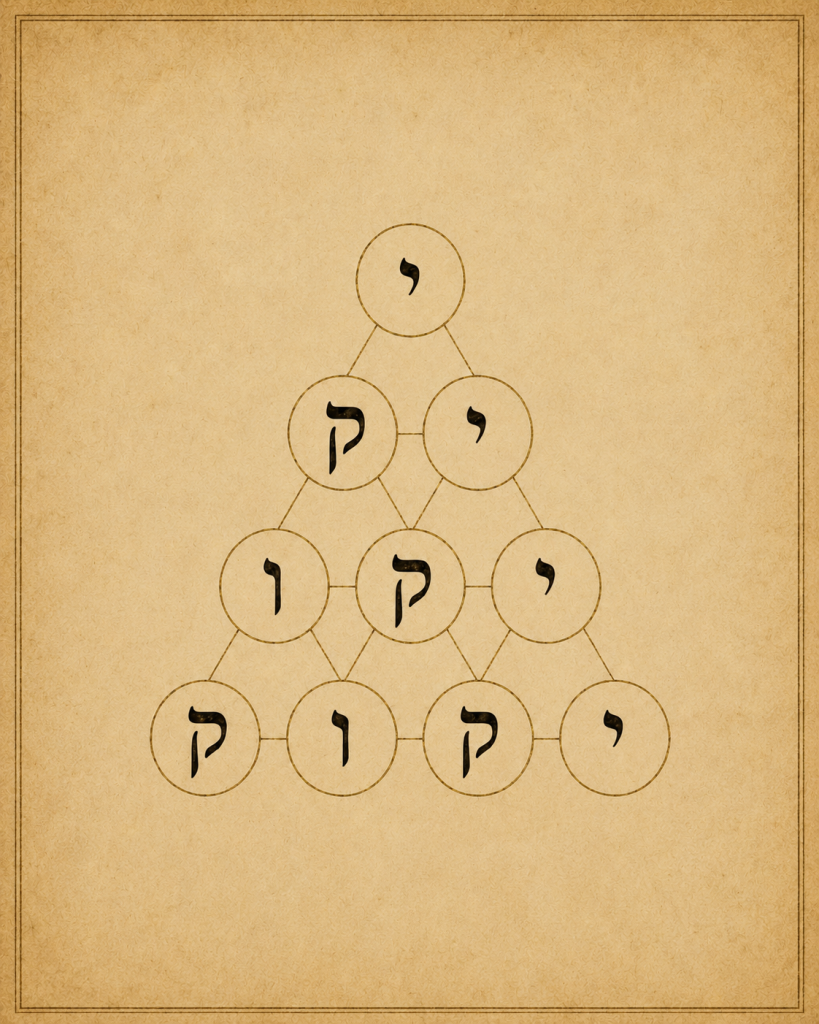
The number ten occupies a singular place in the architecture of the Torah. The world was created by the Ten Utterances (Asarah Ma’amarot). Egypt was struck by the Ten Plagues (Eser Makkot). The Torah was given in Ten Commandments (Aseret ha-Dibrot). A minimum quorum (minyan) of ten men is required for communal prayer. And in Kabbalah, the entire structure of divine emanation flows through ten sefirot—ten luminous emanations through which the Infinite (Ein Sof) manifests in the finite world. All of these tens, the kabbalistic tradition teaches, are rooted in the ten sefirot.
But why ten? The question is not trivial. In number theory, ten is unremarkable—it is neither prime nor a perfect number nor the generator of any deep mathematical structure. If we want to justify the centrality of ten, we must look beyond mathematics to philosophy and theology. We can, after all, justify the importance of the number three as a dialectic triad—thesis, antithesis, synthesis. Can we find a comparable justification for ten?
First, I will consider and reject an Aristotelian route, which treats ten as a list of ontological categories. Second, I will argue that ten represents the minimal architecture of worldhood: threefold intelligibility joined to sevenfold manifestation. Third, I will return to Sinai, where the Ten Commandments appear in a different but related form: five opposite five, the covenantal structure of ten. Then, I will show how the Tetragrammaton itself unfolds as a sacred tetractys: 1+2+3+4=10.
1. The Aristotelian Attempt
Aristotle offered what might seem like a promising starting point. In his Categories (Κατηγορίαι), he identified ten fundamental modes of predication—ten ways in which something can be said to “be”: substance, quantity, quality, relation, place, time, position, state (hexis), action, and passion (being acted upon). If this list were exhaustive—if ten truly captured every possible mode of being—then ten would be the number of ontological completeness.[1]
But the list is not stable. The Stoics reduced Aristotle’s categories to just four (substrate, quality, disposition, relative disposition).[2] Contemporary philosopher E.J. Lowe also condensed the number of categories to four.[3] Kant reorganized the entire project and arrived at twelve categories arranged in four triads.[4] Jonathan Westerhoff has questioned whether a fixed categorical scheme is even achievable.[5] The number ten, in Aristotle’s framework, looks less like a structural necessity and more like an artifact of one philosopher’s particular analysis. Whatever its merits, this path does not lead us to a compelling reason for ten.
2. The Architecture of the World: Three Plus Seven
A more promising philosophical approach begins with asking what a world requires, rather than cataloging modes of being. A world is not simply a collection of existing things. It must be both intelligible and manifest. It must have meaning, form, order, and knowability; and it must also appear as a concrete field in which beings stand in relation to one another. Creation, therefore, requires two orders: an inner order of intelligibility and an outer order of manifestation.
The first order is triadic. For anything to become intelligible to a finite mind, it seems to pass through at least three basic stages. First, there is the originating point of insight: the thing grasped in its seed-form, before it has been fully elaborated. Second, that insight must be developed and differentiated; it must acquire boundaries, distinctions, and inner structure. Third, the developed idea must be integrated, related, and applied. A single term gives identity; two terms give polarity; three terms give a structured relation. This is why triads recur so frequently in philosophy: thesis, antithesis, and synthesis; beginning, middle, and end; subject, object, and relation; knower, known, and knowledge. In kabbalistic language, this corresponds to the intellectual structure of Ḥokhmah, Binah, and Da’at, or, in other enumerations, Keter, Ḥokhmah, and Binah.[6]
The second order is sevenfold. Once intelligibility enters manifestation, it appears within a field of relation. The most basic structure of embodied existence is spatial orientation: right and left, above and below, front and back. These are six directions. Yet six directions require a center from which they are ordered. Without a center, they remain an abstract coordinate system; with a center, they become a world experienced from within. Manifestation, therefore, has the form of six directions plus one center: seven. This helps explain why seven is so deeply associated with nature, rhythm, creation, and completion: the seven days of creation, Shabbat, the Sabbatical year, and the seven lower sefirot. A related six-plus-one spatial symbolism appears in Sefer Yetzirah, which speaks of six extremities and, in another passage, of a central Heikhal ha-Kodesh that “bears them all.”
Ten, then, is three plus seven: intelligibility joined to manifestation, idea joined to embodiment, meaning joined to world. It is the number of complete articulation. One is simple unity. Three is the structure of understanding. Seven is the fullness of embodied creation. Ten is the full architecture by which the One becomes manifest as an ordered world.
This gives coherence to the major tens of Jewish thought. The Ten Utterances are the complete articulation of divine speech into the cosmos. The Ten Plagues are the systematic dismantling of Egypt’s false world, striking the full structure of its natural, social, religious, and political order. The Ten Commandments are the moral architecture of covenant, ordering the relation between man and G-d, man and family, man and society, and man and his own desires. As the Kabbalists put it, the Ten Utterances became the Ten Commandments by means of the Ten Plagues.[7]
Thus, ten is significant because it represents the minimal architecture of worldhood: threefold intelligibility clothed in sevenfold manifestation. Ten is what it takes for the One to manifest as world.
Yet this still does not explain the distinctive structure of the Ten Commandments. Creation may unfold as three plus seven, but the tablets of Sinai are traditionally depicted as five and five.[8] The midrash reads the two tablets as a deliberate moral symmetry: the first five commandments stand opposite the latter five. “I am the L-rd your G-d” faces “You shall not murder”; “You shall have no other gods” faces “You shall not commit adultery”; “You shall not take the Name in vain” faces “You shall not steal”; “Remember the Sabbath” faces “You shall not bear false witness”; “Honor your father and mother” faces “You shall not covet.”[9] The Decalogue is therefore not simply a list of ten divine commands. It is a fivefold mirror in which the truths of the first tablet are translated into the obligations of the second.
3. The Ten Commandments: Five Facing Five
The Pythagorean tetractys explains the number 10 as a generative unfolding: 1 + 2 + 3 + 4. The kabbalistic unfolding of Havayah gives a Jewish analog of that same structure. But the tablets of Sinai reveal a different aspect of ten. Here ten appears as five opposite five. Sefer Yetzirah already describes the ten sefirot this way: “ten fingers, five opposite five, with the covenant of the Unique One positioned in the middle.” Ramban applies this very formula to the Ten Commandments: the first five were written on one tablet and the second five on the other, “five opposite five, as mentioned in Sefer Yetzirah.” At Sinai, ten is therefore not only the number of emanation; it is the number of covenant—two complete hands, two tablets, two orders of obligation, facing one another and joined by the brit in the middle.
Moreover, Sefer Yetzirah offers a geometric parallel closely related to the tetractys and the dimensionality of space. Whereas the tetractys maps the emergence of three-dimensional space, Sefer Yetzirah goes much further, mapping ten sefirot on ten directions in a five-dimensional space:[10]
| Dimension of five-dimensional space | Depths in the language of Sefer Yetzirah |
| Time | A depth of beginning, a depth of end; |
| Moral-spiritual axis | A depth of good, a depth of evil; |
| Vertical space | A depth of above, a depth of below; |
| Horizontal space | A depth of east, a depth of west; |
| Lateral space | A depth of north, a depth of south. |
A “depth of the beginning” and a “depth of the end” are past and future—the time dimension. A “depth of above” and a “depth of below” are two opposite directions in one spatial dimension. A “depth of east” and a “depth of west” are opposite directions in the second spatial dimension. A “depth of north” and a “depth of south” are opposite directions in the third spatial dimension. Thus, we have six spatial directions (up-down, right-left, front-back) that make up three-dimensional space. The addition of time as a dimension expands this space into a space-time continuum. Yet another expansion of the space into a fifth (moral) dimension is mathematically equivalent to a conceptual five-dimensional space. This five-dimensional space comprises ten directions (“depths” in the language of Sefer Yetzirah) that correspond to the ten sefirot.
4. The Pythagorean Tetractys
The Pythagoreans arrived at the primacy of ten by a different route—through geometry rather than the structure of the world. They revered the tetractys (τετρακτύς), the triangular arrangement of ten points:
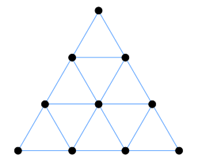
The tetractys encodes the sum 1 + 2 + 3 + 4 = 10. What makes this more than arithmetic is what each summand represents. One is the point—dimensionless, without extension. This is the monad, representing unity. Two points determine a line—the one-dimensional space, dyad, representing power. Three points define a plane—the two-dimensional space—forming a triad that represents harmony. Four points (not all coplanar) determine a solid—the three-dimensional space—known as a tetrad, representing Kosmos. The points add up to ten—the decad, representing the unity of the higher order. The tetractys thus maps the complete unfolding of spatial reality, from the dimensionless point to the full three-dimensional world. Ten is not merely a count; it is the sum of the generative process by which structure itself emerges. The Pythagoreans had a prayer addressing the tetractys:[11]
O holy, holy Tetractys, thou that containest the root and source of the eternally flowing creation! For the divine number begins with the profound, pure unity until it comes to the holy four; then it begets the mother of all, the all-comprising, all-bounding, the first-born, the never-swerving, the never-tiring holy ten, the keyholder of all.
The Pythagoreans considered this so sacred that they swore oaths by it. Later Greek philosophical traditions, particularly Stoicism, also associated numerical order with cosmic order, although the special sanctity of the decad is most characteristic of the Pythagorean tradition.
5. Philo and the Decalogue
The most consequential attempt to bridge the Pythagorean tetractys and biblical thought belongs to Philo of Alexandria (c. 20 BCE – c. 50 CE). In De Decalogo and De Opificio Mundi, Philo argued at length that the number ten is “all-perfect” (pantelēs), and he grounded this claim explicitly in Pythagorean reasoning. Ten, Philo insisted, is the sum of the first four numbers—the tetractys—which contain within themselves the principles of point, line, surface, and solid, and therefore the principles of all spatial reality.
Philo applied this framework directly to the Decalogue. The Ten Commandments are ten, he argued, not by convention or arbitrary divine choice, but because ten is the number that expresses completeness. Just as the tetractys generates the entire structure of the physical world from four summands, the Decalogue generates the entire moral order from ten principles. Philo also noted the ten-based structures in the Tabernacle and connected them to the same Pythagorean logic—the sacred architecture mirrors the mathematical architecture of reality.
Philo’s project was remarkable: he was, in effect, arguing that Moses and Pythagoras had discovered the same truth, with the crucial difference that Moses received it by revelation and Pythagoras arrived at it by reason. Whether or not one accepts Philo’s synthesis, his work demonstrates that the connection between the tetractys and biblical tens has deep roots—reaching back at least two millennia.
The Pythagorean argument, reinforced by Philo, is compelling. But notice where it grounds the number ten: in geometry, in the progressive unfolding of spatial dimensions. Can we go deeper?
6. The Tetractys of the Name
I want to propose that the tetractys structure is already embedded in the most fundamental reality of Jewish theology—the Tetragrammaton, the four-letter Name of G‑d: Tetragrammaton (Yud-Heh-Waw-Heh).
Consider how the Name builds itself progressively, letter by letter:
| Stage | Letters | Count |
| 1 | Y | 1 |
| 2 | Y-H | 2 |
| 3 | Y-H-W | 3 |
| 4 | Y-H-W-H | 4 |
The progressive unfolding of the Name yields exactly 1 + 2 + 3 + 4 = 10.
This is the tetractys of the Name itself. The ten sefirot are not arbitrarily ten. They can be understood as emerging from the internal logic of the Tetragrammaton’s unfolding. Indeed, the kabbalistic tradition already associates the four letters of the Name with the four olamot (worlds)—Atzilut, Beriah, Yetzirah, Assiyah—and with the four levels of the soul and the four stages of creation. The tetractys structure is latent in these associations, waiting to be made explicit.
The structure I am calling the “tetractys of the Name” is not a modern invention. The term tetractys is Greek, but the structure is already present in authoritative kabbalistic sources. Tikkunei Zohar already describes prayer as ascending through four forms of song: simple song (shir pashut), corresponding to Y; doubled song (shir kaful), corresponding to Y-H; tripled song (shir meshulash), corresponding to Y-H-W; and quadrupled song (shir meruba), corresponding to Y‑H‑W‑H. This is precisely the progressive 1+2+3+4 unfolding of the ineffable name, Havayah.[12] Lurianic texts later formulate the same structure explicitly as Y, Y‑H, Y‑H‑W, Y‑H‑W‑H, and identify it with the Name of Ayin Bet (72).[13] What the Greeks called the tetractys appears in Kabbalah as the simple, doubled, tripled, and quadrupled unfolding of Havayah. Since this fourfold unfolding contains ten letters in all, it gives a properly kabbalistic analog to the Pythagorean tetractys: not the tetractys of geometric extension, but the tetractys of Havayah.
I have not found an earlier authoritative kabbalistic source that explicitly states this precise argument—that the progressive letter count of the Tetragrammaton yields the tetractys and thereby explains the ten sefirot.[14] The components of the argument, however, are traditional: the four-letter Name, its staged unfolding, the association of the Name with the four worlds, and the tenfold structure of the sefirot. I only made their tetractys structure explicit.
7. The Relationship Between the Two Tetractys Structures
We now have two tetractys arguments for the number ten—the Pythagorean and the kabbalistic. They are structurally isomorphic: both derive ten from the sum 1 + 2 + 3 + 4. But they are not equivalent. They differ in how the summands are generated.
Philo of Alexandria was not the first Hellenistic Jewish thinker to argue that Greek and Mosaic wisdom share a common root. Some Hellenistic Jewish thinkers already argued that Greek wisdom borrowed from Jewish sources to which they were no doubt exposed. Whether one accepts that historical claim or not, the philosophical convergence is striking: both traditions see ten as the completion of a four-stage unfolding.[15] On this view, the convergence between Greek and biblical thought is not a coincidence but a derivation: the Greeks borrowed from Moses.
For the Pythagoreans, the generative principle is spatial extension: point → line → plane → solid. For the Tetragrammaton, the generative principle is the progressive self-revelation of the Name: Yud → Yud-Heh → Yud-Heh-Vav → Yud-Heh-Vav-Heh.
The Pythagorean oath also mentioned the Tetractys:[16]
By that pure, holy, four-lettered name on high,
nature’s eternal fountain and supply,
the parent of all souls that living be,
by him, with faith find oath, I swear to thee.
Tetractys was a number, not a name. Later readers could easily hear in this phrase an echo of the Tetragrammaton (though the historical claim cannot be demonstrated from this passage alone). This may be indicative that Pythagoras, as other Greek philosophers, was familiar with the Torah and the Jewish tradition.
The Pythagoreans found in geometry the shadow of a deeper structure. They discovered the tetractys in geometry; Jewish theology discovers it in the very Name by which the world was created.
Conclusion
The two arguments we have traced describe the same structure from different vantage points.
The 3+7 argument tells us what ten is: the minimal architecture of a world, threefold intelligibility clothed in sevenfold manifestation. The tetractys of the Name tells us where ten comes from: the progressive unfolding of the Tetragrammaton, 1+2+3+4.
But notice how precisely these interlock. The ten sefirot have always been understood as dividing into two tiers: the three upper sefirot—Keter, Ḥokhmah, Binah[17] (or Ḥokhmah, Binah, Da’at)—constitute the intellectual triad, the inner order of intelligibility. The seven lower sefirot—from Ḥesed through Malkhut — constitute the middot, the attributes of manifest relation. The 3+7 structure is not imposed on the sefirot from without; it is their native architecture. And this architecture, in turn, emerges from the unfolding of the Name.
G‑d spoke the world into being with Ten Utterances—and the number could not have been otherwise. The Name that creates is the Tetragrammaton. The Tetragrammaton unfolds in four stages: 1, 2, 3, and 4. The sum is ten. Those ten articulate as three and seven—thought and manifestation, meaning and world. Creation required ten utterances because the Name required ten steps to fully unfold, and those ten steps required both an inner life of intelligibility and an outer field of manifestation.
Sinai adds another dimension to this argument. The Ten Commandments do not appear merely as ten in sequence, but as five opposite five. Sefer Yetzirah already describes the ten sefirot as “five opposite five,” with the covenant of the Unique One in the middle; Ramban applies this very formula to the tablets. Thus, the same ten that appear in creation as unfolding appear at Sinai as covenantal correspondence. The tetractys gives ten as emanation; the tablets give ten as relation.
The world is not merely described by the number ten. The world is the Name’s unfolding into ten: three of mind, seven of world—and, at Sinai, five facing five in the covenantal architecture of the whole.
Endnotes
[1] Aristotle, Categories and De Interpretatione, trans. J.L. Ackrill (Oxford: Clarendon Press, 1963).
[2] Jacques Brunschwig, “Stoic Metaphysics,” in The Cambridge Companion to the Stoics, ed. Brad Inwood (Cambridge University Press, 2003).
[3] E.J. Lowe, The Four-Category Ontology: A Metaphysical Foundation for Natural Science (Oxford University Press, 2006).
[4] Immanuel Kant, Critique of Pure Reason, trans. Paul Guyer and Allen Wood (Cambridge University Press, 1998).
[5] Jonathan Westerhoff, Ontological Categories: Their Nature and Significance (Oxford University Press, 2005).
[6] Rabbi Schneur Zalman, Tanya, Likkutei Amorim (Kehot).
[7] I heard this from my teacher, Rabbi Benzion Feldman.
[8] Jerusalem Talmud, Shekalim 6:1. The Yerushalmi records the opinion of R. Ḥanina ben Gamliel that the tablets were written “five on one tablet and five on the other.”
[9] Mekhilta DeRabbi Yishmael, Tractate Bachodesh 8:16-22; Pesikta Rabbati 21.
[10] Sefer Yetzirah 1:5. English translation by Rabbi Aryeh Kaplan, Sefer Yetzirah (Samuel Weiser, 1990), p. 44.
[11] Quoted in Tobias Dantzig (1930, repr. 2005) Number: The Language of Science. p. 42; cf. Kenneth Sylvan Guthrie, The Pythagorean Sourcebook and Library (1920).
[12] Tikkunei Zohar, Tikkun 21, 51b
[13] R. Ḥayyim Vital, Pri Etz Chaim, Sha‘ar Tefillot Rosh Hashanah, ch. 3. See also R. Avraham Azulai, Ohr HaḤammah on Zohar 3:259b, s.v. “מרובע,” who explains that the quadrupled form “includes the ten sefirot” and rises to the Name of 72
[14] A diagram arranging the letters of the Tetragrammaton in the form of tetractys appears in medieval and Renaissance Christian sources, such as by German Christian Hebraist and Cabalist Johannes Reuchlin. See also the “Cosmic Rose” at https://commons.wikimedia.org/wiki/File:Amphitheatrum_sapientiae_aeternae_-_The_cosmic_rose.jpg.
[15] A century before Philo, Aristobulus of Alexandria—a Jewish Peripatetic philosopher whose writings survive in fragments preserved by Eusebius (Praeparatio Evangelica, Books VIII and XIII) and Clement of Alexandria (Stromata, Books I and V)—already claimed that Pythagoras, Plato, and other Greek philosophers had drawn on an early partial translation of the Torah. See also Carl R. Holladay, Fragments from Hellenistic Jewish Authors, vol. 3: Aristobulus (Atlanta: Scholars Press, 1995).
[16] The Oath derives from the Golden Verses (Carmen Aureum), traditionally attributed to Pythagoras but likely composed in the Hellenistic period. The Greek original is preserved in Iamblichus, De Vita Pythagorica, and discussed by Theon of Smyrna, Mathematics Useful for Understanding Plato.
[17] R. Ḥayyim Vital, Sha‘ar Ma’amarei Rashbi, introduction, s.v. “שם בתיקון כ״א,” citing Tikkunei Zohar 21, 51b.


