Summary
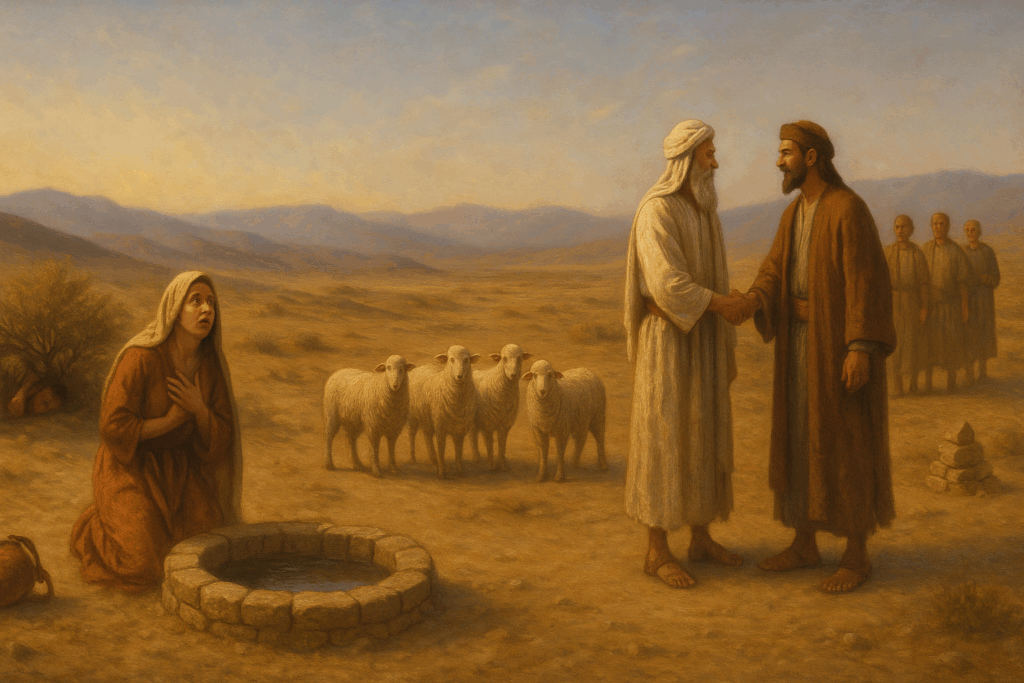
This essay examines two consecutive narratives from Parshat Vayeira, each featuring a well and each posing a distinct epistemological challenge. Hagar’s well (Genesis 21:19) exists physically but remains invisible to her until G-d opens her eyes—a problem of observation and the gap between existence and awareness. Abraham’s well (Genesis 21:25–31) is visible to all, but its provenance is disputed—a problem of testimony and historical proof.
These parallel stories reveal two fundamental modes of knowing: direct observation of present reality and inferential reconstruction of past events. The first requires perceptual access (instruments, theories, or divine intervention to overcome our cognitive limitations). The second requires persistent evidence and methods of inference, ultimately resting on trust—whether in physical traces, logical reasoning, or testimonial authority.
Both science and Torah recognize these dual challenges. Science extends observation through instruments and reconstructs history through evidence. The Torah appeals to divine knowledge as the ultimate guarantor when human knowledge reaches its limits, echoing Descartes’s argument that G-d grounds the reliability of our perceptions and Abraham’s oath that invokes G-d as witness to historical truth.
Introduction
The Torah speaks of two wells in consecutive narratives, each raising a profound epistemological question:
On Thursday, we read: Hagar and Ishmael are dying of thirst. A well of water exists nearby—physically real, filled with life-saving water. But Hagar cannot see it.
“G‑d opened her eyes and she saw a well of water” (Genesis 21:19)
G-d “opens her eyes” and suddenly the well becomes visible (Genesis 21:19). The well exists, but cannot be observed. The midrash thus states, “Rabbi Binyamin: ‘Everyone is presumed blind until the Holy One opens their eyes’.”[1]
Today, Friday’s reading: Abraham has dug a well, but Abimelech’s servants claim it is theirs. When Abraham confronts Abimelech, there is no dispute that the well exists—everyone can see it. The question is: who dug it? Who has the rightful claim? Abraham provides seven ewes as testimony (Genesis 21:25–31). The well exists and is observed, but who created it?
Two epistemological problems, back to back: How do we know something exists? — a problem of observation. How do we know something is true about it? — a problem of testimony and proof.
1. The First Problem: Existence Without Observation
Hagar’s well represents a fundamental challenge: reality that exists but cannot be perceived. This is not about the well being invisible to human senses—Hagar had normal vision. It is about the gap between existence and awareness.
In science, we face this constantly. Quarks exist, but we cannot observe them isolated, only in combination with other quarks (bound states) that make up a hadron particle (e.g., proton or neutron). Dark matter exists—we know from its gravitational effects—but direct detection remains elusive.
The solution in Hagar’s case is stark: someone else has to show you. G-d does not create the well or transport Hagar to it—He disrupts her perceptual blindness by “opening her eyes.” Sometimes knowledge requires intervention from outside our own limited framework.
In science, this is the role of new instruments, new theories, new questions. The Hubble Space Telescope did not create distant galaxies—it opened our eyes to what was always there.
In the famous “invisible gorilla” experiment, people counting basketball passes fail to see a gorilla walking through the scene.[2] Our attention filters reality so aggressively that we literally cannot see what is right in front of us when our focus is elsewhere. Hagar, desperate and focused on her dying son, could not see the well.
Modern neuroscience shows why we often “miss what’s there.” Inattentional blindness famously makes observers overlook a gorilla strolling through a scene; predictive-coding models add that perception is top‑down expectations corrected by bottom‑up error signals. Hagar’s “opened eyes” functions like an attention reset and model update.
The epistemological question, however, is much deeper. Skeptics like Gorgias, Pyrrho of Elis, David Hume, and Immanuel Kant raised doubts about the reliability of our senses. Rene Descartes, facing radical doubt, grounds trust in clear-and-distinct ideas in a non-deceptive G‑d (Meditations III–V). On that view, G-d is constantly “opening our eyes” so that we perceive what is out there. This rhymes with Hagar’s story.
2. The Second Problem: Attribution and Proof
Abraham’s well represents a different challenge: establishing the truth about origins. The well is visible to everyone. The dispute is historical: who made this?
This is the problem of provenance—tracing causation backward through time. Science grapples with this in:
- Cosmology: What caused the Big Bang? Where does dark energy come from?
- Archaeology: Who built this structure?
- Forensics: What sequence of events led to this evidence?
Unlike observation of present reality, establishing historical truth requires evidence that persists and methods of inference.
In science, we establish historical truth through:
- Physical traces: microwave background radiation, movement of stars and planets, fossils, geological layers, radioactive decay
- Logical inference: if the universe is expanding now, it must have been denser in the past
Consilience/retrodictive power: multiple independent lines (e.g., radiometric dates, stratigraphy, CMB features) that converge on the same past.
But here is the limitation: we cannot directly observe the past. We can only infer the past from its fingerprints left on the present.
We can only observe present evidence and infer backward. Abraham cannot make Abimelech see him digging the well in the past. He can only provide his testimony that makes his claim credible.
Avimelech asked Abraham, “What are these seven ewes that you have set aside by themselves?” He replied, “You are to accept these seven ewes from my hand as testimony that I dug this well.” (Genesis 21:29-30)
In modern epistemology, Coady argues that testimony is a basic source of knowledge, not a mere weak proxy.[3] Earlier, Reid grounded our default trust (the principle of credulity).[4] Halakhah anticipated this—raising evidentiary thresholds to curb abuse—a matter shall be established by two witnesses” (Deut. 19:15) and oath‑taking formalizes and binds speech.[5] This is social epistemology: communities certify past facts by norms of testimony.
Hagar’s crisis is perceptual, not ontological: the water is present, but she lacks acquaintance with it until her eyes are opened. Abraham’s issue is different—everyone can see the well—the challenge is the provenance. Bernard Russell would call this the gap between knowledge by acquaintance (direct awareness) and knowledge by description (knowing about something via words or inference).[6] Hagar’s well exemplifies the first; the Be’er Sheva oath, which attributes the well to Abraham, exemplifies the second.
3. Witnesses—Human and Divine
Not all evidence is carved in stone. Some events leave only mental impressions in the minds of those who witnessed them. The evidence is hidden in the witness’s memory, which is inaccessible to outsiders. In some instances, we rely on the testimony of two or more witnesses, who have to corroborate each other’s testimony, as required by the Torah in all capital cases (Deuteronomy 19:15). In other circumstances involving business dealings, we can rely on a shevuah—an oath. The Torah says:
Abimelech asked Abraham, “What are these seven ewes that you have set aside by themselves?” He replied, “You are to accept these seven ewes from my hand as testimony that I dug this well.” That place was therefore called Beersheva, for there the two of them made an oath. (Genesis 21:29-31)
Beersheba literally means “the well of seven.” Why did Abraham offer seven ewes to Abimelech? Because seven in Hebrew (sheva) also means an “oath.” Indeed, Be’er Sheva is often translated as the “Well of the Oath.”[7] Swearing an oath to G-d is bringing G-d as a witness. He was there—He is Omnipresent; He saw—He transcends time; He knows—He is Omniscient. Descartes appealed to G-d to convince himself of the truth of his sensory perceptions—G-d knows and He would not deceive me. Abraham appeals to G-d to convince Abimelech of the truth of the well’s provenance—G-d would not allow Abraham to deceive Abimelech—a clear parallel.
4. Two Kinds of Epistemological Humility
These consecutive passages teach us something profound about the limits of knowledge:
- From Hagar’s well: Just because you do not see something does not mean it does not exist. Reality may be richer than your current perception. Stay open to revelation.
- From Abraham’s well: Just because something exists does not mean its history is self-evident. Establishing truth about origins requires evidence, testimony, and sometimes an irreducible element of trust.
Science operates in this same dual space:
- Expanding observation to see what’s already there
- Building inference chains to understand what already happened
Both require humility. Both require recognizing that direct knowledge has limits—we need instruments to extend perception, and we need evidence to reconstruct history.
5. The Wells Are Still There
The beautiful thing is that both wells are real. Hagar’s well contained actual water. Abraham’s well required actual digging. The epistemological challenges do not undermine the ontological reality.
Truth exists. Our access to it is the challenge.
Sometimes we need our eyes opened to see what is present. Sometimes we need evidence to establish what has happened in the past.
Both are necessary. Both are different. By placing these stories back-to-back, the Torah appears to be teaching us that knowing is not a single thing, but rather many things.
Conclusion
Genesis 21 teaches that knowing is not a single faculty but a duet. Present‑tense acquaintance must be cultivated through attention and openness, while past‑tense attribution must be adjudicated through evidence, witnesses, and responsibly bound speech. Modern science mirrors both: we expand perception with better models and sensors; we secure history with converging lines of proof. Together, the two wells keep us honest: open to revelation, and disciplined about justification.
The Torah’s juxtaposition of these two wells is no accident. Together, they map the complete territory of human knowledge and its limitations. We struggle to see what is present; we struggle to prove what is past. Both struggles are irreducible features of finite minds attempting to grasp reality.
Yet the stories offer hope alongside humility. Hagar’s eyes can be opened. Abraham’s testimony can be trusted. Knowledge is possible—but never complete, never unmediated, never certain in the way we might wish.
The epistemological lesson resonates across millennia: Stay humble about what you think you know. Stay open to having your eyes opened. Stay willing to trust when inference reaches its limits. The wells are real—but accessing their reality requires both revelation and faith.
[1] Bereishit Rabbah 53, critical ed. Julius Theodor and Chanoch Albeck (Jerusalem: Wahrmann Books, 1965).
[2] Simons, D. J., & Chabris, C. F. (1999). Gorillas in our midst: Sustained inattentional blindness for dynamic events. Perception, 28(9), 1059–1074. https://doi.org/10.1068/p281059.
[3] C. A. J. Coady, Testimony: A Philosophical Study (Oxford: Clarendon Press, 1992). Coady defends non-reductionism: testimony is not a second-class, derivative source that must always be reduced to perception, memory, or inference. In ordinary life and science, we are epistemically entitled to accept others’ say-so absent specific defeaters (contradictions, motives to lie, etc.). Social knowledge flows through trustworthy institutions and practices. Abraham’s claim, “I dug this well,” is about a past event no one can presently inspect. On Coady’s view, such claims are not inherently inferior; they are legitimate knowledge via testimony, provided we manage risks with good norms.
[4] Thomas Reid, Essays on the Intellectual Powers of Man (ed. Derek R. Brookes; University Park, PA: Pennsylvania State University Press, 2002). Reid argues that human communication rests on two built-in dispositions: a principle of veracity (speakers generally tell the truth) and a principle of credulity (hearers are disposed to believe others). Without these, language and society would collapse. We start with default trust, then defeat it when we have reasons. Abimelech is not irrational no to take Abraham at his word; baseline trust is rational. But because his servants had seized the well, the situation has defeaters (conflict of interest). So, Abraham escalates from mere assertion to a publicly binding procedure.
[5] Maimonides, Mishneh Torah, Hilchot Edut 1:1 and Hilchot Shevuot 1.
[6] Bertrand Russell, “Knowledge by Acquaintance and Knowledge by Description,” Proceedings of the Aristotelian Society 11 (1910–11): 108–128.
[7] See Rashi to Genesis 21:28, 31 on the seven ewes and the oath that give the name Be’er Sheva both senses—”well of seven” and “well of the oath.”


This is a great eye opener so to speak, thank you!