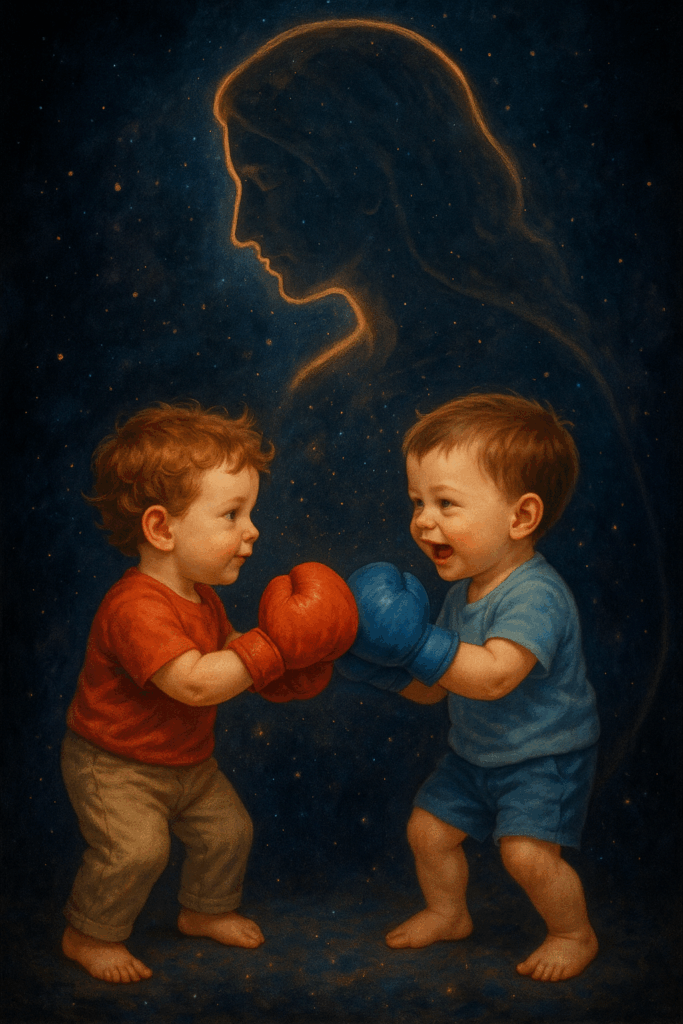
In the first aliyah of the Torah portion Toldot, the Torah turns inward: before Jacob and Esau become nations, they are in conflict within one body.
Rivkah’s pregnancy is mysterious and painful: “The children struggled within her.” (Genesis 25:22)
Later Chassidic teaching reads this as an inner map of the soul. The Degel Machaneh Ephraim explains that “the Torah hints here at a great ethical lesson: there are two inclinations in a person, the good inclination and the evil inclination; this was the very purpose of creating man with two inclinations.”[1]
Chabad teachings deepen this reading: Isaac’s “offspring” represent two legitimate modes of avodah (divine service). Jacob embodies the ish tam yoshev ohalim—the pure, consistent tzaddik dwelling in tents of study. Esau was meant to embody the fierce work of “conquering the inclination,” transforming raw physicality into holiness. Only because he chose badly did that potential collapse into corruption.[2]
One Genome, Two Lives
Jacob and Esau begin as twins (Bereshit 25:24), sharing the same parental source. Spiritually, they represent radically different expressions of that source.[3] Biologically, this mirrors what we observe in identical-twin studies: twins share nearly identical DNA, yet over time, their epigenetic patterns—methylation marks, histone modifications, and gene expression profiles—diverge, sometimes dramatically, leading to different traits, disease susceptibilities, and even personalities.[4]
In other words: one script, two performances. Our Rabbis taught:
There are three partners in a person: the Holy One, blessed be He, his father and his mother… and the Holy One.[5]
Parents give the child his body, but the soul comes from G‑d. Identical twins may have genetically identical bodies, but they always have different souls. So too with Esau and Jacob—one (genetically) body, different souls. Modern biology says: one genome, divergent epigenomes. And, perhaps: one neural substrate, two competing attractor landscapes shaped by different souls.
Two Neural Attractors in One Brain
The prophecy to Rivkah continues:
One nation will grow stronger than the other. (Genesis 25:23)
When one rises, the other falls. This is precisely how computational neuroscience models internal conflict: competing neural populations in an attractor network inhibit each other through lateral inhibition until one pattern “wins” and becomes the system’s stable state.[6]
At any moment, your cortex can settle into a “Jacob state” (truth-seeking, long-term planning, disciplined choice) or an “Esau state” (impulse-driven, immediate gratification, red lentil stew now). The structure of the network—which synapses are strengthened through past experience and habit—determines which attractor basin is deeper and more easily accessible.
Seen this way, “the children struggled within her” becomes a pre-fMRI description of winner-take-all neural dynamics. The Torah’s language, “one shall be stronger than the other,” perfectly captures the mathematics of anti-correlated neural populations: as one network’s activity increases, inhibitory feedback suppresses the other.[7]
Rewiring the Inner Landscape
The first aliyah of Toldot is not merely about two ancient brothers—it is a diagnostic scan of our own inner architecture. But can we retrain our neural networks, reshaping the landscape so that the Jacob-attractor becomes deeper and more stable than the Esau-attractor?
The answer lies in the combination of neuroplasticity and spiritual practice. Choose one behavior where you feel that inner struggle—between comfort and calling, between stew and birthright. Implement one concrete practice: a fixed time for Torah learning, a moment of mindful pause before reacting, a brief prayer when temptation arises. Each repetition strengthens specific synaptic pathways, gradually deepening the Jacob-attractor basin.
While we cannot change the soul we were given—our unique divine imprint—we can shape how that soul expresses itself through the biological substrate we inherited. Over time, the Torah teaches us, we can epigenetically, neurally, and spiritually reweight the system. This is our sacred work: to ensure that our Jacob-nature, our divine portion, guides the neural and epigenetic machinery we share with Esau. The prophecy “the elder shall serve the younger” then becomes prescriptive rather than merely descriptive—our ancient, primal impulses can indeed become servants to our higher, truer self.
[1] R. Moshe Chaim Ephraim, grandson of the Baal Shem Tov.
[2] Rabbi Schneerson, M. M. Likkutei Sichot, vol. 20, on Toldot.
[3] See Bereshit Rabbah 63:8
[4] Fraga MF, Ballestar E, Paz MF, Ropero S, Setien F, Ballestar ML, Heine-Suñer D, Cigudosa JC, Urioste M, Benitez J, Boix-Chornet M, Sanchez-Aguilera A, Ling C, Carlsson E, Poulsen P, Vaag A, Stephan Z, Spector TD, Wu YZ, Plass C, Esteller M. Epigenetic differences arise during the lifetime of monozygotic twins. Proc Natl Acad Sci U S A. 2005 Jul 26;102(30):10604-9. doi: 10.1073/pnas.0500398102. Epub 2005 Jul 11. PMID: 16009939; PMCID: PMC1174919.
[5] Talmud Bavli, Niddah 31a; cf. Kiddushin 30b. See also, Torah Temimah to Ecclesiastes 12:1, §2 and R. David of Lelov, Rosh David, Kedoshim §5.
[6] Rolls, Edmund T. (2010) “Attractor networks,” WIREs Cogn Sci, 1, pp. 119–134.
[7] Ye L. and Li C. (2021) Quantifying the Landscape of Decision Making From Spiking Neural Networks. Front. Comput. Neurosci. 15:740601. doi: 10.3389/fncom.2021.740601


