לע”נ אמי מורתי רחל ב”ר דוד ע”ה
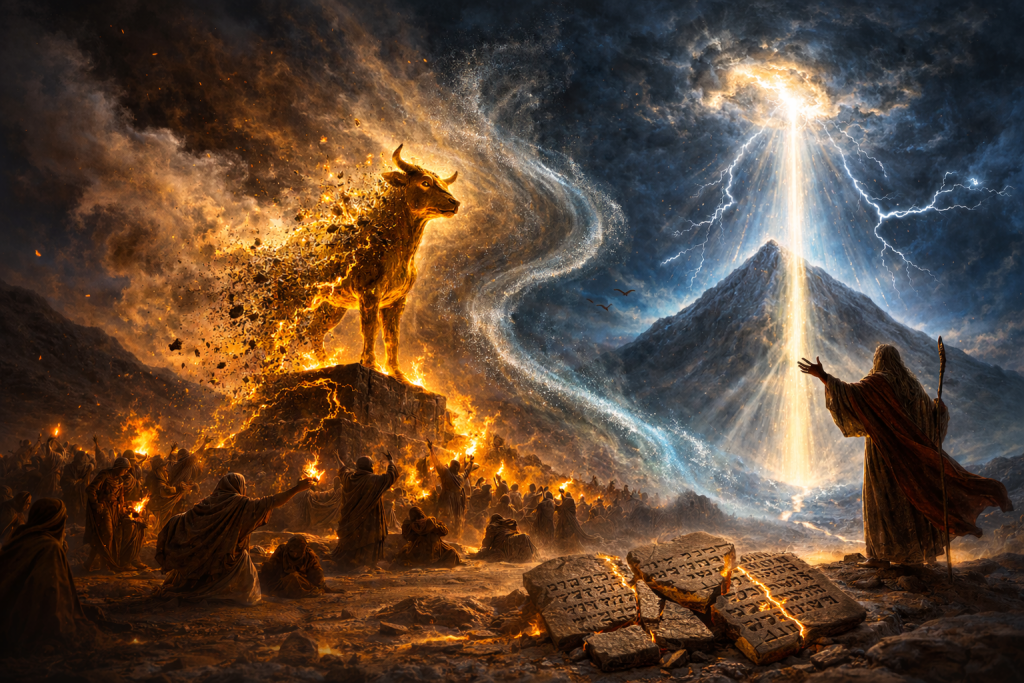
The sin of the Golden Calf is among the most bewildering episodes in the Torah. A people who had witnessed the Ten Plagues, crossed the Sea of Reeds, and stood at Sinai collapse into idolatry within forty days. Conventional explanations—fear, impatience, the corrupting influence of the erev rav—are true as far as they go, but do not reach the structural root. This essay proposes a deeper explanation drawn from physics: hysteresis. A hysteretic system retains the memory of its prior states; its present condition is shaped not only by current forces but by its entire history. The Israelites had left Egypt physically, but Egypt had not yet left them inwardly. The Golden Calf was not a sudden rupture or a random apostasy—it was the remanence of an Egyptian consciousness still deeply embedded within a people caught in mid-transition. The essay traces this reading through the psychology of slavery, the significance of the calf’s timing, Moses’ shattering of the Tablets, and the spiritual function of the wilderness years, arguing that liberation becomes complete only when inner structure, and not merely outer circumstance, has been transformed.
Introduction
The episode of the Golden Calf has always seemed almost impossible to understand. How could a people who had just witnessed the Ten Plagues, crossed the Sea, and stood at Sinai, fall so quickly into idolatry? How could those who had heard the divine voice now dance before a molten image of a golden calf? The usual answers are familiar enough: fear, confusion, impatience, a failure of faith, erev rav (the mixed multitude who accompanied Israel out of Egypt, whose attachment to monotheism remained shallow). Yet those explanations, while true as far as they go, do not fully capture the deeper structure of the event. The sin of the Golden Calf was not simply a sudden lapse or an inexplicable collapse. It was the lingering aftereffect of Egypt. It was hysteresis.
Hysteresis is a concept from physics, but it also names something profoundly human. It describes a system whose present state depends not only on what is happening to it now, but also on what has happened to it before. A system retains memory. It carries residue. It does not instantly become new simply because external conditions have changed. That, I believe, is the key to understanding the Golden Calf. The Israelites had indeed left Egypt, but Egypt had not fully left them. The calf was not merely an act of idolatry. It was the persistence of an older internal structure within a people already on their way to becoming something new.
1. What Hysteresis Means
In my recent essay, “Exodus as a First-Order Phase Transition,” I discussed hysteresis and its manifestation during Exodus in depth. As a quick refresher, in physics, hysteresis refers to path-dependence. A magnet, for example, may remain magnetized even after the external field that aligned it has been removed. The system does not simply snap back to neutrality once the force disappears. It retains an imprint of its past. Its current condition is shaped by its history.
The parallel is compelling because both Scripture and physics here describe the same formal pattern: a system can undergo a dramatic external transition while still retaining the internal memory—remanence—of its prior state. In that sense, hysteresis is not merely a metaphor pasted onto the Golden Calf; it is a concept that clarifies the narrative’s inner logic.
This idea translates readily beyond physics. We see it in human life all the time. A person who has lived through trauma does not immediately become inwardly calm once danger has passed. A nation that has lived under tyranny does not instantly become inwardly free the day its chains are broken. The external situation may change quickly; the inner structure changes more slowly. Memory, habit, fear, and reflex remain. The past continues to exert force long after its outward institutions have been dismantled.
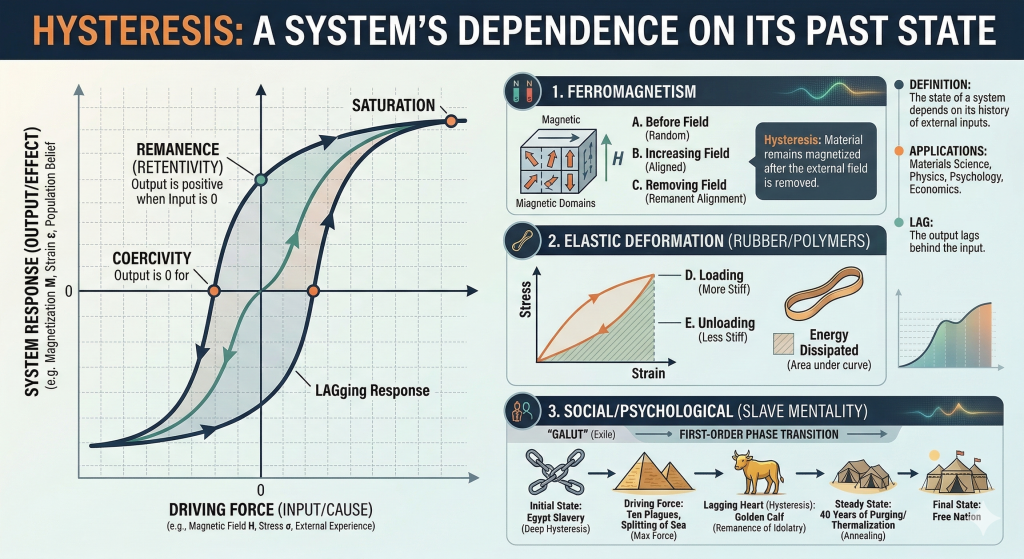
That is why hysteresis is such a powerful lens for reading the Golden Calf. It allows us to see that the problem was not merely what the Israelites believed in that moment, but what still lived within them from the world they had only recently left behind.
2. Egypt as a Residual Internal State
The Israelites had been enslaved in Egypt for generations. Their bondage was not only economic or political. It was psychological, spiritual, and civilizational. They lived inside a culture saturated with visible gods, ritual images, and structures of domination. Egypt was not merely the place where they worked. It was the environment that shaped their instincts, their expectations, and their emotional reflexes.
Slavery leaves marks deeper than bruises. It trains people to depend on external power, to fear uncertainty, to seek security in what is tangible and immediate. It narrows the imagination. It makes freedom difficult not only to attain but to conceive. Even after the miracles of redemption, such habits would not have disappeared overnight. The people could walk out of Egypt physically while still carrying Egypt inwardly.
This is the central point. The Golden Calf was not a sudden invention of evil. It was not a bizarre departure from everything the people had just experienced. It was the resurfacing of an older pattern under stress. The Exodus had begun to transform them, but the transformation was incomplete. The old phase had not fully released its hold.
3. The Golden Calf as the Return of the Familiar
This is why the calf becomes more intelligible when viewed through the lens of hysteresis. The Israelites had undergone an extraordinary upheaval, but no deep transition is ever instantaneous. In physics, a first-order phase transition is not a smooth, effortless drift from one state to another. It involves barriers, discontinuities, and latent resistance. The old phase lingers. The new phase emerges, but it does not immediately permeate the whole system. There is a lag.
So too here. The Israelites had experienced the strongest imaginable external field: the plagues, the splitting of the sea, and the revelation at Sinai. If overwhelming experiences alone could permanently transform a people, this should have been enough. But experience, even miraculous experience, does not automatically undo long formation. The people had been thrust into a new reality before they had fully learned how to inhabit it.
When Moses disappears from view on the mountain, the old reflex returns. The people do not merely feel anxious; they demand something visible. “Make us a god who shall go before us.” That request is theologically disastrous, but psychologically revealing. They cannot bear the absence of the mediator. They cannot tolerate delay, invisibility, or uncertainty. Under pressure, they reach for what they know: an image, an object, something shaped by human hands and available to the senses.
That is precisely the hysteresis loop of the soul. The system has been pushed toward a new state, but when strain arises, it curves backward toward its earlier equilibrium. The Golden Calf is not simply rebellion. It is regression toward the familiar.
4. Why the Calf Appears at the Moment of Delay
The timing of the episode is crucial. The rebellion erupts not in the immediate wake of the revelation at Sinai, but at the first moment of apparent delay. Moses is gone for forty days. The people are left waiting, and waiting proves unbearable. This is highly significant. Hysteresis often reveals itself not when force is being applied most strongly, but when the system is left to itself, and old alignments begin to reassert themselves.
At Sinai, the people had encountered transcendence of an order entirely foreign to their prior experience. But transcendence is difficult to endure. The G‑d of Israel cannot be seen, contained, or manipulated. He does not fit the religious habits formed in Egypt. He cannot be reduced to a stable visual representation. That very invisibility is essential to biblical faith, but it is also deeply unsettling to those accustomed to tangible cultic forms.
The absence of Moses thus becomes the trigger that exposes the incompleteness of the people’s transformation. They panic because they are not yet capable of dwelling faithfully within uncertainty. They still require what Egypt taught them to require: immediacy, visibility, control. Their sin, then, is not only that they choose wrongly, but that their imagination of the divine is still being shaped by the world from which they were redeemed.
5. The Calf as Remanence
One might say that the Golden Calf was the remanent magnetization of Egypt. In physics, remanence is what remains in a material after an external field is removed. The system has been affected, but it has not returned to a neutral blankness. Something of the prior shaping remains behind.
The calf is exactly such a remainder. What emerges at the foot of Sinai is not a wholly new religious impulse, but the return of an inherited symbolic world. The people do not invent a radically original form of rebellion. They reach backward, toward the familiar patterns of pagan image worship and visible mediation that had long surrounded them. What looks like sudden apostasy is actually the reappearance of a deeply embedded structure.
The Egyptians venerated Apis, the sacred bull. Significantly, Apis was a mature bull, not a calf. The Israelites’ choice of a calf (עֶגל, ‘egel) may carry its own symbolic weight: it is a diminished, immature version of the Egyptian archetype, as if the Egyptian imprint within them produces not a full restoration of pagan religion but a degraded, half-formed echo of it—what re-emerges under stress is not Egypt itself but Egypt’s ghost.
This is what makes the episode so tragic. The people are not fully Egypt anymore, but they are not yet fully Sinai either. They are suspended between worlds. They have broken with the old order outwardly, but inwardly they still carry its residues. In the language of physics, this is a metastable condition: not truly stable, yet persisting for a time because the transition has not been completed.
Can you blame people who spent generations in slavery and don’t yet know how to be free? Can you blame people who spent generations worshiping idols with their Egyptian masters and don’t yet know how to relate to the abstract, invisible G‑d, all the miracles notwithstanding? Can you blame people who spent over two hundred years in Egypt, and, when Moses disappears, and they no longer know the way to the promised land, want to go back to Egypt, their familiar home for generations? It seems to me that Moses understood that. As much as he was angry with the people who worshiped the Golden Calf, he was taken aback by the anger of the Almighty. His response to G‑d was firm and audacious:
“Now, if You will forgive their sin [well and good]; but if not, erase me from the Book which You have written.” (Exodus 32:32)
Here is leadership of the highest order: Moses confronts the Almighty on behalf of his people, staking his own life and legacy in their defense.
6. Moses and the Breaking of the Tablets
This reading also sheds light on one of the most shocking acts in the Torah: Moses breaking the Tablets. At first glance, the act appears to be one of sheer anger. But this cannot be the case. Could Moses break the Tablets of Law—the work of G-d—merely out of anger? Can we imagine an act more disrespectful and sacrilegious than that? No, at a deeper level, it is something more profound. Moses sees that the people are in danger of receiving the covenant while still locked in a distorted internal state, stuck in the pagan Egyptian mentality. The new form is about to be joined to an old consciousness. That cannot be allowed to stand.
The breaking of the tablets is thus not merely an outburst. It is an interruption of a failed transition. Moses refuses to let the covenant become anchored in a compromised form. Better to shatter the tablets than to let Torah descend intact into a people dancing around a calf. Better to break the first form than to permit a permanent fusion of revelation and idolatry.
There is something almost surgical about this act. In the physical world, a process that is cooling or hardening improperly may need to be interrupted before defects become fixed in place. Moses does something analogous here. He destroys in order to preserve. He breaks in order to prevent a deeper corruption. He increases entropy to prevent the system from settling into a false attractor. The shattered tablets mark the recognition that the people are not yet ready to receive the covenant in its original form.[1]
7. Moses as the One Outside the Hysteresis Loop
This perspective also highlights Moses’ unique role. He is not only a prophet, lawgiver, and intercessor. He is the one capable of leading a people through transition precisely because he stands, in a crucial sense, outside the full hysteresis loop that binds them. He was raised in Pharaoh’s palace as a free man—indeed, as a prince. He was not inwardly formed by slavery in the same way as the Israelites. He knew exile, danger, and estrangement, but he did not internalize bondage as the people did. Perhaps this is one reason why, seeing an Egyptian striking a Jewish man, Moses kills him immediately. He would not stand by an act of cruelty and injustice while the rest of the Israelites had long grown accustomed to it.
As an aside, the Levites offer a compelling corroborating case worth considering. They are conspicuously absent from the sin—indeed, it is the Levites who answer Moses’ call and carry out the punishment (Exodus 32:26–28). From a hysteresis perspective, this is striking: these are apparently the same people, subject to the same Egyptian enslavement, yet they respond differently to the same trigger. But they are not. The Levites, as a priestly tribe, have had a different history of living in Egypt that altered their hysteretic state. First, they were never enslaved and remained free throughout their stay in Egypt.[2] Second, they did not adopt the Egyptian idolatry and remained faithful to the tradition of Abraham, Isaac, and Jacob.[3] Because they were never “compressed” into slavery, they had no “memory” of the slave-state to revert to. The lack of remanence is critical to avoiding hysteresis. Their resistance to regression corroborates the thesis from the other direction: where internal formation differs, so does the response under stress. When the rest of the nation entered a metastable state (the Golden Calf), the Levites acted as the structural backbone that didn’t buckle. They were the “lattice” that remained rigid as the rest of the material melted. It is no coincidence that Moses used the Levites to purge the idolaters (Exodus 32:27-28). In a phase transition, the “stable” portion of the material is used to realign or remove the “corrupted” domains.
Returning to Moses: as a free man, he can imagine freedom with a clarity the Israelites do not yet possess. He can sustain his relation to the invisible G‑d in a way they still struggle to do. He can endure delay, ambiguity, and transcendence. For that very reason, he becomes the indispensable mediator of a nation not yet able to sustain the transition on its own.
Yet Moses does not stand above the people in cold detachment. His greatness lies precisely in his complete and unbreakable unity with them. After the sin of the calf, he says in effect that if they cannot be forgiven, he too should be erased. He binds himself utterly to their fate. In that sense, he becomes the nucleation point of the nation: the site around which transformation can continue despite failure. He does not abandon the people because they lag behind. He carries them through the lag.
8. The Wilderness as the Slow Completion of Liberation
Seen in this light, the years in the wilderness become more comprehensible. They are not merely punishment. They are the time required for the deeper work of transformation. The Exodus from Egypt was swift; the Exodus from the Egyptian consciousness was slow. The first could happen in a night. The second required a generation.
This is one of the Torah’s most searching truths. Political liberation can be sudden. Spiritual liberation is usually gradual. It requires repetition, discipline, memory, law, failure, repentance, and renewed formation. A people long trained in servitude cannot be remade all at once, even by miracle. The desert becomes the space in which old patterns weaken, and the new identity slowly stabilizes.
The generation that left Egypt had seen wonders, but it still carried Egypt in its marrow. The wilderness was therefore not only a road to the Land. It was a furnace of re-formation, the long interval in which the new generation of a slave people could begin to become a covenantal people.
Conclusion
The Golden Calf is, of course, a theological and moral catastrophe. It is about betrayal, covenant, judgment, mercy, and the perennial temptation to reduce the Infinite to something visible and manageable. This episode has always struck me as one of the best proofs that Torah was authored by G‑d. People tend to glorify their past. We can’t find any historical evidence in Egyptian papyri or on the walls of their temples and monuments: the Egyptians never recorded military defeats, only victories. What human author would write—and what leader would allow—such an utterly embarrassing episode of his own people betraying their Creator? But the concept of hysteresis helps explain why this catastrophe occurred precisely when it did, and why it should not be read as a random interruption in the drama of redemption.
The calf was the residue of Egypt. It was the old phase persisting within a people already called into a new one. It revealed that liberation is not complete when chains are broken, nor even when revelation is given. Liberation is complete only when the inner structure of the soul has been transformed enough to bear freedom without fleeing back toward bondage in disguised form.
That is why this story remains enduringly relevant. Every liberation carries this danger. A person may leave behind oppression and yet continue to think like a captive. A nation may gain freedom and yet remain inwardly shaped by the fears and reflexes of exile. The old order lingers. Nostalgic memories beckon.
If only we had died by the hand of the Lord in the land of Egypt, when we sat by the fleshpots and ate our fill of bread. (Exodus 16:3)We remember the fish that we used to eat free in Egypt, the cucumbers, the melons, the leeks, the onions, and the garlic. (Numbers 11:5)
It offers familiar securities just when the demands of freedom become most difficult.
The Golden Calf, then, is not only about idolatry. It is about the lag between revelation and readiness, between redemption and internal change, between what G‑d has done in history and what the human heart has not yet learned to sustain. It is about hysteresis, the memory of slavery within the newly freed soul.
And yet the story is not one of despair. The tablets can be broken, and the covenant can still be renewed. Egypt can remain in the heart, and the heart can still be remade. The very fact that hysteresis exists means that transformation is not instantaneous. But it does not mean transformation is impossible. It only means that redemption, if it is to become complete, must reach deeper than the event. It must reach into memory, habit, desire, and fear, until freedom is no longer merely an external condition, but an inwardly stable form of life.
Endnotes:
[1] The first Tablets are broken; G‑d then commands Moses to hew a second set—but this time Moses cuts the stone himself, while G‑d inscribes them (Exodus 34:1–4). This difference is theologically significant and maps beautifully onto the hysteresis framework: the covenant is re-established, but on revised terms that take into account the people’s demonstrated limitations. The path back to covenant is not the same as the original path to it—which is precisely what hysteresis predicts. The return loop is never identical to the outward journey. This also connects to the concept of teshuvah: the repentant path is structurally distinct from the path of original righteousness, yet it reaches the same destination.
[2] The idea that the Tribe of Levi was exempt from the Sivlot Mitzrayim (the burdens of Egypt) is a standard element of Jewish tradition, explaining why they had the “energy” to remain the spiritual leadership.
- Midrash Tanchuma, Va’era 6: This source explains that Pharaoh, in his “wisdom,” did not want to interfere with the priestly class. Since the Levites were considered the “scholars” or “priests” of the Israelites, they were exempt from the corvée labor.
- Exodus Rabbah 5:16: When Moses and Aaron first approach Pharaoh, they are not working in the pits. The Midrash explains that the tribe of Levi was “free from labor.”
- Talmud, Tractate Sotah 11b: Discusses how the labor began with “soft words” and voluntary participation. The Levites, sensing the trap or being dedicated to study, never volunteered, and thus Pharaoh never legally gained “ownership” over their labor.
[3] While the general population was heavily influenced by Egyptian polytheism, the Levites are traditionally understood to have maintained their ancestral traditions.
- Sifrei Devarim 354: This Midrash explicitly states that while the Israelites in Egypt neglected the covenant of circumcision and turned to idols, the Tribe of Levi remained faithful to the “Covenant of the Fathers.”
- Maimonides (Rambam), Mishneh Torah, Laws of Idol Worship 1:3: “The root that Abraham had planted was becoming uprooted… but because of G-d’s love for us… He established the Tribe of Levi as the teachers of the way of G-d… and they never served idols.”
- Rashi on Exodus 32:26: When Moses calls out, “Whoever is for the Lord, come to me!” and all the Levites gather, Rashi notes that this was because none of them had participated in the worship of the Golden Calf, continuing their history of monotheistic fidelity from Egypt.


