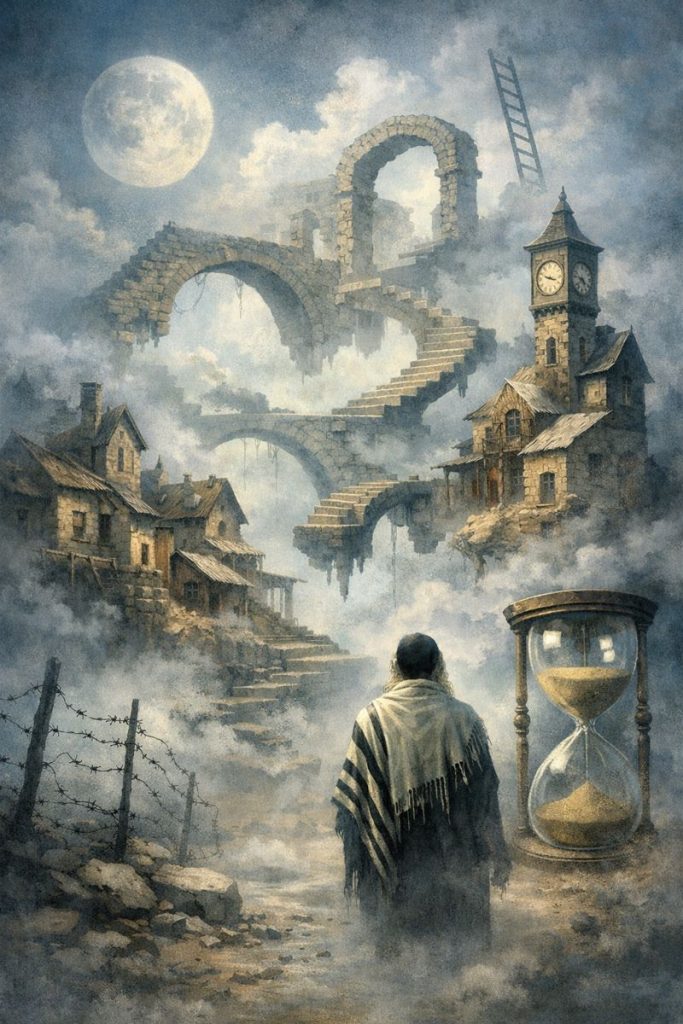
When the Lord restored the fortunes of Zion, we were like dreamers.” (Psalms 126:1)
Abstract
This essay reads Exile (Galut) as a dream-state: a mode of consciousness in which meaning blurs, contradictions coexist, and reality can feel fragmented. Drawing on Jewish sources and a Chabad framing of “awakening to redemption from the dream of Galut,” this essay argues that Redemption (Geulah) is not merely a change in external circumstances but a phase transition in perception itself. It then introduces two timelines of redemption—be’itah (“in its time”) and aḥishenah (“I will hasten it”)—as two ways in which awakening can arrive: a second-order phase transition marked by gradual clarification, or a first-order phase transition marked by sudden discontinuity. The goal is not prediction, but transition: to learn how to live so that the dream thins and waking becomes possible.
Introduction
In my recent essay “G‑d Who Dreams: Creation, Companionship, and the Entropic Imagination,”[1] I explored the classical metaphor of creation as a divine dream. In the subsequent essay, “Phase Transitions I: Sleep Architecture of Joseph’s Dreams,”[2] I proposed a correspondence between the architecture of sleep and Joseph’s life. Unlike the previous essay, which focused on Joseph’s individual dreams, this essay examines humanity’s collective dream as a metaphor for the Galut mentality.
1. Exile as a Dream
Classical Jewish sources, including the Talmud,[3] Midrash,[4] biblical commentators,[5] Kabbalah,[6] and Ḥasidut,[7] all portray Exile (Galut) as a dream. Not the creative, lucid dream that G-d “dreams” in sustaining the worlds, but a confusing and paralyzing dream that scrambles our senses, distorts our priorities, and blurs our very identities. In the dream of Galut, falsehood can masquerade as truth, trivialities can feel urgent, and the presence of the Dreamer can seem absent or implausible. The Redemption (Geulah) is thus not only a change in history but a change in consciousness: a collective awakening from the dream of Exile, in which the illusions of separation, meaninglessness, and randomness lose their grip.
Seen through the lens of the previous essays in this series, these two dreams are nested. On the most encompassing level, creation is G-d’s dream to allow for free will and genuine relationship. Within that dream, however, we can fall asleep ourselves. We can become trapped in the secondary dream of Exile, mistaking the physical shell for the whole of reality, reading chaos as proof of abandonment rather than as material for rectification—tikkun. Redemption is not an escape from G-d’s dream, but an awakening within it: a shift from being lost inside our own Exile-dream to recognizing that we are already held inside a larger, divine imagination.
In Chabad terms, to awaken within the dream is to make a dwelling place for G-d in the lowest worlds (dira betaḥtonim), revealing the divine Dreamer in this material world. When we use the “noise” of this world—the randomness,1 the surprises, even the fractures—to uncover sparks of Tohu (the shattered primordial vessels in the universe of Chaos) and elevate them to their source, we begin to align our small, confused dreams with the cosmic dream of creation. Perhaps the purpose of life is not to wake up from G-d’s dream, but to stop sleepwalking through the spiritual Exile, to open our eyes inside the divine imagination.
Psalms (Tehillim) describes redemption in the language of dreams: “When the Lord restored the fortunes of Zion, we were like dreamers.” The experience of Galut is not only suffering; it is unreality—the sense that the world is out of joint, that events follow dream-logic: distortions, sudden reversals, missing causes.
In this register, Redemption (Geulah) is not merely political liberation. It is waking: reintegration of meaning, the end of disorientation, the return of reality’s coherence.
2. Two Tempos of Redemption
The prophet says, “I, the Lord, in its time I will hasten it.” (Isaiah 60:22) Talmudic Sages read this as two possible timelines for the arrival of redemption. The Talmud resolves the tension: if we merit, redemption comes suddenly—aḥishenah (“I will hasten it”); if we do not merit, it arrives at the destined time—be’itah (“in its time”).[8]
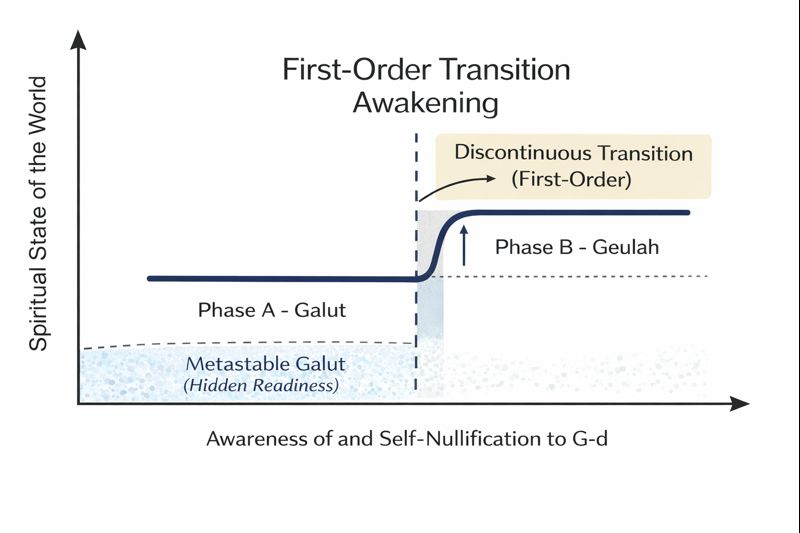
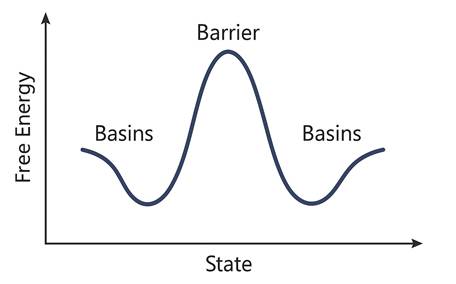
Here, the language of phase transitions becomes more than metaphor. It becomes a model: Aḥishenah as a first-order phase transition to redemption: the switch flips.[9] The system jumps basins.[10] What was stable becomes impossible, and what seemed impossible becomes the new normal.
Be’itah, as a second-order phase transition to redemption, is a gradual approach to criticality. The system is slowly driven toward a point where the old phase can no longer persist.[11] As the critical point nears, instability grows—fluctuations, polarization, confusion, dream-logic intensifying as the old order loses its grip.
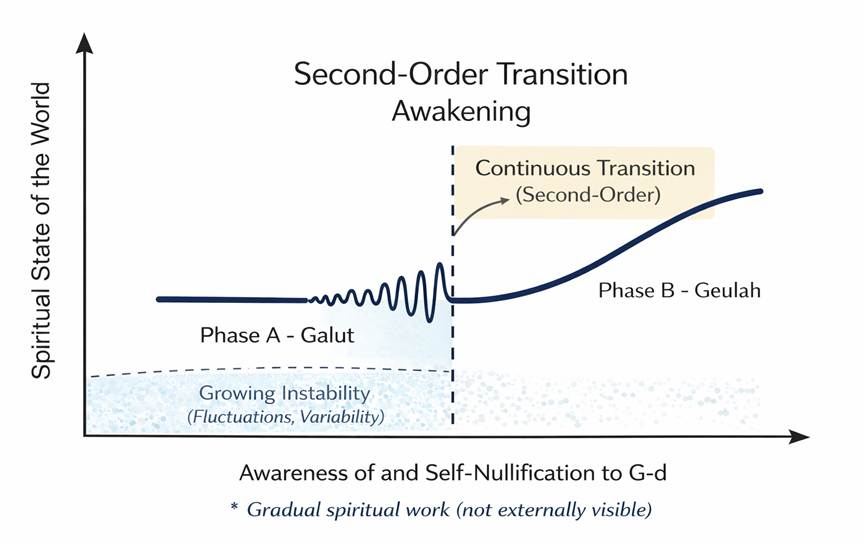
Instability near the end does not always mean the system is failing. Sometimes it means the system is approaching a threshold. Instability emerges as the main sign of approaching the redemption point (Geulah be’itah). Perhaps this is why some of the sages of the Talmud declared: Let the Messiah come—but let me not see him in my lifetime![12]
Conclusion
Exile is not only where we are; it is also how we see. To awaken is to recover coherence: to notice the hidden unity beneath the dream’s discontinuities and to act as if reality is already revealing truth. Whether redemption arrives in its time or is hastened, the inner work is the same: to become less scattered, more aligned, and more faithful to what is real. When a dream begins to repeat itself and lose its grip, it may not be the morning yet, but the first light has already entered the room.
If Exile is a dream within a dream, then redemption may be understood as a phase transition not out of divine dream, but into deeper alignment with it, so that our world becomes the dwelling place for G‑d (dirah betaḥtonim).
As we shall explore, with G‑d’s help, in subsequent installments of this series, the instability we witness today—the hallmark of a second-order phase transition—may indicate that Geulah be’itah (“redemption in its time”) is near. However, we do not wish merely to wait. We want to hasten it, to merit the sudden clarity of a first-order transition—Geulah aḥishenah (hastened Geulah). May it come immediately!
[1] A. Poltorak, “G‑d Who Dreams: Creation, Companionship, and the Entropic Imagination,” QuantumTorah.com, Dec. 5, 2025 (https://quantumtorah.com/g-d-who-dreams-creation-companionship-and-the-entropic-imagination/)
[2] A. Poltorak, “Phase Transitions I: Sleep Architecture of Joseph’s Dreams,” QuantumTorah.com, Dec. 17, 2025 (https://quantumtorah.com/phase-transitions-i-sleep-architecture-of-josephs-dreams/)
[3] Talmud, Taanit 23a; Berakhot 31a (see commentary of R. Steinsaltz).
[4] Midrash Tehillim (Shocher Tov) to Tehillim 126:1; Midrash Rabbah on Shir Ha-Shirim 5:2; Midrash Zuta (Buber), Shir ha-Shirim 5:2.
[5] Meiri and Radak on Tehillim 126:1.
[6] Zohar III, 95a on Shir Ha-Shirim 5:2; on Tehillim 126; Tikkunei Zohar 17b (Tikkun 10); Eitz Ḥayim and Pri Eitz Ḥayim.
[7] Torah Ohr, Vayeshev; Sefat Emet (Vayetzei, esp. 5643).
[8] Talmud, Sanhedrin 98a.
[9] A first‑order transition is a type of change in a physical system where one state abruptly switches to another as a controlling parameter—such as temperature or pressure—crosses a critical point. Unlike gradual changes, this transition occurs suddenly, with the material’s properties (e.g., density or structure) changing abruptly from one set of values to another rather than varying smoothly. This sharp discontinuity is what makes first‑order transitions striking and easy to distinguish from more continuous, second‑order transitions.
[10] In the context of phase transitions, basins refer to regions of stability in a system’s free-energy landscape. Imagine the energy landscape as a surface with valleys and hills: each basin is a valley where the system tends to settle because it represents a local minimum of free energy. Each basin corresponds to a distinct phase (e.g., solid, liquid, gas). When external conditions, such as temperature or pressure, change, the system may gain sufficient energy to climb out of one basin and fall into another, leading to a phase transition. This concept explains phenomena such as metastability, in which a system remains trapped in a shallow basin even though a deeper basin (a more stable phase) exists.
[11] A second‑order phase transition is a transformation in which a system changes from one phase to another continuously, without any abrupt jump in its primary properties. Unlike first‑order transitions, there is no sudden switch; instead, quantities like density or magnetization vary smoothly across the transition point. What makes it distinctive is that, although the phase change appears gradual, certain response functions—such as heat capacity or magnetic susceptibility—often diverge or exhibit sharp anomalies, reflecting a deep restructuring of the system at the microscopic level. These transitions are associated with the emergence of long‑range correlations and critical phenomena, making them central to modern physics.
[12] Ulla and Rabba said this; see Sanhedrin 98b, and Rabbi Yoḥanan, using the same phrase, in Yalkut Shimoni to Jeremiah, remez 351.
- For the connection between randomness and divine providence, see Alexander Poltorak, “Randomness as a Mechanism for Divine Providence” (paper presented at the 7th Miami International Conference on Torah and Science, Miami, FL, December 12–15, 2007). ↩︎


I couldn’t help but think of the shofar blasts when looking at these phase transition graphs. Especially since the Rambam states that the shofar is like a wake-up call for all the sleepers. Maybe the shofar represents the marking of a phase transition, an entry into new consciousness and a new year!