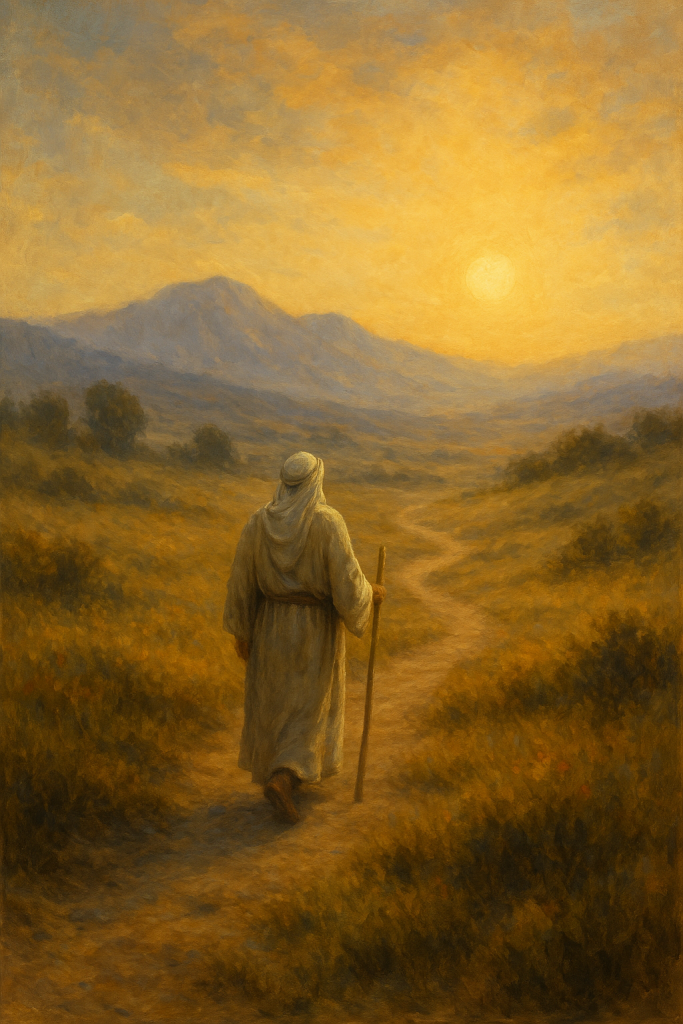
And the Lord said to Abram: Lech lecha—go forth from your land, your birthplace, and your father’s house, to the land that I will show you. (Genesis 12:1)
Lekh lekha literally means “go to yourself.” The Alter Rebbe explains that G-d was telling Abram to journey “to the root of your soul, to your essence”—to return to the inner source from which his life-force flows.[1] This is not a physical command but a spiritual imperative: to keep moving inward, shedding layers of habit, environment, and inheritance, until one uncovers the divine core of selfhood.
Carl Jung called this process individuation: the lifelong work of becoming who we truly are by integrating our conscious and unconscious aspects. This process involves shedding one’s Persona, shaped by societal expectations, and uncovering the true Self. In Jungian analytical psychology, the “Self” is the imago Dei within—the spark of wholeness that transcends the ego. In Chassidic language, it is the nefesh Elokit, our godly soul. Both paths call for a descent into the depths of one’s psyche in order to ascend to one’s spiritual center.
In modern scientific metaphor, the self is not a static particle but a quantum field of potential. Each act of awareness, each step of lekh lekha, collapses the superposition of who we might be into who we are becoming. Growth requires leaving the old eigenstate of comfort for the uncertainty of transformation.
“The greatest journey is not across space but through the depths of the self.”
Takeaway:
The call of lekh lekha still resonates in every generation. It tells us: do not settle for the self you inherited. Keep walking toward the self you are meant to reveal. The “land that I will show you” lies not somewhere out there—but within.
[1] Rabbi Schneur Zalman of Liadi, Torah Or, Lech Lecha, 6b.


