Alexander Poltorak
Abstract
This essay addresses the anigmatic statement of the Jewish Sages, stating that G-d created this world with the letter Heh and the Next World (Olam Habah) with the letter Yud. The surprising answer we arrive at is that this statement hints at the number of universes in the multiverse of String Theory. The essay further wrestles with a puzzling Talmudic narrative about the 500-year journey as the distance between (and through) the seven heavens. I argue that the Talmud’s recurring measure, “a journey of five hundred years,” is a unit-stride in a spiritual metric. Surveying Talmudic statements together with Kabbalah teachings about the angel who elevates prayer “five hundred years” by the power of the Name Y-ah, the essay reads “500” as one full articulation of Binah: the Fifty Gates of Understanding expanded by sefirotic interinclusion (50 × 10). This yields a scale-invariant ladder in which each rung, firmament to firmament, limb to limb, and up to the Throne of Glory, lies at a constant conceptual distance. The essay proposes rigorous physics parallels: equal renormalization steps in MERA/AdS (constant radial distance), ultrametric/tree geometries (level-dependent distance), and information-geometric metrics of distinguishability. A brief discussion positions 10500 string-vacua counts as a symbolic echo of the divine name Y-ah. The result is a conceptual bridge: “500 years” functions as a universal unit of separation across Olam–Shanah–Nefesh (world, time, soul), clarifying how rabbinic number-language encodes structural invariants and offering a precise vocabulary for dialogue between Torah and physics.

TL;DR: “Five hundred years” is the fixed step of a fractal spiritual metric; 10500 string-vacua counts as a symbolic echo of the name Y-ah.
Introduction
In the Iggeret HaKodesh section of Tanya, the Alter Rebbe cites a famous statement of our Sage, who said that G-d created the world with the first two letters of his ineffable name, Tetragrammaton—Yud and Heh. Specifically, the Sages inform us that G-d created this world with the letter Heh and the Next World (Olam Habah) with the letter Yud.[1] The whole universe with one letter? What could this possibly mean?
It so happens that this section of the Tanya was studied (according to the annual cycle of Tanya study instituted by the Previous Lubavitcher Rebbe, Rabby Yosef Yitzchak Schneersohn) last week, the same week during which we studied the Torah portion of VaEtḥanan (often transliterated as Va’etchanan, Deuteronomy 3:23 – 7:11). The Arizal commentary on the first word of this portion may help us to answer our question.
The word of the portion of Va’etḥanah starts with, well, “VaEtḥanah” (in Hebrew, all portions of the Torah are usually named with the first significant word in that portion, so, no surprise here). The classical Torah commentator, Rashi, explains that this word means “supplicated”[2] and its numerical value (gematriyah) is 515, which suggests that Moses supplicated to G-d 515 times to allow him to cross the river Jordan to see the promised land.
The Arizal explains:
Know, that there is an angel appointed over prayers, who elevates them from earth to heaven, this being a journey of five hundred years (Sefer HaLikutim and Likutei Torah, parashat VaEtḥanan).[3]
I. The Journey of Five Hundred Years
1. Seven Heavens
The concept of seven heavens (more correctly translated as firmaments) is found in the Talmud, Kabbalah, and Chasidic thought. While not explicitly in the Torah, these traditions interpret biblical verses to describe a multi-tiered universe with distinct spiritual realms. The number seven is significant, symbolizing a complete, sacred structure, and each heaven has its own unique function, angelic inhabitants, and purpose.
In the Talmud
The Talmud, particularly in the tractate Ḥagigah, enumerates and describes the seven heavens, each with a Hebrew name. These are not merely physical spheres but are understood as different realms of existence:
- Vilon (Curtain);
- Rakia (Firmament);
- Shechakim (Millstones);
- Zevul (Abode);
- Ma’on (Residence);
- Machon (Foundation); and
- Aravot (Highest Heavens).
Aravot is the highest heaven. It is the dwelling place of G‑d’s throne, the souls of the righteous, and the highest ranks of angels like the Seraphim and Ophanim.[4]
Commenting on the Sinaitic epiphany, Rashi states that, at Sinai, G‑d opened seven heavens.[5]
In Kabbalah
Kabbalah expands on the Talmudic concept, associating the seven heavens with the sefirot—the ten divine emanations or attributes of G‑d.[6],[7] These heavens are seen as spiritual states or levels of consciousness, not just physical places. They are linked in the Zohar to the lower seven sefirot (midot), from Ḥesed (Kindness) to Malkhut (Kingship).[8] The mystic’s goal is to ascend through these spiritual realms to achieve a higher state of awareness and connection to the divine.
The Zohar further elaborates on these heavens, describing them as “upper palaces” or “halls” (Hekhalot) that one must pass through on a spiritual journey. This ascent is a central theme in Merkavah mysticism, an early form of Jewish mysticism that focused on Ezekiel’s vision of the divine chariot.
Lurianic Kabbalah introduced the concept of Seder Hishtalshelut (the “chainlike order” of ontological unfolding of the worlds). According to this doctrine, the created universe comprises four ever coarser (lower) worlds:
- Atzilut (the world of “Emanation,” strictly speaking, not a created world);
- Beriyah (the world of “Creation”),
- Yetzirah (the world of “Formation”), and
- Assiyah (the world of “Action”).
The world of Assiyah is further subdivided into two strata: Olam HaAssiyah Ruchni (“spiritual world of the Action”) and Olam HaAssiyah Gashmi (“physical world of the Action”). The spiritual world of the Action, Olam HaAssiyah Ruchni, is further subdivided into seven levels corresponding to the seven lower sefirot (midot): Ḥesed (love, kindness), Gevurah (power, judgment), Tiferet (beauty, harmony, mercy), Netzaḥ (victory, eternity), Hod (glory, humility), Yesod (foundation), and Malkhut (kingship, sovereignty). These seven midot of the spiritual world of the Action are identified in Lurianic Kabbalah and Hassidic thought with the seven heavens.
It is clear that in Jewish mysticism, the seven heavens are not physical spaces but conceptual spaces, where ideas/concepts make up the points of the space. The distance between points is measured as the degree of similarity (or rather, dissimilarity) of the concepts represented by these points—the more similar the concepts, the closer the points, the more dissimilar, the further apart.
In Chasidic Literature
Many Hasidic masters transpose the sevenfold cosmology into seven modes of inner divine service (avodah), rooted in Zohar’s mapping of the seven heavens to the seven middot. Chasidic thought reinterprets the seven heavens in a more internal and psychological sense. Instead of a physical ascent, the seven heavens represent various levels of a person’s spiritual service[9] and connection to G‑d, and spiritual ascent.[10]
Each heaven corresponds to a different mode of divine service, from basic observance of commandments to the highest levels of selfless devotion and bitul (self-nullification).
The ultimate “seventh heaven” in Chasidic literature represents a state of complete unity and blissful connection with G‑d, a feeling of being in a state of ultimate joy and transcendence. It resonates with the common English phrase “in the seventh heaven,” describing a state of supreme bliss.
In essence, some Chassidic schools transform the cosmological structure of the seven heavens into a personal journey of spiritual growth, making the concept accessible and relevant to the daily life of every individual.
2. The Journey
If seven heavens (of firmaments) are conceptual spaces, the journeys between or within them must be understood as intellectual progression in the levels of understanding of the divine.
We may ask, what is the difference between journeys between these firmaments or within them? It seems to me that each firmament represents a quantum leap in understanding. Consider the following example. In Russian public schools, children are taught physics for five years, from fifth grade to the (highest) tenth grade. During these five years, children study mechanics, electricity, atomic physics, physics of fluids, optics, and other topics in physics—all on a relatively simple mathematical level without the use of calculus. In a university physics department, students study essentially the same subjects but on a completely different, much more rigorous level, using advanced mathematics. As postdocs, those young scientists delve into these disciplines even at a higher level. Similarly, each heaven may be viewed as structurally similar (each of them has ten sefirot), a body of the divine understanding, but at a progressively deeper level. The journeys between firmaments may be viewed as preparatory steps (similar to having to learn new mathematical disciplines before attempting to apply them to studying advanced topics in physics).
3. 500 Years
The Talmud states:
Now, is there not from the earth to the firmament a walking distance of five hundred years, and the thickness of the firmament itself is a walking distance of five hundred years, and a similar distance exists between each and every one of the firmaments?[11],[12]
The crucial questions in understanding this enigmatic Talmudic statement are: Where does the number 500 come from, and what is its meaning?
The Kabbalah explains the number 500 as the five main middot (Ḥesed, Gevurah, Tiferet, Netzach, and Hod) as they each include ten sefirot, which in turn, also include ten sub-sefirot.[13]
Binah
As we said before, the seven heavens are conceptual spaces, and the journeys to or through them are intellectual journeys into deeper levels of divine wisdom.
Binah (Understanding) is the principal sefirah of the mochin (“intellect”). Naturally, the journey into deeper levels of the divine wisdom is made using the sefirah of understanding, Binah. The second letter of the Tetragrammaton is the letter ה (Heh). The numerical value of the letter Heh is five.
| Tetragrammaton | sefirot |
| Yud | Ḥokhmah |
| Heh | Binah |
| Vav | Six Middot from Ḥesed to Yesod |
| Heh | Malkhut |
One of the main innovations of the Lurianic Kabbalah is the concept of the interinclusion of sefirot—every sefirah includes all others. Thus, Binah includes all ten sefirot. Since the numerical value of the letter Heh representing Binah in the Tetragrammaton is five, due to the interinclusion of all ten sefirot in Binah, it becomes fifty (5×10). Hence, we have Fifty Gates of Understanding.[14] Each of these Fifty Gates of Understanding also includes ten sefirot, resulting in the number 500 (5×10×10). So, the 500-year journey can be viewed as the full expansion or articulation (×10) of the Fifty Gates of Understanding (Binah).
Sefirot
As mentioned before, the Seder Hishtalshelut (the “Chainlike Order” of ontological unfolding of the worlds) comprises four worlds. Each of these worlds corresponds to a letter of the Tetragrammaton. However, the apex of the Yud (kutzo shel yud) corresponds to the level of Adam Kadmon, which precedes the Seder Hishtalshelut:
| Tetragrammaton | Worlds |
| Apex of the Yud | Adam Kadmon |
| Yud | Atzilut |
| Heh | Beriyah |
| Vav | Yetzirah |
| Heh | Assiyah |
In each world (olam), the ‘inner sanctuary’ is the configuration of its ten sefirot; since each sefirah inter-includes ten, each world can be viewed as a 10×10 articulation resulting in 100 interincluded sefirot.[15] Given the five worlds, each containing 100 sefirot, we again arrive at the number 500.
Partzufim
Another innovation of Lurianic Kabbalah was the introduction of Partzufim—divine visages (or divine personas), which are dynamic configurations of interincluded sefirot. There are five primary Partzufim:
- Atik Yomin (the “Ancient of Days”);
- Aba (Supernal “Father”);
- Imah (Supernal “Mother”);
- (“Small Face”); and
- Nukvah (“Female”).
Each of these Partzufim is built on a principal sefirah (or six sefirot in the case of the Z’eir Anpin). Each Partzuf corresponds to one of the worlds of Seder Hishtalshelut and one of the letters of the Tetragrammaton:
| Tetragrammaton | World | Principal Sefirah | Partzuf |
| Apex of the Yud | Adam Kadmon | Keter | Atik Yomin |
| Yud | Atzilut | Ḥokhmah | Aba |
| Heh | Beriyah | Binah | Imah |
| Vav | Yetzirah | Six Middot from Ḥesed to Yesod | Z’eir Anpin (Z”A) |
| Heh | Assiyah | Malkhut | Nukvah |
Each Partzuf has ten interincluded sefirot—100 in total. Thus, five Partzufim have 500 sefirot.
Yovel
Let us note that the expression describing the distance to each haven is a journey of 500 years. It is not coincidental. One of the main temporal cycles in Judaism is Yovel (Jubilee), a period of fifty years. At the end of Jubilee, there is a complete reset—the land returns to the original owners and slaves are set free. Jubilee is related to Binah (which is why it is a fifty-year cycle). If we replace Binah with its full complement of ten sefirot, we arrive at 500 years.
Soul
The Jewish soul comprises five souls: Nefesh, Ru’aḥ, Neshamah, Ḥayah, and Yeḥidah. Each of these souls has ten sefirot, called ten “powers of the soul.” When ten expands into 100 (when each sefirah is represented as a full complement of all ten sefirot), we get the total of 500 sefirot. Thus, on the level of the soul, a journey of 500 years is a process of rectification of 500 sefirot that make up five souls (or five levels of the soul). Alternatively, this process can be viewed as a meditative ascent along 500 ranks of the spiritual ladder of our soul.
The final kaf
In Jewish numerology, gematriyah, the number 500 is represented by the final letter kaf (ך). The word “kaf” means “palm.” This is highly significant because a hand has five fingers anchoring this letter in Binah, which has five Ḥasadim (five categories of kindness) and five Gevurot (five categories of strict judgment), not to mention the fact that it is identified with the letter Heh of the Tetragrammaton, as discussed above.
Hazal say the five final letters (מנצפ״ך), which close words, were a later prophetic addition.[16] In Kabbalah, these finals are often read as the five gevurot (modes of delimitation/judgment), i.e., the principles that constrain—and thereby measure—revelation. On that reading, the very first of the finals (ך = 500) naturally tags the first “hundreds” step beyond the last letter of the Hebrew alef bet, tav (400 = ת) as a boundary quantum. The constant “500” then becomes the canonical stride of delimitation between layers (firmament to firmament, limb to limb).
However, the word “kaf” can also mean the sole of the foot (כַּף־רֶגֶל). In fact, the Talmudic passage we quoted above measures the kaf raglei ha’ḥayyot (the “ankles/hoof-soles” of the heavenly beasts) at one constant unit—“a journey of five hundred years.” This directly connects the letter kaf (ך) with the journey of 500 years, completing the circle.
In Tanakh, Kaf is the palm/sole that is used as a measure: “I will not give you… even a tread of a foot sole (מִדְרַךְ כַּף־רָגֶל)” (Deuteronomy 2:5). Since Hazal give five hundred to each boundary between strata and Kabbalah treats the five final letters as modes of delimitation (gevurot), the “500-year journey” reads as a canonical stride: the fixed unit that completes one level and permits ascent to the next.
Olam-Shanah-Nefesh
Sefer Yetzirah states:
He set them [sefirot] in the worlds (Olam), in the year (Shanah), and in the soul (Nefesh). (Sefer Yetzirah 6:4)
These three domains—Olam (space/world), Shanah (time/year), and Nefesh (soul/life/spirituality)—represent the dimensions through which creation is expressed and experienced:
- Olam refers to the three spatial dimensions;
- Shanah refers to the temporal dimension; and
- Nefesh refers to the spiritual or moral dimension.
We have traced how the number 500 manifests in all three domains—the worlds of Seder Hishtalshelut (Olam), Yovel-Jubilee (Shanah-time), and in the soul (Nefesh). The number 500, therefore, is not merely a measure of travel time but a symbol of structural completeness. It represents the total, fully articulated expression of a spiritual system, whether it is the realm of Shanah (Time), Olam (the worlds), or Nefesh (the human soul).
A fundamental constant of the spiritual universe
The Talmudic quote at the beginning of this section continues:
Above them are the divine creatures. The feet of the divine creatures correspond in distance to all the firmaments; the ankles of the creatures correspond to all of them; the shins, knees, thighs, bodies, necks, heads, and horns of the creatures each correspond to all of them. Above them is the Throne of Glory. The feet of the Throne of Glory correspond to all of them, and the Throne itself corresponds to all of them. And above it dwells the living, almighty, lofty, exalted King.
The Talmud states:
- The length of “the feet of the divine creatures” is a journey of 500 years;
- The height of “the ankles (or hoofs) of the creatures corresponds to all of them” is a journey of 500 years;
- The size of the “the shins, knees, thighs, bodies, necks, heads, and horns of the creatures” is a journey of 500 years;
- The height of “the feet of the Throne of Glory” is a journey of 500 years; and
- The size of the “Throne itself” is a journey of 500 years.
Taken together, these Talmudic narratives suggest a canonical “unit step” (500 years) that separates fully-articulated layers of the vertical cosmos.”[17]
In Ḥagigah, the Sages quantify the vertical architecture of reality with a single “unit step”: a journey of five hundred years. From earth to firmament, from firmament to firmament, and through every stratum of the merkavah (“chariot”) and the Throne (Kisei HaKavod), the same span recurs. Read together with the Arizal’s teaching that an angel elevates prayer by “a journey of five hundred years” through the power of the Name Y-ah, this constant is not an astrophysical distance but a spiritual metric: one complete unfolding of Binah—the Fifty Gates fully articulated (5×10×10)—that separates fully realized levels. The cosmos is thus presented as a scale-invariant ladder: equal steps between layers that each recapitulate the whole.
Physical parallels
The simplest parallel that immediately comes to mind is that Chazal measure space by the time of travel. This is exactly how distances between stars and galaxies are measured in contemporary astronomy and cosmology using light-years—the time it takes light to travel from point A to point B.
We can speculate that a modern analogue is the renormalization-group[18] picture in which equal changes of scale correspond to equal geometric distance (as in holography/MERA).[19] That is a precise modern version of “one rung up the firmament ladder always costs the same.”
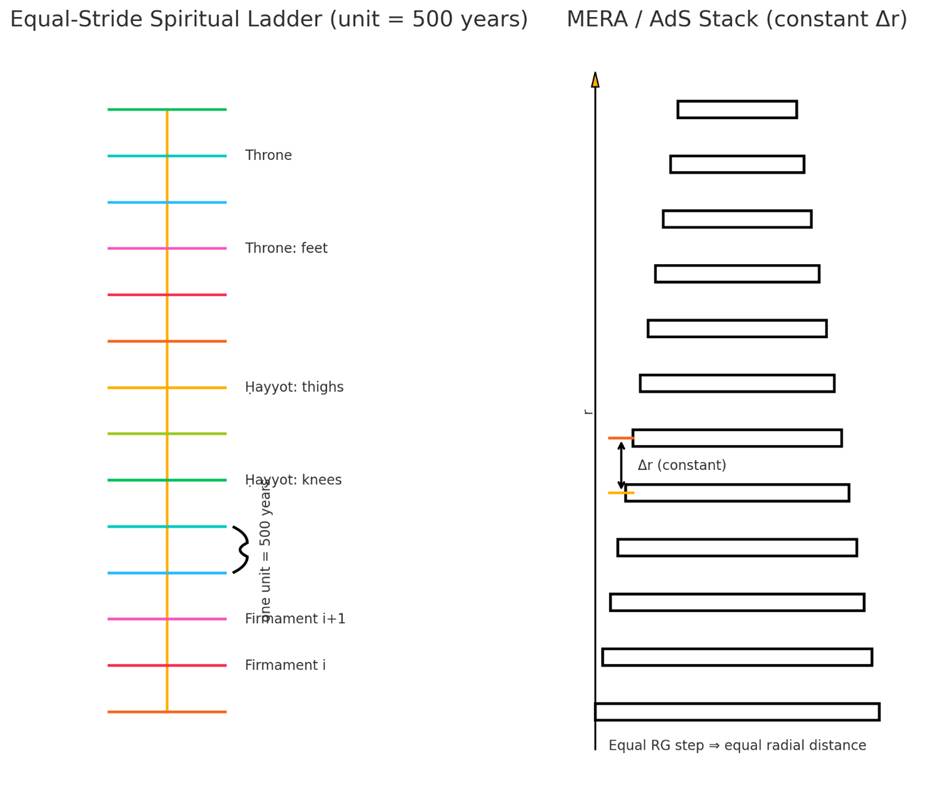
If “spiritual distance” means “dissimilarity” or “conceptual distinguishability,” then the Fubini–Study/Bures distance is a natural analog that measures equal increments of conceptual distinguishability.[20] On this reading, “five hundred years” is the fixed quantum of separation required to pass from one complete articulation to the next.
A 500-year unit acts like a fixed lattice spacing a in a discretized vertical dimension.[21]
That is exactly how layered theories (Kaluza–Klein on a lattice, extra-dimensional models, or numerical AdS[22]) treat the emergent radial/vertical coordinate—equal steps, equal cost.
In tree-like spaces, the distance between layers depends only on the level, not on the horizontal position. The Talmud’s refrain “each segment equal to all of them” reads like an ultrametric ladder. The p-adic AdS/CFT models geometry by a Bruhat–Tits tree with uniform edge length—a mathematical twin of the constant “500-year” stride.[23]
II. How Many Worlds Were Created?
Now, we can return to our original question: How could the whole physical universe be created with a single letter Heh?
The Arizal further taught:
Know, that there is an angel appointed over prayers, who elevates them from earth to heaven, this being a journey of five hundred years. He elevates them with the power of the divine name Y-ah, which G‑d used to form the worlds.
The divine name Y-ah consists of two letters, Yud and Heh. This is a reference to the Talmudic dictum that G-d created this world with the letter Heh and the Next World (Olam Habah) with the letter Yud. Talmud derives this from the prophecy of Isaiah 26:4, which says:
Trust in the Lord forever, for in G‑d, the Lord (Y-ah), is the Rock of Ages. (Isaiah 26:4)
The word forever (olamim) can also mean “worlds,” and the Rock (Tzur) can be translated as “formed.” Thus, this verse could be understood as saying:
Trust in G‑d forever, for with the letters Yud and Heh, G‑d formed the worlds.
1. From Mystical Numerology to a Modern Multiverse
The numerical value of the letter Yud is 10. The numerical value of the letter Heh is 5. In our context, the number 5 is expanded into 500 through inter-inclusion of sefirot and their sub-sefirot (5×10×10).
So, how many worlds did G-d create—10 or 500? The creative force of the universe is represented by the pairing of the numbers 10 (from Yud) and 500 (from Heh). How should we interpret this pairing?
An ancient Kabbalist would not have used modern exponential notation. Yet, a modern reader, looking back at these texts, can see a striking albeit speculative parallel. If we were to translate this mystical pairing into the language of modern cosmology, we might be tempted to see not an additive or multiplicative relationship, but an exponential one: 10⁵⁰⁰ (this is a scientific notation for the number that has five hundred zeros).[24] At least, this is what I imagine when I look at the two numbers, 10 and 500, in the context of the divine name (Y-ah) responsible for the creation of the universe.
Remarkably, this is the very number that emerges from the “landscape” of modern String Theory. In an attempt to unify general relativity and quantum mechanics, String Theory posits that the universe has extra, hidden dimensions. The theory predicts that there are a vast number of ways these extra dimensions can be folded or “compactified,” with each distinct configuration resulting in a different vacuum state—a unique universe with its own set of physical constants and laws. The estimated number of these possible worlds is 10⁵⁰⁰, a number[25] so vast it is often called the “cosmic landscape” or the multiverse.[26]
Conclusion
The “problem” of the 10⁵⁰⁰ possible solutions in String Theory was later reframed as a prediction of a vast multiverse. This essay has traced the significance of the number 500 in Jewish mysticism, showing it to be a symbol of structural wholeness. When paired with the number 10 corresponding to the letter Yud from the divine name used to create the worlds, a provocative allegorical reading emerges: 10⁵⁰⁰.
To be clear, this is an act of modern interpretation, not a claim that the Talmudic Sages, the Arizal, or the Alter Rebbe were practicing theoretical physics. They were not describing Calabi-Yau manifolds or dimensional compactification. However, the parallel is striking. By framing the cosmos in terms of divine letters, numerical values, and layered conceptual realms, they developed a spiritual grammar that, in a fascinating way, parallels the mathematical grammar used by physicists today. Were the ancient masters hinting at a multiverse? Perhaps the question is better framed as a testament to the power of these mystical frameworks to resonate with—and find new meaning in—the ever-expanding landscape of human knowledge. You be the judge.
Endnotes and References
[1] Talmud, Tractate Menachot 29b.
[2] Va’eschanan is derived from the word חינון, which means [the request for] an unearned (חנם) gift. This is one of ten terms used for prayer (Sifri).
[3] Translated and adapted by Moshe Wisnefsky from Sefer HaLikutim and Likutei Torah, parashat VaEtḥanan, “Apples From the Orchard,” (Thirty Seven Books, 2008)
[4] The seven heavens are: Vilon (Curtain): The first heaven, serving as a curtain that is rolled up and down to reveal or conceal the stars; Rakia (Firmament): This is the heaven where the sun, moon, and stars are located, in other words, the cosmos; Shechakim (Millstones): A place where “millstones” grind manna for the righteous; Zevul (Abode): A celestial Jerusalem containing the heavenly Temple; the archangel Michael serves as the high priest there; Ma’on (Residence): The home of various angels who sing praise to G‑d at night and are silent during the day; Machon (Foundation): A repository for snow, hail, rain, and other natural elements, which are released to Earth; Aravot (Highest Heavens): The seventh and highest heaven. It is the dwelling place of G‑d’s throne, the souls of the righteous, and the highest ranks of angels like the Seraphim and Ophanim.
[5] Rashi on Deuteronomy 4:35.
[6] Zohar, Ha’azinu, ch. 4.
[7] Zohar, Ra’aya Meheimna, Pinchas, ch. 69;
[8] Zohar, Trumah, ch. 72, 704.
[9] Shem MiShmuel (Sochatchov), Korach references the seven firmaments within a discourse on divine servie, avodah.
[10] Kedushat Levi (R. Levi Yitzḥak of Berditchev), Beshalach §3 explicitly clusters sevens, “seven lands, seven seas, seven rivers, seven heavens,” and then speaks of the ascent of the worlds to the level of Ayin (self-nullification/bitul).
[11] Aside from the seven heavens, this gemarah adds another narrative that Sandalfon is taller than his colleague by 500 years.
[12] Talmud, Tr. Pesaḥim 94a; Talmud Yerushalmi, Berakhot 9:1.
[13] Wisnefsky, Mosheh Yaakov, “Apples From the Orchard,” (Thirty Seven Books, 2008), p. 851.
[14] Talmud, Tr. Rosh HaShanah 21b.
[15] While the interinclusion of sefirot is truly fractal and continues, in principle, ad infinitum, in practice, we consider on one (×10) or two levels (×100) of expansion.
[16] Talmud, Tr. Shabbat 104a; Megillah 2b–3a.
[17] Bavli Pesachim 94b, Ḥagigah 13a; Yerushalmi Berakhot 9:1.
[18] Fukuma, M., Matsuura, S., & Sakai, T. (2002). Holographic Renormalization Group. ArXiv. https://doi.org/10.1143/PTP.109.489
[19] Swingle, “Entanglement Renormalization and Holography,” Phys. Rev. D 86 (2012).
[20] Wootters, W. K., (1981). “Statistical distance and Hilbert space,” Phys. Rev. D 23, 357.
[21] A discrete metric (distance) d can be defined as d (leveli,levelj) = ∣i−j∣ a, with a = 500 years.
[22] Brower et al., “Lattice setup for QFT in AdS₂,” Phys. Rev. D 103 (2021); “Hyperbolic lattice for scalar field theory in AdS₃,”105 (2022)—explicit AdS discretizations with constant radial steps.
[23] Gubser et al., “p-adic AdS/CFT,” Comm. Math. Phys. 352 (2017).
[24] Susskind (2003). “The anthropic landscape of string theory.” arXiv:hep-th/0302219; Douglas (2003). “The statistics of string/M theory vacua.” Journal of High Energy Physics, 2003(05), 046.; Denef, F., & Douglas, M. R. (2004). “Distributions of flux vacua.” Journal of High Energy Physics, 2004(05), 072, and KKLT (2003); Kachru, S., Kallosh, R., Linde, A., & Trivedi, S. P. (2003). “de Sitter vacua in string theory.” Physical Review D, 68(4), 046005; Ashok, S. K., & Douglas, M. R. (2004). “Counting flux vacua.” Journal of High Energy Physics, 2004(01), 060.
[25] The number 10500 is a model-dependent estimate (flux compactifications) and is contested. We are using it as a metaphoric parallel, not a proof. Initially, this vast “landscape” was considered a “swampland”, a term coined by physicist Cumrun Vafa, referring to the set of vacua that are mathematically consistent but physically implausible. Later, however, the landscape was reconceptualized as a String Theory version of multiverse.
[26] Read, James; Le Bihan, Baptiste (2021). “The landscape and the multiverse: What’s the problem?” Synthese. 199 (3–4): 7749–7771.
© 2025 Alexander Poltorak. All rights reserved.


Well worth the wait from the last article to this article. You have a gift of presenting the parallel in a reader friendly way. Thank you. However, could you give a little more explanation to the physics.