Synopsis
The essay resolves the apparent paradox in the Torah's dual command to "remember what Amalek did" and simultaneously "erase the memory of Amalek" by distinguishing between two kinds of memory. Drawing on the physics of hysteresis — the tendency of a system to retain the imprint of its prior state even after conditions have changed — the essay argues that the "memory" to be erased is not a historical record but a systemic drag: the internal residue of Egypt's slave-consciousness that keeps pulling the liberated Israelites back toward their former equilibrium. Amalek, who attacks at the moment of greatest transitional vulnerability, is identified as the archetype of this relapse force — the cooling, doubt, and cynicism that exploit hysteresis to prevent a new identity from stabilizing. The command to remember Amalek is therefore a diagnostic discipline: learning to recognize the signature of relapse. The command to erase Amalek is the active work of driving the system past its coercive threshold so the old alignment loses its hold. The essay culminates in a reading of Purim, where the Amalek-pattern recurs through Haman but the people — responding from agency rather than inertia — break the hysteresis loop from within, demonstrating what completed erasure looks like: not amnesia, but redemption stabilized.
1. Introduction: a commandment that sounds like a contradiction
On Purim (and during Torah reading on Shabbat before Purim), we read Parashat Zachor, which commands us to remember the unprovoked attack by Amalek after the Exodus from Egypt. The Torah seems to command an impossibility: “Remember what Amalek did to you…” and, in the same breath, “you shall erase the memory of Amalek.” It presents a classic logical knot. The instruction to remember appears to undermine the instruction to erase. From a neuroscientific perspective, this is a paradox: the act of recall reinforces the neural pathways associated with the information. To remember is to strengthen; to strengthen is the opposite of erasing. The more a narrative is repeated, the deeper its grooves become—whether in a brain, a culture, or a people.
Yet the Torah is not naïve about human psychology or collective life. It is unlikely to hand us a self-defeating spiritual program. The paradox is real, but it is also a clue: we may be misreading the word “memory” in “erase the memory of Amalek.” The resolution, I suggest, is to treat “memory” not (primarily) as a fact stored but as a history-dependent state—what physics and Complex Systems Theory call hysteresis: the system’s “memory” that persists as lag, drag, and relapse even after circumstances have changed.
2. The textual problem, stated precisely
The Torah gives two closely-related imperatives:
Zekhirah — remembrance: “Remember what Amalek did to you on the way, when you came out of Egypt… you shall not forget.” (Deuteronomy 25:17–19)
Meḥiyah — erasure: “You shall erase the memory of Amalek from under heaven.” (Deuteronomy 25:19; and compare Exodus 17:14)
Read superficially, these two imperatives collide: remembering seems to preserve what erasure aims to remove.
But the sources already signal that the “erasure” is not a call for historical amnesia. It is an instruction to eliminate Amalek as an active, living force in the world—klipah (evil husk, in the language of Kabbalah). That is why the Torah also frames this as an enduring struggle: “The Lord will have war with Amalek from generation to generation.” (Exodus 17:16) And it is why the prophetic narrative in I Samuel 15 treats the command as the removal of a destructive embodiment, not the deletion of a historical narrative from an archive.
So the question sharpens: if the goal is to eliminate Amalek as a force, then what exactly is the “memory” that must be erased, and why must we remember in order to erase it?
3. A systems lens: phase transitions and the persistence of the prior state
When the Israelites left Egypt, they did not merely migrate. They underwent a civilizational transformation. In the language of complex systems, this resembles a phase transition: a shift from one stable regime to another. We have developed this framing elsewhere as a first-order transition—like water freezing or boiling—where the system jumps between states separated by an energy barrier. (Exodus as a First-Order Phase Transition)
But first-order transitions have a signature feature: the new state does not instantly “take.” It is common for systems to exhibit hysteresis—a dependence on history that produces lag and relapse. The system carries forward an imprint of its prior regime. Even after external conditions change, the internal dynamics continue to pull the system back toward its previous basin of attraction.
That is exactly what the Torah describes in the wilderness: a people physically free yet psychologically and spiritually magnetized by slavery’s equilibrium.
Would that we had died by the hand of the Lord in the land of Egypt, when we sat by the flesh-pots…” (Exodus 16:3)
“We remember the fish…the cucumbers, and the melons…” (Numbers 11:5)
These are not merely complaints about menu options. They are diagnostic readouts of a system still governed by the inertia of its prior phase: the “Egypt-state” continuing to assert itself after the exit.
4. What hysteresis is, in plain physics
The word “hysteresis” comes from Ancient Greek and means “lagging behind.” First‑order hysteresis arises because the system has multiple stable or metastable states. This creates “memory” because the system can remain trapped in a state inherited from the past, and it creates “path asymmetry” because the transition point depends on the direction of parameter change.
When the system resides in a metastable state, it retains information about its prior state: If it is in the liquid minimum while being cooled, it stays liquid until it is forced out of that state and becomes solid (frozen). If it is in the solid minimum while being warmed, it stays solid. Thus, the system’s response depends on the minimum it previously occupied. This is what “memory” in the language of thermodynamics or complex systems means: the system’s current state carries information about its past because it stays trapped in a metastable minimum inherited from that past.
Hysteresis is often taught with magnetism. If you apply an external magnetic field to a ferromagnet, the magnetization does not simply track the field instantaneously and symmetrically. As you increase and then decrease the field, the magnetization follows a loop rather than retracing the same curve. The material “remembers” where it has been.
The crucial idea: hysteresis is not memory as information in a file. It is memory as structure in the system—an internal persistence that resists the new equilibrium. It is why the system can remain partially aligned with the old regime even when the “field” has changed.
Translated into psychology, Egypt is not only a location; it is a stable configuration of consciousness—habits, fears, reflexes, dependency patterns. Leaving Egypt changes the “external conditions,” but the internal configuration does not instantly re-equilibrate. The leftover imprint is the lagging “Egypt-memory” that keeps trying to reassert itself.
In Hasidic language, Mitzrayim (Egypt) becomes meitzarim (narrow constraints)—the constriction of mind, imagination, courage, and faith. Liberation is not merely a political event; it is a daily demand to exit inner constriction and limitations.
5. Amalek as hysteresis made personal: the drag that cools the transition
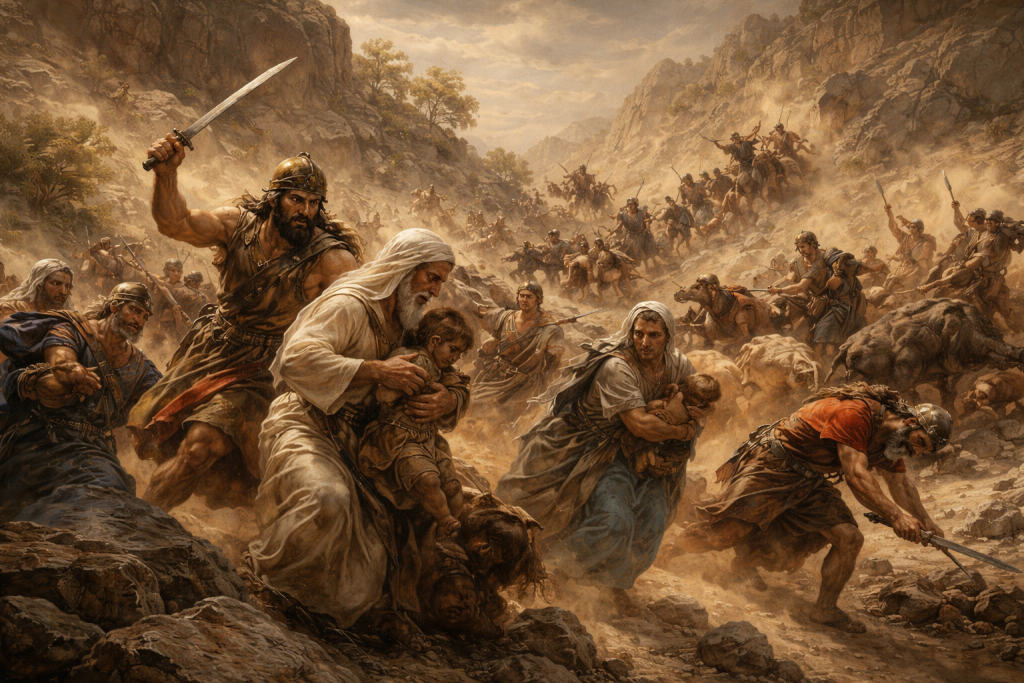
Into precisely this unstable post-Exodus moment enters Amalek. Torah emphasizes both the timing and the target: Amalek strikes on the way and attacks those who are weak/straggling at the rear (Deuteronomy 25:18). Amalek is not only an external enemy; Amalek is the force that exploits transitional vulnerability—when a system is between regimes and not yet settled into its new identity.
Classical and Hasidic readings sharpen this further. Amalek is associated with korkha—“cooling” fervor and enthusiasm, turning awe into lukewarmness, turning a charged spiritual event into fatigue, cynicism, and doubt.
Hasidic tradition often identifies Amalek with safek (doubt) and spiritual sabotage: not honest inquiry, but corrosive uncertainty that paralyzes commitment. (The famous observation that the numerical value of Amalek equals safek functions as a mnemonic for this idea.)
Put in systems terms: Amalek is the internal friction that makes hysteresis costly. Amalek is the drag force that prevents the new equilibrium from stabilizing. Amalek is the voice that says: the old state was real; the new one is a fantasy; go back to what you know.
This is why Amalek is not merely “another nation.” Amalek is the archetype of relapse.
6. Resolving the paradox: two kinds of memory
Now the contradiction dissolves, because the two commandments are speaking about two different “memories.”
The Torah commands us to remember facts and meanings: the character of Amalek’s attack, the moral and spiritual pattern it represents, and the vulnerability it exploits. This is cognitive remembrance—an act of interpretation and vigilance.
The Torah commands us to erase a different memory: not the record of what happened, but the systemic imprint that keeps reproducing Amalek’s effect inside us—the hysteresis that keeps pulling the liberated system back toward Egypt.
In other words, remembering Amalek is remembering the mechanism of the trap, while erasing Amalek’s memory is eliminating the trap’s continuing causal power.
Or, stated more sharply: the Torah does not want us to forget Amalek; it wants us to stop being governed by Amalek.
7. How hysteresis is erased: coercive force, realignment, and spiritual practice
In physics, hysteresis is reduced when the system is driven strongly enough to break free of the metastable remnants of the old alignment. You apply a “coercive” influence to push the system past the point where the previous history can keep dictating the present. In magnetism, that may mean cycling fields, heating past a critical point, or applying a sufficiently strong opposing field until domains reconfigure.
The Torah’s language of “war” aligns with this: not a single reflection but sustained counter-force—“from generation to generation.” (Exodus 17:16) Amalek, as hysteresis, is not erased by passive forgetting. It is erased by active rearrangement.
Practically, this maps onto a spiritual discipline. If Amalek is cooling, the counter-force is heat: renewed aliveness in avodah, a cultivated intensity that refuses cynicism’s comfort. If Amalek is doubt-as-sabotage, the counter-force is commitment: not the elimination of questions, but the refusal to let corrosive doubt and uncertainty become an identity. If Amalek attacks the stragglers, the counter-force is collective coherence: strengthening the “rear,” integrating the weak points, refusing to abandon those who lag.
The mitzvah of remembrance, then, becomes the diagnostic tool: it trains us to detect the onset of relapse. It is a spiritual early-warning system: identify the signature of hysteresis before it consolidates into a return to Egypt.
8. Examples: Egypt-memory in the desert, and Egypt-memory in us
The wilderness narratives become case studies in hysteresis. When the Israelites stand at the Sea of Reeds and see the Egyptian army behind them, they panic and immediately speak like slaves again—wishing they had never left Egypt. Even though they are physically free, their instincts still belong to the old reality. When they complain about the manna and long for the food of Egypt, it is not really about taste; it is about familiarity. Slavery was terrible, but it was predictable. And when Moses delays on the mountain, their anxiety pushes them back to familiar idolatry. These reactions are not random moral failures. They are what often happens when people undergo a major transition. The body may leave the old place quickly, but the mind and heart take longer to adjust. The past continues to shape reactions even after circumstances have changed.
And the same pattern is legible on the personal level. Every genuine inner “exodus”—leaving an addiction, a limiting story, a narrow identity, a spiritual stagnation—has a desert phase. The external change occurs first. The internal re-equilibration follows slowly. Hysteresis appears as nostalgia for the old chains: not because they were good, but because they were known.
In that space, Amalek appears as the whisper that reinterprets freedom as threat: better the flesh-pots than the open desert; better the certainty of bondage than the risk of becoming. To “erase Amalek” is to remove that whisper’s authority.
9. Purim and the recurrence of Amalek: breaking the loop
The Book of Esther introduces Haman as “Haman the Agagite” (Esther 3:1), linking him explicitly to Agag, king of Amalek (I Samuel 15). The Amalek-pattern reappears centuries after the wilderness. History has moved on; Israel is no longer a band of newly liberated slaves in a desert. Yet the same destructive archetype resurfaces. This recurrence is precisely what hysteresis predicts.
In a system exhibiting hysteresis, past alignments create a loop. Even when the external parameters shift, the system may trace a path that reactivates earlier configurations. The “loop” does not mean simple repetition; it means that the trajectory of the present depends on the unresolved residue of the past.
Purim reads like a hysteresis loop. Israel survives Amalek in the wilderness. Amalek’s line is not fully erased (Saul spares Agag; I Samuel 15). Generations later, the latent residue reappears as Haman. The same existential threat emerges under entirely different geopolitical conditions.
The recurrence is not accidental. It is structural.
In physics, if a system is not driven past the coercive threshold required to fully reconfigure its internal domains, remnants persist. Those remnants can seed future re-alignments under favorable conditions. What was not completely erased at one stage becomes the nucleation site of crisis at a later stage.
Saul’s incomplete fulfillment of the Amalek-command (I Samuel 15) can be read through this lens: partial erasure leaves structural residue. That residue later manifests as Haman the Agagite. The narrative link from Saul to Purim resembles an incomplete domain realignment that allows a metastable configuration to survive.
But Purim does something new. Unlike the Exodus, Purim contains no open miracles, no splitting seas, no Sinai-level revelation. The system does not experience a dramatic external field. Instead, the transformation occurs internally—through courage, identity-clarification, strategic action, fasting, and collective coherence. Esther’s declaration, “Go, gather all the Jews…” (Esther 4:16), is a move toward systemic integration. The community re-aligns.
And here is the key difference from the wilderness episode. At Purim, the Jewish people do not nostalgically long for Persia’s “flesh-pots.” They do not ask to return to the prior equilibrium. Instead, they accept responsibility. The hysteresis loop is not merely survived; it is broken.
This is why the Megillah emphasizes “kimu ve-kiblu”—they reaffirmed and accepted (Esther 9:27). Rabbinic tradition reads this as a voluntary re-acceptance of Torah. In systems terms, Purim represents a stabilization of the new regime from within, without dependence on overwhelming external forcing.
If Amalek is hysteresis—the pull of prior constriction—then Purim marks a deeper erasure than the wilderness battle. Not because the story is forgotten, but because the system has reorganized enough that the old alignment cannot easily reassert itself. The loop closes, but it does not trap.
10. Conclusion: remembering in order to un-remember
The Torah’s “paradox” is a sophisticated distinction. We are commanded to remember Amalek precisely so that we do not preserve Amalek’s power in the only place it can truly survive: within the history-dependent lag of a system that has left Egypt but still carries Egypt inside it.
“Erasing the memory of Amalek” is not the deletion of a fact; it is the elimination of hysteresis—of that stubborn internal residue that keeps reconstituting the old regime inside the new.
The Torah’s command to remember Amalek and erase Amalek is not a contradiction. It is a systems prescription.
We must preserve narrative memory—the clarity of what Amalek represents: cooling, sabotage, relapse, attack on vulnerability. That is vigilance.
But we must erase system-memory—the hysteresis that keeps reconstituting Amalek inside us long after Egypt is gone.
Purim demonstrates what successful erasure looks like. The Amalek-pattern reappears, but the people no longer respond from the inertia of slavery. They respond from freedom and responsibility. The system does not revert.
Erasing Amalek’s memory, then, does not mean eliminating history. It means eliminating history’s drag.
The Torah commands us to remember the mechanism so that we can dismantle it. To recall the attack so that the attack cannot recur from within. To close the hysteresis loop so completely that, even if history curves back upon itself, the old alignment no longer has the power to take hold. That is not amnesia. That is redemption stabilized.
In that sense, memory is not the opposite of erasure. It is the method by which erasure becomes possible: remembering, not to keep Amalek alive in narrative, but to prevent Amalek from remaining alive as a system-state.


