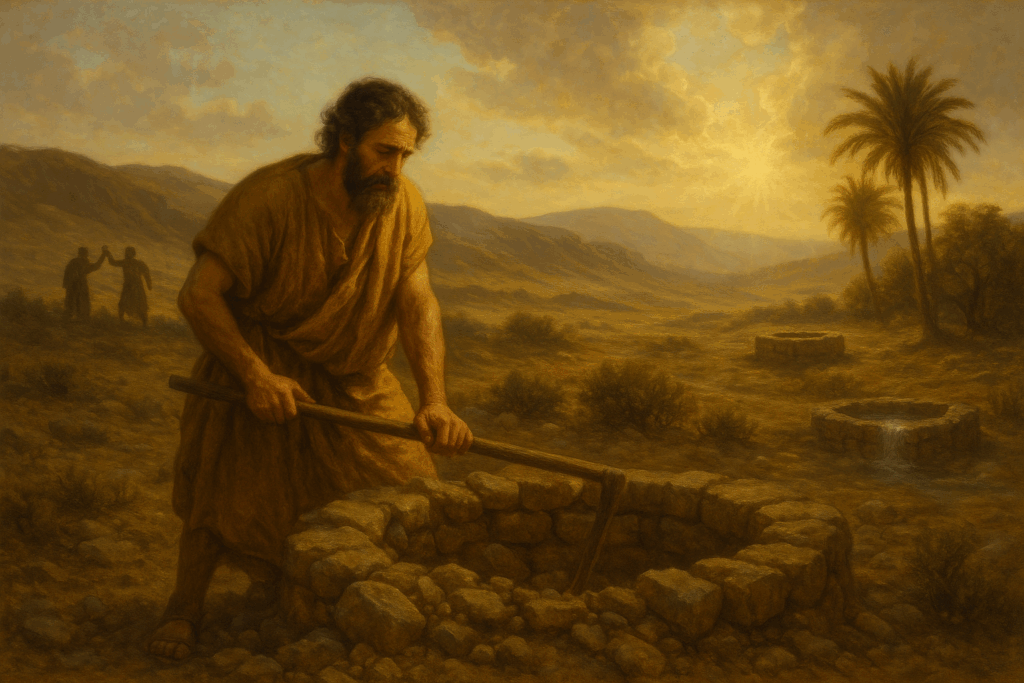
The third aliyah of Parshat Toldot presents a profound metaphor through Isaac’s well-digging enterprise. Isaac re-opens his father’s wells, stopped up by the Philistines; then his servants dig new wells: Esek (“contention”), Sitnah (“harassment”), and finally Reḥovot (“wide spaces”), where, at last, there is no quarrel:
For now Hashem has granted us room, and we will be fruitful in the land. (Genesis 26:12–22)
Ḥassidic teaching sees “digging wells” as a metaphor for inner service (avodah). Rabbi Yosef Itzchak Schneersohn[1] explains:
Acceptance of the Divine Yoke helps a Jew plumb the depths of his character and reveal the profundity of his innate understanding, good emotional attributes and character traits. This whole manner of service is known by the name “well,” while the incisive comprehension, emotional attributes and good character traits which this service reveals are known as “living waters.”[2]
This well of living waters is buried under “earth”—the coarseness of the animal soul. Avodah means digging: to peel away unhealthy habits, ego, and numbness, until the better self comes gushing out.
In that same maamar of the Frierdiker Rebbe, the three wells are read as three inner “wells” we must uncover: the well of good character traits, opposed by Esek (the clash with ingrained nature); the well of Torah understanding, opposed by Sitnah (the “Satan” of secular cynicism, hedonism, and heresy); and the well of self-sacrifice (mesirut nefesh), which has no opposition and is called Reḥovot – expansiveness without resistance.[3]
The Rebbe, quoting the Baal Shem Tov on “You shall be for Me a desirable land,” teaches that every Jew is a “desirable land,” full of hidden gems and wellsprings of living waters. Digging a well does not create water; “the water was always there, but if you don’t make the effort to dig, it will remain hidden.”[4] Isaac’s digging, then, is not only about his own soul; it is a model for how we dig in others. “Digging wells” can mean digging for the goodness within people who look like nothing but stones and mud, refusing to be discouraged when our first attempts seem to fail or even backfire.[5]
This process of uncovering hidden potential finds a striking parallel in neuroscience: in the brain, many synapses are “silent”—structurally present but functionally mute until the right pattern of activity “unsilences” them by inserting AMPA receptors[6] and making them transmit.[7] Neuroscientists now think these silent synapses are a latent reservoir of plasticity in the adult brain—a hidden capacity for new learning and circuit remodeling that becomes available when life’s experiences “dig” in the right way.[8] During critical periods of development, whole networks are reshaped as silent synapses become active; experience quite literally “uncaps” buried connections.[9]
Isaac’s wells and your brain are telling the same story: you are already a wellspring full of “living water,” and your brain is already wired with more possibilities than you can see. The work is not creating a new self but rather to keep digging—in your middot, in your Torah learning, and in small acts of mesirut nefesh (self-sacrifice)—and to dig gently but persistently in the people around you until their “silent wells” begin to flow.
Recall that the godly soul (nefesh elokit) has five levels (nefesh, ru’aḥ, neshamah, ḥayah, and yeḥidah),[10] whereas the animal soul (nefesh ha-bahamit) has only the first four—it is missing the yeḥidah. It means that the first four levels of the godly soul are opposed by their corresponding levels of the egoistic animal soul, which are in constant tug-of-war for the control of your body. But there is no opposition on the level of yeḥidah—the highest and the deepest level of the godly soul.[11] What Chabad sources teach is
- Reḥovot well = the well of mesirat nefesh with no opposition[12]
- Mesirat nefesh = expression of the level of yeḥidah in the soul[13]
These teachings reveal a deeper structure: By the law of “categorical syllogism” (if A=B and B=C, then A=C), we can deduce that yeḥidah = Reḥovot. In other words, yeḥidah, the level of the essence of the godly soul, corresponds to Reḥovot —that expansive space, where there is no opposition. Digging a well is digging deeper into your soul. When you reach the essence of the soul, yeḥidah, also called the pintele yid, you find your Reḥovot.
Takeaway for today: Choose one place to dig a little deeper—one rough trait to refine, one page of Torah to understand more deeply, or one small act that costs you something—and dedicate it as your “Reḥovot well.”
[1] Rabbi Yosef Itzchak (Joseph Isaac) Schneersohn (1880 – 1950) was the sixth Lubavitcher Rebbe, a.k.a. Rebbe Rayatz or the Frierdiker Rebbe.
[2] Yosef Yitzchak Schneersohn, “Discourse 23: ‘Ve-kibel ha-Yehudim – And the Jews Took Upon Themselves,’” in Chassidic Discourses, Vol. I, trans. Sholom B. Wineberg, ch. II, where he defines the service of be’er (“well”) as revealing “living waters” of intellect and middot (emotional attributes or character-traits). See online at https://www.chabad.org/library/article_cdo/aid/67786/jewish/Discourse-23.htm. (Retrieved on 11/19/2025)
[3] Ibid., ch. III, where the Frierdiker Rebbe explicitly identifies three forms of “well-digging” – the well of good emotional attributes, the well of comprehension, and the well of mesirut nefesh – and links them to Esek, Sitnah, and Reḥovot on the basis of Bereishit 26:20–22.
[4] Rabbi Menachem M. Schneerson, “Mission of the Generation, Pt. 2: ‘Yitzchak,’” Living Torah, program 387 (11 Shevat 5731 / Feb. 6, 1971). (https://www.chabad.org/therebbe/livingtorah/player_cdo/aid/1744442/jewish/Mission-of-the-Generation-Pt-2-Yitzchak.htm, retrieved on 11/18/2025).
[5] Rabbi Menachem M. Schneerson, “Chassidic Insights for Parshah Toldot,” in Kehot Chumash, on Gen. 26:19–22, which interprets “digging wells” as digging for the goodness within people who appear to be only “stones and mud,” (https://www.chabad.org/parshah/article_cdo/aid/770370/jewish/Chassidic-Insights.htm, retrieved on 11/18/2025).
[6] AMPA receptors are a type of ionotropic glutamate receptor in the brain that play a critical role in fast excitatory neurotransmission. AMPA stands for α-amino-3-hydroxy-5-methyl-4-isoxazolepropionic acid, which is a synthetic compound that selectively activates these receptors. They are ligand-gated ion channels that open when glutamate (the brain’s main excitatory neurotransmitter) binds to them. When activated, AMPA receptors allow sodium (Na⁺) and potassium (K⁺) ions to flow across the neuronal membrane, causing depolarization and generating an excitatory postsynaptic potential (EPSP). AMPA receptors are central to long-term potentiation (LTP), a mechanism underlying memory formation.
[7] L. L. Voronin and E. Cherubini, “‘Deaf, mute and whispering’ silent synapses: Their role in synaptic plasticity,” Journal of Physiology 557, no. 1 (2004): 3–12, https://doi.org/10.1113/jphysiol.2003.058966.
[8] Dimitra Vardalaki, Courtney E. Yaeger, and Mark T. Harnett, “Silent Synapses in the Adult Brain,” Annual Review of Neuroscience 48 (2025): 169–189, https://doi.org/10.1146/annurev-neuro-112723-032924.
[9] Weifeng Xu, Siegrid Löwel, and Oliver M. Schlüter, “Silent Synapse-Based Mechanisms of Critical Period Plasticity,” Frontiers in Cellular Neuroscience 14 (2020): 213, https://doi.org/10.3389/fncel.2020.00213.
[10] R. Ḥayyim Vital, Pri Etz Ḥayyim, Sha’ar Rosh Ḥodesh, ch. 3, and Devarim Rabbah 2:36 as quoted in Pri Tzaddik, Pesach §7. See also Rabbi Yosef Yitzchak Schneersohn, Sefer Ha-Ma’amarim 5700, maamar “Shemini Atzeres ve-Simḥas Torah 5694,” ch. 3, Rabbi Menachem M. Schneerson, “Inyanah shel Torat ha-Ḥassidut” (Kuntres), ch. 5–6, esp. note 11, or translated into English, On the Essence of Chassidus, trans. Yanki Tauber (Brooklyn, NY: Kehot, 2014).
[11] See Likkutei Sichos, Vol. 20, p. 296; Sefer HaMaamarim 5707, p. 187; Hemshech 5666, pp. 355ff. (Kehot, 2010).
[12] Yosef Yitzchak Schneersohn, maamar “Ve-kibel ha-Yehudim,” in Sefer Ha-Ma’amarim 5704–5705 (Brooklyn: Kehot Publication Society), ch. 3; English translation in Chassidic Discourses, vol. 1, “Discourse 23: ‘And the Jews took upon themselves.’”
[13] Rabbi Menachem M. Schneerson, Likkutei Sichot, vol. 23, Parshat Pinḥas and vol. 18, Parshat Ḥukat.


