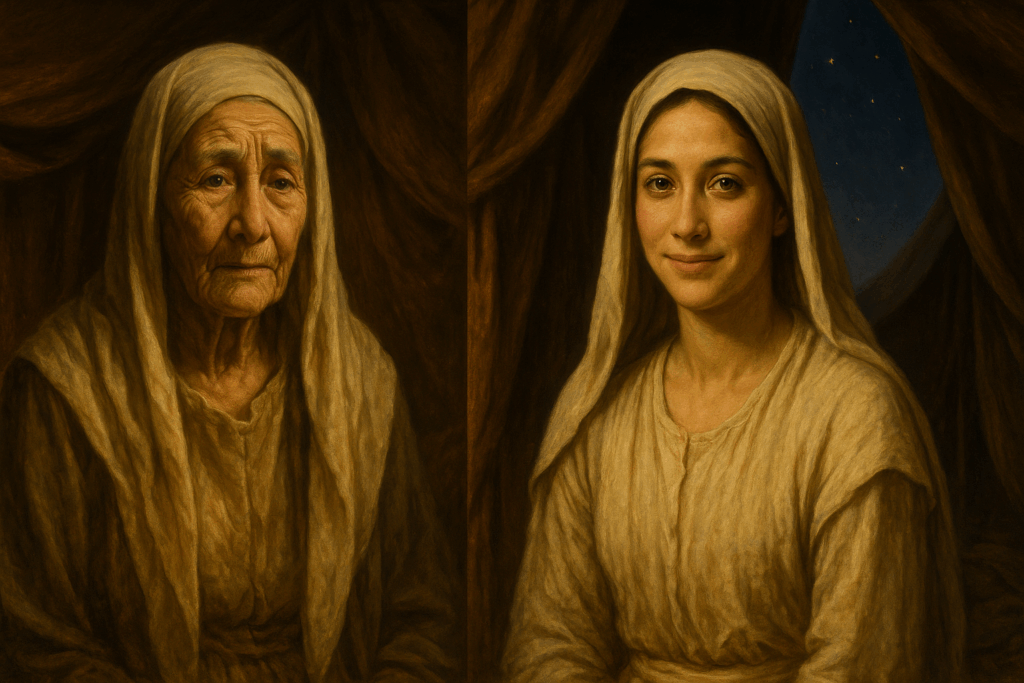
And Sarah laughed within herself, saying, “After I have become worn out, will I have ednah [renewal]?” (Genesis 18:12)
Sarah’s laugh is more than skepticism—it is a question that echoes across millennia. Can aging truly be reversed? Can worn-out tissues regain their youthful vigor? Can biological clocks run backward?
Rashi interprets ednah as the return of menses[1] and smooth skin[2]—a biological rejuvenation embedded in the verse itself. The Midrash and Talmud expand on the miracle: Sarah’s reproductive capacity was fully restored, and her body was transformed. This is not merely about childbearing; it is about the fundamental question of whether aging is reversible.
The Science of Turning Back Time
Modern gerontology reveals that aging is not a single switch that flips at a predetermined age. Rather, it is a complex network of interconnected processes—what researchers call the “hallmarks of aging.” These include genomic instability (DNA damage accumulating over time),[3] epigenetic drift (changes in which genes are active),[4] cellular senescence (cells that stop dividing but refuse to die),[5] stem cell exhaustion,[6] and more.
Here is the revolutionary insight: several of these hallmarks appear to be plastic, not fixed. They can potentially be adjusted, reversed, or reset. Sarah’s question is becoming science’s quest.
Epigenetic Reprogramming: Resetting the Cellular Clock
One of the most promising frontiers involves epigenetic reprogramming—essentially, convincing cells to forget their age. Scientists have discovered that briefly activating a specific combination of factors (called OSKM factors,[7] named after the genes Oct4, Sox2, Klf4, and c-Myc) can reset molecular age markers in cells.
In landmark experiments, partial expression of these factors in mice not only paused aging, it appeared to reverse it.[8] Even more remarkably, in studies targeting damaged retinal neurons, a related cocktail (OSK) restored vision and rolled back DNA methylation patterns—one of the key molecular signatures of aging.[9] The cells became functionally younger.[10]
Senolytics: Clearing Out the “Zombie” Cells
Another avenue targets what scientists call senescent cells—cells that have stopped dividing but refuse to die. Think of them as cellular “zombies”: they do not perform their normal functions anymore, but they hang around, secreting inflammatory chemicals that damage neighboring tissues. These secretions create what researchers call a “senescence-associated secretory phenotype,” or SASP—essentially, chronic low-grade inflammation that accelerates aging in surrounding areas.
Enter senolytics—drugs designed to selectively eliminate these zombie cells. In mice, removing senescent cells has been shown to delay or even reverse several age-related pathologies. More excitingly, early human trials are showing promise. In patients with severe lung scarring (idiopathic pulmonary fibrosis), a short course of two drugs—dasatinib (originally a cancer medication) and quercetin (a plant-derived compound available as a supplement)—proved safe and was associated with improvements in physical function, including increased walking distance.[11] While these are preliminary findings, they suggest the principle works in humans, not just mice.
The Landscape of Aging: Valleys, Ridges, and Renewal
To understand what is happening at a deeper level, imagine cells sitting in “attractor basins” on an epigenetic landscape (Waddington landscape)—a metaphor borrowed from developmental biology and physics. Picture a hilly terrain where balls (cells) settle into valleys (stable cell states). Young cells occupy high, well-organized valleys where genes are precisely regulated—low entropy, high coherence.
As we age, cells gradually roll down into lower, noisier valleys. Gene regulation becomes less precise and more chaotic—higher entropy, lower functional coherence. The cell no longer knows exactly what it should be doing.
Epigenetic reprogramming and senolytics aim to push cells back over the ridge, into the younger, more ordered basins. It is about reducing the molecular entropy of aging—restoring the precise gene regulation patterns that define youthful function. This is not fantasy; it is measurable biochemistry.
The Psalm’s Promise
“Who renews your youth like the eagle.” (Psalm 103:5)
The Psalmist’s image of the eagle—a creature that in ancient tradition was thought to renew itself—resonates with what we are discovering. The biblical miracle of Sarah bearing a child at an advanced age may carry an additional layer of meaning: biological rejuvenation is not metaphysically impossible. It is a challenge, an invitation. If Sarah’s aging were reversed, perhaps the mechanisms exist within nature itself, waiting to be understood and engaged. I see it as a permission, indeed, an imperative to develop the science of age reversal.
Brain Aging: A Personal Research Focus
My current work focuses on one critical aspect of aging: brain aging. Specifically, I research how a particular stage of sleep, called “slow-wave sleep,” can reactivate the glymphatic clearing system—the brain’s sophisticated waste-removal network that operates primarily during sleep.
During deep sleep (known as the slow-wave sleep), the glymphatic system gives the brain a thorough cleansing, flushing out amyloid-beta and other misfolded proteins and pathogens that accumulate during waking hours. This nightly maintenance is crucial for keeping a young and healthy brain. When this system functions optimally, it may help prevent or delay the onset of neurodegenerative conditions. Understanding and enhancing this natural renewal process represents another avenue for pushing back against biological aging—this time, protecting the organ that makes us who we are.
From Miracle to Medicine: What This Means Now
Full-body age reversal is not yet here—we are not about to see 90-year-olds transform into 30-year-olds anytime soon. However, targeted rejuvenation is transitioning from science fiction to legitimate research. We are at the beginning of a profound shift in how we understand aging: not as an inexorable decline, but as a potentially modifiable process.
For now, the most effective interventions remain decidedly unglamorous but powerfully proven: plentiful, high-quality sleep, both aerobic and resistance training, a healthy diet, and maintaining cardiovascular and metabolic health. These are not just “wellness tips”—they are the foundation that allows our cellular repair systems to function optimally. Meanwhile, we must cautiously and rigorously translate epigenetic and senolytic therapies through clinical trials, ensuring they are safe and effective before widespread use.
Between miracle and medicine lies our mandate: to study, to understand, to heal, to cultivate life’s renewal and extension. Sarah’s laugh—born of disbelief—transformed into Isaac’s birth (Isaac, in Heb. Yitzchak, means “he will laugh.”) Isaac was the paragon of modern longevity—he lived to be 180 years old. The Lubavitcher Rebbe once said that Isaac is our father, and we can all potentially live to be 180 years young, as he did—Amen to that!’ Perhaps our own skepticism about conquering aging will likewise transform into joy as science uncovers the mechanisms of rejuvenation.
A longer healthspan is not beyond the horizon. And while we work toward it, we can honor the deeper wisdom: to live fully and meaningfully now, to make every moment count. That itself is a form of renewal and life extension—one available to us today.
[1] Gen. Rabbah 48:17.
[2] Heb. “smooth flesh,” עֶדְנָה, is cognate with an expression of time, עִדָּן, interpreted as a period. Tan. Shoftim 18.
[3] Genomic instability in aging refers to an increased tendency to acquire genetic alterations of various kinds, resulting from increased DNA damage and less-than-perfect replication/repair, and mitotic control. It includes, but isn’t limited to: single-nucleotide variants and small indels that accumulate with age in many tissues, chromosomal/structural lesions, replication stress–driven damage, and mitochondrial genome instability. Mechanistically, this hallmark reflects both more damage (endogenous ROS, mobile elements, replication errors) and less faithful upkeep (age-impaired DNA repair/checkpoints). It’s one of the canonical hallmarks of aging.
[4] Simply put, epigenetic drift is the age-related, partly random “blurring” of the epigenome, which makes gene regulation less precise as we age. More precisely, epigenetic drift refers to the gradual, mostly stochastic change in epigenetic marks—especially DNA methylation—across cells and over time, resulting in increased variability and “noisier” gene regulation with age. Global patterns tend to lose methylation at repeats, while some promoter CpG islands gain methylation; histone marks and chromatin accessibility also shift. Together, these changes make epigenetic states more heterogeneous within a tissue. Classic twin studies show young monozygotic twins are epigenetically similar, but older twins diverge markedly—textbook evidence of age-related drift. Longitudinal twin work confirms divergence over a decade. Imperfect maintenance of methylation during DNA replication, plus environmental/exposure effects, introduces small errors that accumulate, creating epigenetic mosaicism. Drift is linked to dysregulated transcription, stem cell exhaustion, immunosenescence, and increased cancer risk, as clones with advantageous (but aberrant) characteristics expand. It is one pillar of the broader hallmark epigenetic alterations in aging.
[5] Aging of cells. Most senescent cells die through apoptosis—self-destruction, or cellular suicide. If senescent cells don’t self-destruct, they become toxic. With aging, the number of senescent cells increases, which contributes to inflammation—one of the primary causes of aging.
[6] Stem-cell exhaustion is an age-related decline in both the number and function of tissue stem cells, characterized by reduced self-renewal, impaired differentiation, and increased senescence. It is driven by accumulated damage, epigenetic alterations, telomere attrition, mitochondrial and niche/inflammatory changes—yielding poorer maintenance and repair of tissues.
[7] OSK and OSKM are sets of Yamanaka factors—transcription factors used to reprogram cells. They bind regulatory DNA, remodel chromatin, and reset epigenetic programs toward pluripotency. In longevity work, OSK (without c-Myc) is often used for partial or transient reprogramming to reduce tumor risk and avoid full loss of cell identity, whereas OSKM reprograms more aggressively but carries higher oncogenic/teratoma risk due to c-Myc.
[8] Ocampo, A., Reddy, P., Martinez-Redondo, P., et al. (2016). “In Vivo Amelioration of Age-Associated Hallmarks by Partial Reprogramming.” Cell, 167(7):1719-1733.e12. doi: 10.1016/j.cell.2016.11.052.
[9] Lu, Y., et al (2020). “Reprogramming to recover youthful epigenetic information and restore vision.” Nature, 588(7836):124-129. doi: 10.1038/s41586-020-2975-4.
[10] Karg, M.M., Lu, Y.R., Refaian, N., Cameron, J., Hoffmann, E., et al. (2023). “Sustained Vision Recovery by OSK Gene Therapy in a Mouse Model of Glaucoma.” Cellular Reprogramming, 25(5):188-200. doi: 10.1089/cell.2023.0074.
[11] Baker, D., Wijshake, T., Tchkonia, T. et al. Clearance of p16Ink4a-positive senescent cells delays ageing-associated disorders. Nature 479, 232–236 (2011). https://doi.org/10.1038/nature10600


Alle Entitäten sind von den „bezeugten Zeiten“ (MOÃDIM) des ADoNaJ abhängig, gepriesen sei der HaScheM. Diese Zeiten sind jedoch beim Menschen nicht unverrückbar festgelegt, sondern sie sind variabel. Zu diesen Zeiten gehören alle relevanten Gesichtspunkte des Lebens. Und wie aus dem Buch BöReSchIT, Kapitel 1 Vers 14, eindeutig hervorgeht, sind die „bezeugten Zeiten“ somit der erste gemeinsame Nenner, auf den im Denken des Menschen offensichtlich schon sehr früh zusammengelaufen sind. Und seit ADaM und ChaWaH gehören alle Prozesse des Lebens zu den „bezeugten Zeiten“, die sich nach den „Gelichten“ am Himmel ausrichten. Im besagten Vers aus dem 1. Buch MoSchäH heißt es: „Und ÄLoHIM sprach: Es wird, dass Gelichtete im Firmament der Himmel, zu scheiden zwischen dem Tag und der Nacht. Und sie werden zu Zeichen und zur Bestimmung von „bezeugten Zeiten“ und zu Tagen und Jahren.
Auch ABhRaHaM und SsaRaH sind den „bezeugten Zeiten“ unterworfen. Und auch für sie gelten somit die vom ADoNaJ, gepriesen sei der HaScheM, eingesetzten Faktoren von „Zeugung“, „Schwangerschaft“, „Geburt“ und „Tod“. Alle diese Aspekte, die der höheren Ordnung des ADoNaJ folgen, gepriesen sei der HaScheM, sind Voraussetzungen für das Leben. Und dass die TORaH diesem Faktor eine eigene Beschreibung widmet, zeugt dafür, dass im Rahmen des Lebens die „bezeugte Zeit“ (MOẼD) schon zu archaischen Zeiten für unsere Vorfahren sehr wichtig war.
Der Beitrag „Und Sarah lachte: Ein kurzer Rundgang durch echte Langlebigkeitsforschung“ erscheint mir besonders informativ zu sein und Fakten zur Diskussion zu stellen, die eine neue Betrachtungsweise aufzeigen. Wenn wir uns in diesem Zusammenhang das biblische Alter des Menschen betrachten, dann dürfen wir dies nicht pauschal machen. So war das Alter des „Vor-Sintflut-Menschen“, die wir eigentlich als MaBUL und somit als „Wasserwirre“ bezeichnen müssen, deutlich höher als das Alter des Nach-MaBUL-Menschen. Die in 1. Buch MoSchäH, Kapitel 6 Vers 3 erwähnte Zahl von 120 Jahren dürfen wir in der Regel nicht als eine absolute Begrenzung der individuellen menschlichen Lebensspanne interpretiert. In Rahmen dieser Vorstellung gibt es für diese TaNaKh-Passage zwei theologische Interpretationen. Die gängigste Auslegung besagt, dass die 120 Jahre die Zeitspanne waren, die der Menschheit vor dem Gericht des ADoNaJ, gepriesen sei der HaScheM, durch die MaBUL gewährt wurde, um Buße zu tun. In dieser Zeit hat NoaCh die TeBhaH (Arche) gebaut.
Nach der Zeit der MaBUL fand eine allmähliche Verringerung der Lebensspanne statt. Eine andere Sichtweise ist, dass der ADoNaJ, gepriesen sei der HaScheM, das maximale Lebensalter des Menschen nach und nach auf ungefähr 120 Jahre reduziert hat. Dies wird durch die Tatsache gestützt, dass die Menschen nach dem MaBUL-Ereignis immer noch deutlich älter wurden (NoaCh lebte 950 Jahre, ABhRaHaM 175 Jahre), das Alter aber im Laufe der Generationen kontinuierlich sank. Der älteste in der TORaH erwähnte Mensch, MöTUSchäLaCh (Methusalem), erreichte ein Alter von 969 Jahren. In der samaritanische TOLöDOT-Liste hat er allerdings lediglich ein Alter von 720 Jahren erreicht. Es sei hier angemerkt, dass die moderne Wissenschaft 120 Jahre für die obere Grenze der natürlichen menschlichen Lebensspanne hält. !20 Jahre ist also ein Alter, das bisher nur in einem dokumentierten Fall (Jeanne Calment, 122 Jahre) überschritten wurde. Im Buch BöReSchIT, Kapitel 18 Vers 11 steht in diesem Zusammenhang: „Aber ABhRaHaM und SsaRaH waren Alte, ja Hochbetagte, abgelassen hatte es für SsaRaH, dass ihr wurde gemäß der Weiber Pfad.“ Und trotzdem muss man sich, wie es Dr. Alexander Poltorak macht, die Fragen stellen: „Kann das Altern rückgängig gemacht werden? Kann abgenutztes Gewebe seine jugendliche Vitalität zurückgewinnen? Können biologische Uhren rückwärtslaufen?“
Durch einen medizinischen Vorgang kann heute eine Refertilisation bei der Frau durch eine Wiederherstellung der Eileiter herbeigeführt werden, um dadurch den Transport von Eizellen wieder zu ermöglichen. Dieser Eingriff, der oft mikrochirurgisch per Bauchspiegelung durchgeführt wird, kann eine natürliche Schwangerschaft ermöglichen. Oftmals reicht aber schon eine Hormonbehandlung. Tatsache ist, dass auch ältere Frauen noch einen Eisprung haben können, aber die Fruchtbarkeit nimmt mit dem Alter stark ab, vor allem nach dem 40. Lebensjahr. Solange eine Frau keine Menopause (12 Monate ohne Regelblutung) hat, ist ein Eisprung möglich und eine Schwangerschaft kann eintreten. Und selbst wenn die Liebeslust (Ä̃DNaH) nicht mehr vorhanden ist, wie es im 1. Buch MoSchäH, Kapitel 8 Vers 12, heißt und sich SsaRaH fragt, ob ihr nach ihrem Vernütztsein wieder eine Erneuerung (Ä̃DNaH) widerfährt, beweist ihr Sohn, dass sie als alte Frau noch Nachkommen zeugen konnte. Wie dem auch sei: Wir müssen uns darüber im Klaren sein und den Umstand umfänglich akzeptieren, dass dem ADoNaJ, gepriesen sei der HaScheM, nichts unmöglich ist.