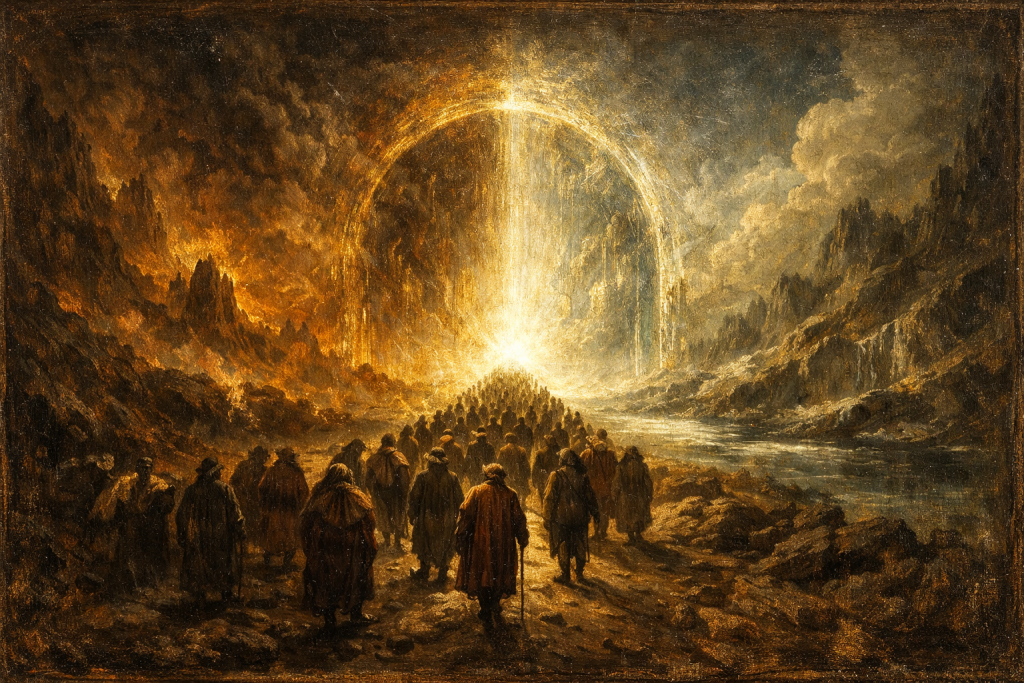
Dedicated to the speedy and complete recovery of Rachel bat Sarah
Introduction
The Exodus from Egypt (Yetziat Mitzrayim) can be read as a rapid collective reconfiguration: the Israelite population, long trapped in a stable “slave phase,” abruptly reorganizes into a new macroscopic state: publicly distinct, synchronized, and capable of coordinated action. Landau phase-transition theory is a phenomenological language for describing exactly that kind of transformation: stability as a free-energy minimum, resistance as barriers and metastability, and sudden change as a discontinuous transition triggered by external driving and nucleation.
Landau theory is essentially a way to predict when a substance will suddenly change its “personality,” such as water turning to ice or a block of metal becoming magnetic, by using a simple mathematical “map.”
Israelites in Egypt were not simply “unhappy” or “oppressed”; they existed in a fundamentally different state than what they would become. The Exodus was not gradual emancipation but a phase transition: from slavery to freedom, from a collection of tribes to a chosen nation, from Egyptian subjects to G-d’s people.
1. Phase Transitions: First-Order and Second-Order
A phase transition is a dramatic, qualitative transformation in which a system doesn’t merely change by degree but becomes something fundamentally different. The key insight is that these changes are often sudden and complete rather than gradual. Such discontinuous transitions are called first-order transitions. However, second-order transitions can be gradual, in which quantitative changes become qualitative, leading to the emergence of a new phase.
At 32°F, water doesn’t just get “very cold.” It reorganizes into an entirely new crystalline structure: liquid above freezing, solid below. The transition is sharp and discontinuous.
- Each kernel of popcorn sits unchanged as the temperature rises, then, suddenly and explosively, transforms into something qualitatively different. There’s no “half-popped” state. Individual psychology can shift gradually, then suddenly tip into collective behavior with entirely different dynamics, as when a crowd becomes a mob.
Physicists distinguish between transitions that involve a sudden, discontinuous jump (first-order) into a new attractor and those that are continuous (second-order). Boiling water is first-order: there is latent heat, bubbles, and a clear before-and-after. The Exodus, as we’ll see, has this character of sudden, dramatic rupture rather than gradual evolution.
As we discussed in the previous essay, a second-order transition is observed in a ferromagnetic material, such as iron, as its temperature is lowered below its Curie point, gradually acquiring magnetic properties.
2. Landau’s Framework for a Driven, Asymmetric First-Order Transition
2.1 Order parameter
In physics, things are usually either messy (disordered) or neat (ordered). The order parameter is just a number we use to measure that neatness. An order parameter is a quantity that distinguishes between phases: it is zero (or minimal) in one phase and takes on a definite value in another. It measures “how much” of the new phase character is present.
For example, at high temperatures, everything is chaotic. Molecules are zooming around like a crowd at a busy train station. The Order Parameter is 0 because there’s no specific pattern. On the other hand, at low temperatures, things settle down. The crowd stops moving, and everyone sits in neat rows of chairs. The Order Parameter is now non-zero (e.g., 1) because a pattern has emerged.
To develop an intuition for this concept, let us consider some familiar examples. Imagine a dance floor. If everyone is dancing wildly to their own rhythm, the “order” is zero. If everyone suddenly starts doing the same dance moves in unison to the beat, the “order parameter” spikes. It indicates a phase transition (from “random dancing” to “line dancing”) has occurred. Or consider a wedding. While the music plays and everyone is dancing, the order parameter is low (depending on how chaotic the dancing is, it is either 0 or near 0). When the music stops, all guests go back to their tables and take their assigned seats. The order parameter is non-zero now at its maximum, indicating a transition from dancing to organized sitting.
In physics, an order parameter has to do with changes in the phase of matter: liquid-to-solid, or liquid-to-gas. For example, liquid water has no preferred direction. Ice has a definite crystalline axis. The degree of crystalline order serves as the order parameter. When birds fly randomly, there is no collective direction (order parameter ≈ 0). When they suddenly flock together, moving as one, a definite direction emerges. Above a critical temperature, a piece of iron has no net magnetization; the atomic magnets point randomly. Below that temperature, they align, creating a measurable magnetic field. Magnetization is the order parameter: zero above the transition, non-zero below.
A good order parameter must capture the essential difference between phases: the thing that is zero in one state and “switched on” in the other. What quantity distinguishes enslaved Israel from redeemed Israel? Several candidates emerge:
Covenantal consciousness: In Egypt, Israel had memories of the patriarchal covenant but no active relationship with G-d as a nation. After Sinai, the covenant is alive: codified, embodied, practiced.
National identity: Scattered tribes with shared ancestry become a unified people (am) with shared law, mission, and destiny. Exodus from Egypt is the birth of the Jewish nation.
Freedom/agency: The capacity for self-determination, absent in slavery, becomes the defining characteristic of the new state.
The order parameter for the Exodus can thus be understood as collective covenantal identity: minimal in Egypt and increasingly manifest throughout the Exodus, reaching full expression at Sinai.
2.2 Free energy
Nature is lazy and efficient. It always wants to be in the state that requires the least “effort.” In physics, this effort is called Free Energy (F). Free energy is nature’s “score” for a system: lower is better, and systems naturally evolve toward states of minimum free energy. Think of it as a landscape where a ball always rolls downhill to the lowest valley. Just as a ball rolls to the lowest accessible point to minimize its energy, a stretched rubber band “wants” to contract because the contracted state has lower free energy. Similarly, salt crystals spontaneously dissolve in water (up to a point) because the dissolved state has lower free energy than a separate crystal and water.
Free energy is a tug-of-war between two things: the internal energy (the desire to be still and bonded, which dominates when it’s cold), and the entropy (the desire to be free and messy, which dominates when it’s hot).
Landau’s genius was realizing that you can write a simple equation for Free Energy based entirely on the Order Parameter. He pictured Free Energy as a landscape—a series of hills and valleys.
Imagine such a landscape. Free energy tells you the elevation at each point. The system’s current state is a ball somewhere on this landscape. Over time, it will roll to the nearest valley floor. But here is the key: the shape of this landscape can change with conditions (temperature, pressure, external forces). When conditions change, valleys can become hilltops and vice versa—forcing the ball to roll to an entirely new location.
In Egyptian conditions, Israel’s “lowest energy state”—their stable configuration—was slavery. The system had settled into this valley. For liberation to occur, the energy landscape itself had to be reshaped. The plagues weren’t just punishment; they were a systematic restructuring of the energetic landscape, making the slavery-state unstable and the freedom-state favorable.
2.3 Critical threshold (tipping point)
The tipping point is the critical moment when a system can no longer remain in its current phase—the old valley has become a hilltop, and the system must roll to a new state. It is the point of no return.
Let us consider a few simple examples. You can sometimes cool water below freezing without it solidifying—it’s metastable, sitting on a hilltop. But tap the glass, and it instantly freezes. It was past the tipping point, waiting for a trigger.
A pencil balanced on its tip is theoretically stable, but the slightest perturbation sends it falling. The balanced state is past its tipping point—any fluctuation triggers collapse into a new state.
These concepts are not restricted to physics. Take social movements, for example. Grievances accumulate invisibly until one incident—a Rosa Parks moment—triggers cascade effects that were “waiting to happen.” Although the context is different, physics is the same.
Systems near tipping points become exquisitely sensitive. Small perturbations that would normally dampen out instead get amplified. The system fluctuates wildly, as if uncertain which way to fall.[1]
2.4 External driving field h(t)
Landau theory introduces the free energy F and an order parameter ϕ, a coarse-grained variable that captures the macroscopic state on which F depends.[2]
Landau also allows an external field h conjugate (that is, directly related[3]) to the order parameter (ϕ), which tilts the landscape (biasing the system toward larger or smaller ϕ.[4]
Mathematically, the linear “field term” is the clean representation of an external driver that pushes the order parameter in a preferred direction. In this essay’s mapping, h(t) is the exogenous divine force acting through command, signs, and plagues—not merely internal social dynamics.
In what follows, we treat the divine intervention in the plagues and commands as an explicitly time-dependent driving field, h(t).
3. First-order dynamics
3.1 Metastability and barriers
A metastable state is one that appears stable—and can persist for a very long time—but is not the most stable state available. The system is stuck in a local valley, not the deepest valley. Given sufficient perturbation, it will transition to the truly stable state and never return.
Imagine a ball resting in a small depression partway up a hillside. It’s not rolling anywhere—it is locally stable. But a deeper valley exists below. The ball would “prefer” to be there (lower energy), yet it cannot reach that valley without first climbing over the rim of its current depression. That rim is the energy barrier. The ball is metastable: stable against small nudges, vulnerable to large ones.
Let us consider a few examples. Water cooled carefully below 32°F (0°C) can remain liquid metastably. It “should” be ice, but the nucleation barrier traps it in the liquid state. Tap the container, and it freezes instantly. Another familiar example is a diamond. Chemically, diamond is a metastable form of carbon. Graphite is actually more stable at room temperature. Yet diamonds persist for geological ages because the energy barrier to conversion is enormous. A book balanced on its edge can stand for hours, but this isn’t its lowest-energy orientation. A small push sends it flat—the truly stable state—and it won’t spontaneously stand back up.
Metastable states can be deceptive. Because they persist—sometimes for centuries—they appear permanent. But they are living on borrowed time. The transition, when it comes, is often sudden and irreversible.
3.2 Hysteresis
Hysteresis means the system’s state depends not only on current conditions but on its history—the path it took to get here. The transition point going forward differs from the transition point going backward. The system has memory.
Consider: the temperature at which water freezes (going down) is not always the same as the temperature at which ice melts (going up). You can supercool water below 32°F (0°C), but you cannot superheat ice above 32°F at normal pressure. The forward and backward paths are asymmetric.
Here are some examples. Magnetize a piece of iron by applying a strong field. Now reduce the field to zero. The iron remains magnetized—it does not return to its original unmagnetized state. To demagnetize it, you must apply a field in the opposite direction. The magnetization “lags behind” the driving force. This lag is hysteresis. It is often easier to damage trust than to repair it. The path into friendship differs from the path out of estrangement. Emotional systems exhibit profound hysteresis.
Hysteresis means you cannot simply reverse a process by reversing the conditions. The system has changed along the way. The return requires a different path than the departure.
3.3 Nucleation
Nucleation is how phase transitions actually begin—the formation of a tiny seed or nucleus of the new phase within the old one. Even when conditions favor transformation, the system needs a starting point, a foothold from which the new phase can grow.
Here is the puzzle: even when a phase transition is thermodynamically favorable (the new phase has lower free energy), it does not happen instantaneously throughout the system. Why? Because creating the interface between old and new phases costs energy. A tiny droplet or a “bubble” of the new phase is mostly surface, and that surface tension makes small nuclei energetically unfavorable. They tend to revert to the old phase.
Only when a nucleus reaches a critical size does it become self-sustaining. Below this threshold, it shrinks and vanishes. Above it, it grows spontaneously, converting more and more of the old phase.
Everyday examples illustrate this phenomenon: in boiling, bubbles nucleate on microscopic scratches in the pot or dissolved gas particles, and without such nucleation sites, water can superheat and then boil explosively when disturbed. In carbonated drinks, CO₂ escapes preferentially from scratches or dropped-in objects like Mentos, because those surfaces seed bubble formation. Similarly, honey can remain supersaturated for months before rapidly crystallizing when a seed crystal or even dust is introduced. In cloud formation, water vapor condenses or freezes around particles such as dust, pollen, or bacteria, which is why cloud seeding works by adding artificial nucleation sites.
There are two types of nucleation: homogeneous and heterogeneous. Homogeneous nucleation occurs spontaneously through random fluctuations—molecules happen to cluster in the right configuration. This is rare and requires significant supercooling or supersaturation. Heterogeneous nucleation occurs on pre-existing surfaces, impurities, or defects that lower the energy barrier. This is far more common in nature. A scratch on a glass, a speck of dust, or an introduced seed provides scaffolding that makes nucleus formation easier.
Nucleation plays a critical role in phase transition. Not surprisingly, it played a critical role in the Exodus as well, a phase transition from slavery to freedom.
Nucleation is central because it explains why a favorable transition to a new attractor still needs a concrete trigger and a mechanism for local growth.
3.4 Latent heat
During a phase transition, energy is absorbed or released without a change in temperature. This energy does not make things hotter or colder—it goes entirely into reorganizing the system’s internal structure. This hidden energy is called latent heat (from Latin latere, “to lie hidden”).
Heat a pot of ice. The temperature rises steadily until it reaches 32°F, then stops rising. You keep adding heat, but the temperature refuses to budge. Where is the energy going? Into breaking the bonds of the crystal lattice, converting rigid ice into flowing water. Only after all the ice melts does the temperature resume climbing.
Similarly, boiling water stays at exactly 212°F no matter how high you turn the flame. The energy is absorbed during the phase change, liberating molecules from the liquid to the gas phase.
Everyday examples illustrate this concept. Evaporating sweat absorbs latent heat from your skin, cooling you without making the sweat “hotter,” and steam at 212°F causes worse burns than water at 212°F because steam releases latent heat as it condenses on your skin, delivering extra energy beyond its temperature. Ice absorbs latent heat as it melts, which is why ice packs cool more effectively than merely cold water at the same temperature. Water vapor condensing into rain releases enormous latent heat into the atmosphere, powering the storm’s updrafts, causing thunderstorms, and intensifying the weather system.
Whether latent heat is absorbed or released depends on the direction of transition: melting, evaporating, dissolving absorb latent heat (endothermic); freezing, condensing, crystallizing release latent heat (exothermic). The transition from a disordered to an ordered phase typically releases energy; the reverse absorbs it.
The Exodus phase transition, from disordered slavery to a new attractor—ordered covenantal nationhood—should release latent energy. And indeed, the narrative records remarkable energy releases at the moment of transition. Israel leaves not empty-handed but laden with Egyptian gold, silver, and clothing. The Egyptians thrust wealth upon them: “and they despoiled Egypt.” This material abundance is the economic manifestation of latent heat release: stored energy in the Egyptian system, transferred to Israel at the phase boundary.
4. Mapping Landau’s Concepts onto Exodus
4.1 Narrative
Jews became enslaved in Egypt, subjected to harsh labor. This stable enslaved regime in Egypt can be considered a social “phase.” Moses and Aaron, sent by G-d to redeem the Jewish people from slavery, emerge as catalytic leaders. The Ten Plagues (makot) are visited upon Egypt, thereby accelerating the redemptive process through “signs and wonders.” The Passover night threshold protocol—sacrifice, blood on the doorposts (mezuzot) and lintel—acts as an internally synchronized collective act harmonizing the Jewish people.
Immediate post-exit stabilization commands that function as persistent “seeds” and synchronizers: the commandment to keep calendar (Rosh Ḥodesh), and the “sign” on the hand and between the eyes (the textual root of tefillin). All these elements map precisely on the first-order transition in Landau theory.
Taken together—persistent resistance followed by sudden expulsion, a clear threshold event (the tenth plague), and a distributed nucleation protocol (Passover enacted household-by-household but in synchrony)—the Exodus reads like a driven first-order transition rather than a gradual, continuous reform.
4.2 Order parameter ϕ as a “unity index”
Let us define ϕ as a “unity index”: how well the Israelites can act together as one people rather than as isolated, easily controlled individuals. When ϕ is low, the people are fragmented and easily managed; when ϕ is high, they can follow shared commands, move together, and maintain a distinct public identity.
In Egypt, ϕ is near zero—fragmentation, fear, and externally imposed structure. Thus, the Torah tells us:
So Moses spoke thus to the Israelites, but they did not listen to Moses because of shortness of breath and because of harsh labor. (Exodus 6:9)
As the process advances, ϕ rises sharply toward a new stable value. G-d tells Moses that after one more plague, Pharaoh will send Israel out—indeed, drive them out (Exodus 11:1). After Moses relays the Passover message and what will happen that night, the Torah records Israel’s response:
In the original Hebrew, the Torah describes “the people” as ha-am (“the nation”), indicating a higher degree of national unity and coherence—i.e., higher ϕ.[5]
4.3 Pre-exodus commandments as synchronizers and “seeds”
Alongside the plagues and Passover, the Torah gives several mitzvot before the departure that function as synchronizers and stabilizers of the emerging unity. Sefer Yetzirah describes reality in three “dimensions”: olam (space), shanah (time), and nefesh (soul/spirituality). The pre-exodus commands mark nationhood in all three. In space (olam), people marked doorposts and lintels with the blood of the Passover sacrifice, establishing the root source of the later mezuzah motif as a household boundary marker. In time (shanah), they sanctified the new moon and began a shared calendar (Rosh Ḥodesh), giving the people a synchronized temporal reference frame. In soul (nefesh), the command of a “sign” on the hand and between the eyes (the textual root of tefillin) embedded collective memory in the body.
In Landau language, these coordinated practices increase ϕ and reshape the free-energy landscape, thereby lowering the barrier between the slavery and freedom phases.
4.4 External driving field h(t): the plagues as pulsed forcing
In a purely endogenous story, one might treat the “control parameter” as an internal stressor (oppression, demographics, economic strain). Exodus insists on something else: an external, purposive driver acting into history.
Landau’s (h) term is the correct formal analog: the system is not drifting neutrally; it is being driven. The narrative frames this as a planned sequence of interventions—“signs and wonders” with Pharaoh’s resistance anticipated as part of the process. “I will harden Pharaoh’s heart… and multiply My signs and wonders.”
So, read phenomenologically: h (t) increases in staged pulses (plagues); those pulses do not merely “persuade” but reshape the effective stability of the Egyptian free energy basin, and they bias the entire system toward higher ϕ.
The ten plagues systematically move Egypt and Israel toward a tipping point. Each plague disrupts Egyptian stability while strengthening Israelite distinctness (note how later plagues spare Goshen). By the tenth plague, the death of the firstborn, the tipping point is reached. Pharaoh doesn’t gradually negotiate better terms—he expels Israel in the middle of the night. The transition is sudden, complete, and discontinuous. This is first-order phase transition behavior.
In the Landau language, the plagues do two things at once. They increase the effective field h(t), thereby escalating external pressure and pushing toward liberation. They also change the “material parameters” of the Egyptian state—effectively altering the coefficients of the Landau polynomial by degrading infrastructure, legitimacy, and the regime’s stability mechanisms.
The important narrative point is that a single shock does not trigger the transition; it is engineered through successive pulses until the old minimum is no longer tenable. The “multiply signs and wonders” framing is a near-perfect textual analog of a driven, staged destabilization.
4.5 Barrier reinforcement and hysteresis: Pharaoh’s hardening
A classic signature of a first-order transition is hysteresis: the old phase persists stubbornly even as the landscape tilts. Exodus gives that persistence a name: hardening.
In Landau terms, hardening corresponds to maintaining or even raising the barrier that prevents ϕ from rolling into the new basin. The “release” does not occur at the first sign of pressure; it occurs only after repeated driving and after a threshold protocol is enacted (Passover).
This is why the plagues are not redundant. They read like a controlled parameter sweep in a metastable regime: repeated shocks push the system, but the state remains trapped until the barrier is finally breached.
4.6 Metastability and hysteresis in the people’s response
Israel’s condition in Egypt was metastable. They had adapted to slavery, developed survival strategies, and achieved a kind of equilibrium. Generations passed. The state appeared permanent—stable enough that the Israelites themselves could not envision an alternative (“Let us alone that we may serve the Egyptians”).
But this stability was local, not global. A state of freedom—the deeper valley—existed, inaccessible across an enormous barrier of Egyptian power, Israelite conditioning, and the sheer improbability of liberation. The plagues supplied the activation energy to overcome that barrier, destabilizing the metastable state until the system tumbled into its true minimum.
The concept of metastability also illuminates why Israel could not simply “decide” to leave. You cannot wish a ball over a barrier. Energy must be supplied from outside the system.
Hysteresis is crucial for understanding why the Exodus could not be a simple reversal of enslavement. Israel did not enter Egypt as slaves—they entered as honored guests of Joseph’s family, were gradually subjugated, and over centuries had their identity eroded, their agency stripped, their self-conception warped.
Reversing this wasn’t a matter of removing Pharaoh’s decrees. The people themselves had been transformed by centuries of bondage. When Pharaoh initially increased their labor, the Israelites blamed Moses, not Pharaoh—a response shaped by the psychology of oppression. When offered freedom, their first instinct was often to return to the familiar metastable state (“We ate fish and garlic in Egypt”).
The path out of Egypt was longer, harder, and utterly different from the path in.
4.7 Nucleation in Yetziat Mitzrayim
The concept of nucleation raises a profound question for the Exodus narrative: Where did the new phase begin?
A nation cannot transform all at once from within. Something must serve as the nucleus—the seed of the new phase around which transformation crystallizes.
Moses himself functions as a nucleation site. Raised in Pharaoh’s house yet maintaining Israelite identity, educated in Egyptian wisdom yet called at the burning bush, he embodies the new phase in his person before it exists in the nation. His encounter with G-d at Horeb is the formation of the critical nucleus—small enough to be one man’s experience, yet containing within it the complete pattern of what Israel will become.
Aaron—the older brother of Moses—meets Moses upon his return from Midian and embraces him. Aaron becomes Moses’ mouthpiece and the second nucleation site.
The family structure of the Paschal lamb—“a lamb for each household”—creates distributed nucleation sites throughout Goshen. Rather than one large nucleus trying to grow against resistance, countless small nuclei form simultaneously, each household becoming a seed crystal of the new covenantal reality.
In Exodus, Moses and Aaron function as localized, directive centers through which the external field h is applied into the social medium.
The text describes their pairing in explicitly “transduction” terms: Aaron becomes Moses’ mouthpiece; Moses stands “as G-d” to Pharaoh and Aaron as his prophet.
Phenomenologically, Moses and Aaron are not merely leaders; they are the channels through which the driving field couples to the system’s degrees of freedom. They reduce “activation energy” by converting an abstract promise into an executable protocol: who does what, when, and with what public signals.
This is heterogeneous nucleation: G-d does not wait for Israel to spontaneously fluctuate into readiness (homogeneous nucleation is slow and uncertain). Instead, He provides the nucleation sites—Moses, Aaron, the elders, the Passover lamb for each household—that catalyze the transition.
4.8 Passover as distributed nucleation
If Moses and Aaron are catalytic sites of nucleation, Passover is the distributed nucleation protocol: it creates countless local domains of the new phase at the household level, all synchronized.
The blood on the doorposts and lintel is explicitly commanded:
They shall take some of the blood and put it on the two doorposts and the lintel… (Exodus 12:7)
The household becomes a locally ordered domain (a droplet of the new phase). The marking of the doorway is a boundary condition: the domain is declared, made visible, and protected in the narrative logic (“the sign” that differentiates). The key is simultaneity: nucleation does not happen as scattered rebellions; it happens as a coordinated percolation event—many droplets exceeding criticality together, producing a macroscopic jump.
This is why Passover is not only a commemoration; it is the mechanism of transition.
4.9 Calendar reset as synchronization
Exodus introduces a radical act of collective phase-coherence: time itself is reset around liberation.
This month shall mark for you the beginning of the months…” (Exodus 12:2)
In Landau terms, a phase transition requires not only a new minimum but coherence across the system. A shared calendar is a synchronization operator: it couples distant households into a single rhythm, so that nucleation is coordinated rather than thermally noisy.
Put simply, the transition is clocked by the calendar. The people are not merely escaping; they are being entrained into a common temporal reference frame whose zero-point is freedom.
4.10 Tefillin as “pinning” memory into the body
Immediately after the exit, Exodus frames memory as an embodied sign: “a sign on your hand… between your eyes.” (Exodus 13:9)
In a driven first-order transition, post-transition relaxation can revert unless the new phase is stabilized. The embodied sign functions like persistent local pinning: it keeps ϕ from decaying by embedding the transition into daily, physical practice. It prevents the system from “forgetting” the field history that created the new basin.
4.11 Doorposts (mezuzot) as boundary markers
Strictly speaking, the formal mezuzah command (writing words on doorposts) appears in Deuteronomy, not Exodus, but Exodus already identifies the doorpost (mezuzah) as the critical threshold surface in the transition protocol through blood marking.
So, within the Exodus frame, the doorpost is already established as the boundary where identity is declared. Later, Torah law stabilizes that boundary marker into a permanent covenantal inscription.
Conclusion
Read through Landau’s framework, Exodus appears to be a driven first-order transition in the collective order parameter ϕ (unity-as-coherence) under a time-dependent external field h(t) (divine intervention applied through Moses and Aaron and realized through “signs and wonders”).
The Ten Plagues function as staged increases in that external driving and as progressive reshaping of the old regime’s stability landscape, while Pharaoh’s hardening is the narrative analog of barrier persistence and hysteresis.
Most importantly, the transition is not only forced from above; it is nucleated from within through commanded protocols that create synchronized “bubbles” of the new phase across the entire population: Passover sacrifice and blood on the doorposts and lintels, the calendrical reset that entrains collective time, and the embodied “sign” (tefillin) that pins the new order into daily practice.
In this reading, the genius of Exodus is not merely that the barrier breaks; it is that the text supplies a complete nucleation-and-stabilization package—leadership as catalytic coupling, plagues as external driving, and ritual/time/body as the mechanisms by which a discontinuous jump becomes a durable macroscopic phase.
Further Reading
Landau, L. D. “On the Theory of Phase Transitions” (1937).
Goldenfeld, Nigel. Lectures on Phase Transitions and the Renormalization Group (1992).
Weimer (lecture notes). “Landau Theory for Phase Transitions.”
Olmsted, P. D. “Lectures on Landau Theory of Phase Transitions.” (Georgetown Physics)
Endnotes:
[1] Landau theory shows us how the shape of that landscape changes as the temperature (T) drops.
Phase 1: High Temperature (the Single Bowl)
When it is hot, the Free Energy landscape looks like a single, deep bowl with the bottom at zero. The “marble” (our system) rolls to the center and stays at 0. Everything is messy and disordered.
Phase 2: The Transition (the “Mexican Hat”)
As we cool the system down, the bottom of the bowl begins to flatten out. At a specific “Critical Temperature,” the landscape warps. The center (zero order) actually becomes a hill, and two new valleys dip down on either side.
The marble can no longer stay at zero; it must roll into one of the new valleys. This “roll” is the phase transition. The system has spontaneously chosen to become ordered.
[2] If the system is invariant under a transformation that sends ϕ → -ϕ, thenF(ϕ) = F(-ϕ), and all odd powersmust vanish. In this case, the Landau equation for free energy has only even terms:
F(ϕ) = F0 + aϕ2 + bϕ4 + cϕ4 + …
In a ferromagnet, for example, the symmetry is spin inversion (or, more abstractly, a ℤ2 symmetry): flipping all spins changes the magnetization’s sign but leaves the Hamiltonian unchanged when there is no external magnetic field. So the free energy must be an even function of ϕ.
Once there is an external field that explicitly breaks that symmetry, odd terms are permitted and (generically) appear. In the ferromagnet, a magnetic field h adds a field term:
F(ϕ) = F0 + aϕ2 + bϕ4 + cϕ4 + … –hϕ
When there is no sign-flip symmetry (no reason that (ϕ) and (-ϕ) are equivalent), the Landau free energy is expanded in the most general analytic form as a polynomial of the order parameter consistent with the problem’s actual constraints:
F(ϕ) = F0 + a1ϕ + a2ϕ2 + a3ϕ3 + a4ϕ4 + …
Odd terms are not “optional”; they are generically present unless a symmetry forbids them.
[3] Imagine a ball on a landscape: the ball’s position = ϕ, tilting the ground = h. Here, the tilt is conjugate to the ball’s position. Even a small tilt biases the ball to roll one way. The tilt doesn’t force the ball to a specific spot—it biases the outcome. This simple example provides intuition not only for the meaning of the term “conjugate” but also, more specifically, for how the field h biases the energy landscape, thereby directly affecting the order parameter.
[4] The Landau equation for free energy in a general case, where there is a field h, is
F(ϕ; h) = F (ϕ) – hϕ,
or
F(ϕ) = F0 + a1ϕ + a2ϕ2 + a3ϕ3 + a4ϕ4 + … –hϕ.
[5] Crucially, the order parameter ϕ is not sign-symmetric. “More unity/coherence” is not equivalent to “less unity/coherence.” There is no ϕ to ϕ symmetry here, so odd terms belong in the polynomial F(ϕ) above.


Out of curiosity, Rabbi, do you have a perspective on the work of theoretical physicist and philosopher Avshalom Elitzur which I believe is a positive philosophical and scientific development