Synopsis
This essay reads Jacob’s agreement with Laban over the streaked, speckled, and spotted sheep as far more than an odd detail in an ancient shepherding story. Drawing on Lurianic Kabbalah, it shows how these three types of markings allude to the worlds of Akudim, Nekudim, and Berudim—stages in which the sefirot move from undifferentiated unity, to chaotic separation, to rectified integration. The essay then maps this triad onto three major conceptions of elementary particles in modern physics: point-like particles, field excitations, and vibrating strings. In doing so, it suggests that the Torah’s imagery encodes deep structural patterns that recur from the spiritual architecture of the worlds down to our best physical theories.
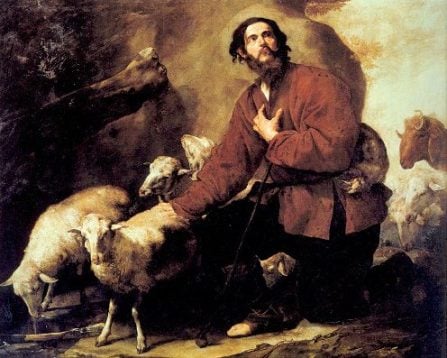
“And it came to pass at the time that the flock conceived, that I lifted up mine eyes, and saw in a dream, and, behold, the he-goats which leaped upon the flock were streaked, speckled, and spotted.” (Genesis 31:10)
This evocative vision of streaked, speckled, and spotted animals is not just a curious detail in a shepherd’s dream; it sets the stage for Jacob’s unconventional deal with Laban and, on a deeper level, reveals how the Torah hints at the innermost structures of the cosmos.
This week’s Torah reading, Vayeitzei (Gen. 28:10-32:3), describes three kinds of sheep: streaked, speckled, and spotted. These distinctive animals become Jacob’s agreed-upon wages—he will receive the outliers, the nonuniform members of the flock—and the Torah lingers on their markings in a way that begs for deeper interpretation.

Streaked sheep (Heb. “akudim”) were ankle-ringed, as if a dark band encircled their legs like a rope. They looked as if their ankles were bound together with a black rope. Hence the name— akudim (from akud, meaning “bound” as in “Akeda,” binding of Isaac). Already in this simple etymology, “binding” and “tying together” hint at a state in which many potentialities are held in one bundle.
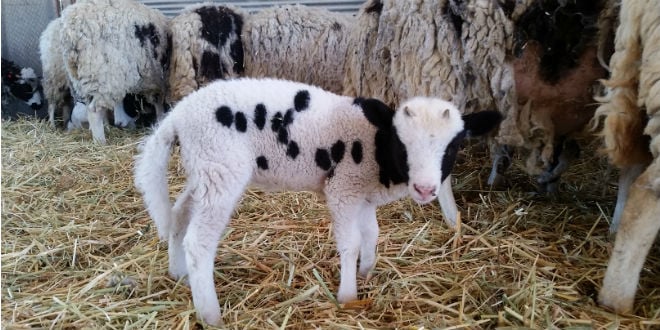
Speckled sheep (Heb. “nekudim”) were sheep with dark dots, each dot like an isolated point of ink on a parchment.
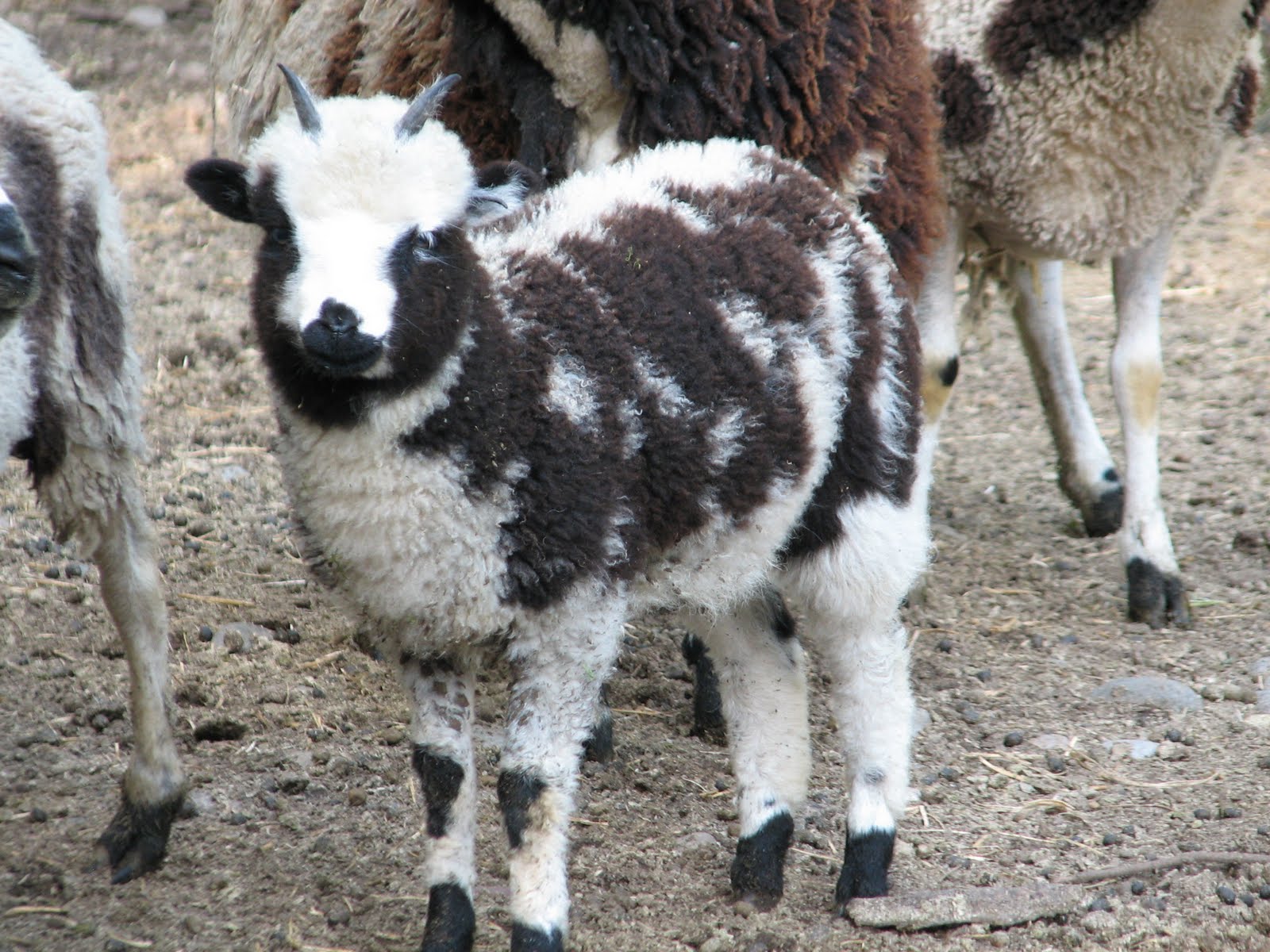
Spotted sheep (Heb. “berudim”) were blotched with irregular patches and clusters of color rather than isolated dots.
The Kabbalistic Reading: Three Primordial Worlds
What is the significance of these streaks, speckles, and blotches that the Torah devotes so much attention to them? At its simplest, they explain how Jacob legally outmaneuvered Laban. But Torah, especially as read by Kabbalah, is not content with a merely simple explanation. If the text lingers on color patterns, it is because those patterns mirror something in the structure of the worlds themselves. The masters of Kabbalah teach that these are metaphors for various spiritual worlds in which Divine Emanations, Sefirot, are arranged in different configurations.
Rabbi Ḥayyim Vital writes in Etz Ḥayyim that the ten Divine Emanations—sefirot—exist in three stages: Akudim (Ringed), Nekudim (Speckled), and Berudim (Spotted). These are not three different “places” but three distinct modes in which the same ten sefirot can be configured—first as undifferentiated unity, then as fractured multiplicity, and finally as harmonized integration.
The highest of these worlds is the world of Akudim. The streaks on the feet of Jacob’s sheep are also called “akudim.” As mentioned above, this word means “bound.” This is the world where sefirot are bound together. They are not differentiated yet. That is why, at this stage, they are called “hidden” sefirot. There are ten lights (Heb. ʾorot or ohrot), but only one vessel (Heb. “kli”). Ten lights are “tied” together in one vessel. The world of Akudim is identified with Adam Kadmon—Primordial Man. In Akudim, all the later richness of Divine attributes—kindness and severity, beauty and kingship—is present, but only as potential. It is like white light, invisibly containing all colors before it passes through a prism. Nothing has yet separated out, and precisely for that reason, everything is already there.
The second world is the world of Nekudim. Nekudim are dots. Speckled sheep are called “nekudim” because of the black dots on their coat of wool. This is the world where sefirot are represented by dots—they are already separated into 10 individual sefirot with self-identity, but they cannot relate to one another. There are ten lights (ʾorot) and ten vessels (kelim). But there is no interinclusion of the sefirot—each sefirah stands on its own like a separate dot. Each point insists on being itself, without yielding or making space for the others. In Lurianic terms, this rigidity leads to shevirat ha-kelim, the “breaking of the vessels,” when the intensity of the Divine light cannot be sustained by these isolated, non-cooperative points. This world is identified with the Olam HaTohu—the Universe of Chaos, where the breaking of the vessels (shevirat hakelim) occurred. It is “chaotic” not because it lacks structure but because its structure is too rigid: everything is sharply defined, and nothing is flexible enough to relate.
The third world, the world of Berudim, is where sefirot are reunited and interincluded. Each of the ten sefirot contains all ten subsefirot in a fractal configuration. The specific configurations of sefirot are called Partzufim (pl. of Heb. “partzuf”). These groupings of Sefirot are symbolized by the blots on the spotted (flecked) sheep of Jacob, where separate dots merge into large blotches of darker color. What appears on the sheep’s coat as an irregular patch is, in the spiritual reading, a pattern of attributes interwoven with one another—kindness within strength, strength within kindness, and so on. From a distance, you see a blotch; up close, you would see an intricate tapestry of interwoven qualities. The world of Berudim is identified with the Olam HaTikun—the Universe of Order and Rectification (fixing, correction, reparation, or mending), which is our Universe. Here, the sefirot do not renounce their individuality, but they learn to work together and cooperate.
To me, three types of Jacob’s sheep—streaked, speckled, and spotted—are a metaphor for three views on the nature of elementary particles. After all, if the sefirot are the building blocks of the spiritual world, then elementary particles are the building blocks of the physical world. Just as Kabbalah describes a progression from undifferentiated unity to fractured points and then to integrated patterns, modern physics has moved from thinking in terms of little hard particles, to fields, and then—at least in some approaches—to underlying strings. The sheep in Jacob’s flock thus become a kind of illustrated textbook for both mysticism and physics.
Particle Physics
Historically, as the theory of elementary particles was first developed, particles were viewed as zero-dimensional points. Zero-dimension, meaning they lack width, depth, and height as infinitesimally small dots with no dimensions to them. Physical properties are assigned to these point-like particles. Mass, charge, and spin are all ascribed to these “points,” even though the points themselves, strictly speaking, occupy no volume at all.
While it is difficult to imagine any physical object that takes up no space, elementary particles, according to particle physics, do not take up space, although they possess other physical characteristics, such as energy, momentum, spin, etc. This view is still held by many particle physicists. Clearly, speckled sheep of Jacob can be viewed as a metaphor for point-like elementary particles. Each dot on the sheep’s coat suggests an isolated, idealized point in space, carrying its own set of properties and not intrinsically blended with its neighbors. Conversely, elementary particles in this point-like paradigm are a good physical metaphor for the sefirot in the world of Nekudim. Just as the sefirot in Nekudim stand as separate “points” of Divine expression that cannot yet relate to one another, the point-particle idealization imagines particles as fundamentally distinct entities, only later connected by externally imposed rules of interaction. It is a powerful picture, but also a brittle one, prone, like Tohu, to conceptual “infinities” and breakdowns that require renormalization and other repairs.
Particle as Field Excitation

As quantum field theory developed, an elementary particle began to be viewed as an excitation of a field, or, simply put, as blotches of the field. For example, a photon is viewed in quantum field theory as an excitation of the electromagnetic field. A gluon is an excitation of the field that carries the strong nuclear force. W+, W−, and Z bosons are excitations in the field carrying the weak force. The Higgs boson is an excitation in the Higgs field, a yet-to-be-discovered graviton is thought to be an excitation of the gravitational field, etc. Once again, spotted sheep of Jacob can be viewed as a metaphor for quantum field theory, with the blotches on the sheep’s coat representing the physical field’s elementary particles. And conversely, quantum field theory provides a good physical metaphor for sefirot as they exist in the world of Berudim. In Berudim, each sefirah includes all the others; no attribute exists in isolation. Analogously, in quantum field theory, no field is truly alone: fields’ excitations interact, mix, and influence one another. What we call a “particle” is really a localized, temporarily stable pattern in an all-pervading field—more like a wave on the surface of the ocean than like a tiny billiard ball. The blotches on the sheep’s coat thus correspond to localized field excitations against a continuous backdrop.

Vibrating Quantum String
Lastly, the streaked sheep of Jacob are a metaphor for quantum strings. String theory envisions elementary particles as tiny strings vibrating in nine dimensions, six of which are curled up and, therefore, invisible to us. The streaks on the ankles of the sheep actually look like strings that tie the ankles together. Instead of individual dots or isolated blotches, we now have lines—extended one-dimensional objects whose different vibrational modes show up to us as different particles. A photon, an electron, and a graviton would, in this picture, be different “notes” (different frequencies) played on the same underlying string.
Moreover, just as sefirot of the world of Akudim are called “hidden” sefirot, so too strings vibrate in mostly hidden dimensions, which are the extra-dimensions above our three spatial dimensions—length, width, and height. Just as in the world of Akudim, ten lights coexist in one vessel, String Theory envisions elementary particles as various notes corresponding to different frequencies of a vibrating string. Clearly, strings provide an excellent physical metaphor for the sublime world of Akudim. If Akudim is the stage at which all the multiplicity of later worlds is already bound together in a single, higher unity, then strings offer a similar image on the physical side: many observed particles emerging from one deeper, unified object. The streaks on Jacob’s sheep, tying the ankles together, quietly allude to this binding—unity that has not yet unfolded into scattered dots or separated blotches.
The Torah’s description of Jacob’s flock invites us to see that the same patterns—points, patches, and lines; chaos and repair; unity and multiplicity—recur from the highest spiritual worlds down to the equations of modern physics and the markings on a sheep in an ancient field.
Conclusion
So, was our forefather Jacob a simple shepherd, an expert kabbalist, or a theoretical physicist working out string theory while breeding Laban’s sheep? You be the judge. At the very least, the Torah’s careful attention to streaked, speckled, and spotted animals invites us to notice that the same pattern repeats across scales: hidden unity in Akudim and strings, fractured points in Nekudim and particle pictures, and healed inter-inclusion in Berudim and quantum fields. What begins as a wage agreement in an ancient pasture thus becomes a lens on how Divine energy descends, shatters, and is repaired—and how our physical models, in their own language, trace that same arc. Reading Jacob’s sheep this way reminds us that Torah and science are not competing stories but complementary descriptions of a single, multifaceted reality.


