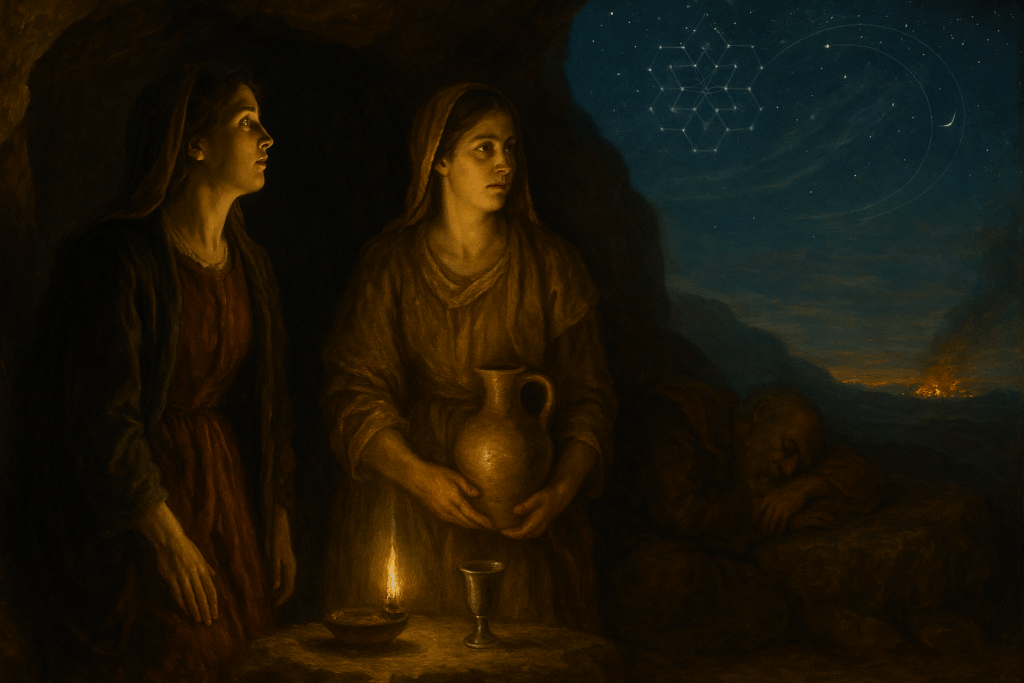
There is not a Shabbos in which we do not read the parasha of Lot (Bereshis Rabbah 51:9)
The Kabbalistic Dimension: Hidden Unities and Dimensional Collapse
The mystical tradition offers a startling reinterpretation of the narrative of Lot and his daughters, transforming our understanding entirely. Rather than seeing the daughters’ actions as merely a tragic miscalculation, Kabbalistic sources reveal a deeper cosmic pattern at work.
The M’or Vashemesh (Rabbi Kalonimus Kalman of Krakow) teaches that the forbidden union of Lot with his daughters represents, in the physical realm, a spiritual reality that we enact in holiness every time we pray with deep emotion and longing—especially on Shabbat. In prayer, the lowest aspect of the Divine (Malkhut-Kingship, which is also called “daughter”) unites with the highest (Ḥokhmah-Wsidom, which, as partzuf, is called Aba, that is “Father”).[1] What is a transgression in one realm reflects sacred unity in another—it all depends on the level at which it is considered.
Science metaphor—quantum superselection. Some quantum states belong to different “charge sectors” that cannot be coherently mixed unless you provide a reference (like a phase standard). Halakhah functions like superselection—certain mixtures are simply not permissible in this era. Shabbat and prayer act as lawful “reference frames” that let higher alignment occur within the boundary—honoring the boundary rather than erasing it. Similarly, good reactions often stall behind a barrier; a catalyst does not change what is right or wrong—it provides a fit pathway that lowers the barrier. Mitzvot, kiddushin, and Shabbat are catalysts that channel yearning into permitted channels. They never license the prohibited; they make the permitted channel wider and more accessible.
The Derech Mitzvosecha by the Tzemach Tzedek goes even deeper. He explains that in the upper worlds, certain unifications and harmonies between different aspects of the divine (the ten Sefirot) are too holy and pure for this world in its current state. These exalted unities cannot be properly revealed here—hence the term gilui arayot (“revealing nakedness”). They must remain hidden in the spiritual realms, manifesting in this world only as forbidden unions.[2]
Yet, there are two extraordinary exceptions when these higher-dimensional unities can be revealed in our world: when God gave the Torah, Ḥokhmah (Wisdom) united with Malkhut (Speech/Manifestation) and was revealed in this world as the giving of the Torah at Sinai. When Moshiach arrives,G‑d’s Wisdom (Ḥokhmah) will again fill the world (Malkhut), as the Rambam writes: “The earth will be filled with knowledge of G-d as water covers the seabed” (Hilchot Melakhim 12:5).
Allowed and Forbidden States
In quantum physics, selection rules govern which state-transitions are “allowed.” Others are called “forbidden”—not impossible, but suppressed unless special conditions (multi-photon processes, altered symmetry) permit them. Holiness likewise sets “selection rules” for union: some couplings are life-giving, while others are proscribed until reality is rectified in the Messianic era.
Halakhah establishes allowed couplings (kiddushin) and forbidden couplings (arayot) not because desire is evil, but because the world’s spiritual “vessels” can only channel certain unions without damage. The Tzemach Tzedek explains this across several Derech Mitzvosecha essays on Issurei Arayot.
In crystals, electrons can move only inside “allowed bands,” while a “forbidden band gap” blocks motion. A gap can ne crossed only if conditions change—by adding energy, changing the material (“doping”), or applying strong fields. Permitted unions are like allowed bands; the arayot are like a gap in our world’s present “material.” At Sinai—and ultimately in the Messianic future—the “material properties” change, opening lawful conduction paths for higher light without breaking any rule.
Note: this is an analogy for structure, not a license. Halakhic prohibitions never “relax” through private inspiration; they are absolute in our era. The point is to see why Torah draws boundaries: to ensure that the flow of life-giving shefa travels only through channels the world can hold—just as physics permits only those transitions the symmetries allow.
Compactified Dimensions and Symmetry Breaking
This Kabbalistic teaching finds remarkable parallel in modern physics. In string theory and higher-dimensional models, extra dimensions beyond our familiar three spatial dimensions are thought to be “compactified”—curled up so tightly that they’re invisible at ordinary scales. These hidden dimensions profoundly affect the physics we observe, yet remain inaccessible to direct measurement.
Similarly, in quantum field theory, certain symmetries exist at high energies that become “broken” at lower energies. Configurations that would be unified and harmonious in high-energy states manifest as distinct, sometimes seemingly incompatible states at lower energies. The electroweak theory, for instance, shows how the electromagnetic and weak forces—unified at high energies—appear as separate forces in our everyday world.
The story of Lot’s daughters, viewed through this lens, represents a kind of symmetry breaking or dimensional collapse. What exists as sacred unity in higher spiritual dimensions (Ḥokhmah -Malkhut unification) cannot maintain that form when “projected down” into our physical realm without proper conditions. It collapses into a distorted, transgressive manifestation.
Boundary Conditions: Torah and Messianic Revelation
The two exceptions mentioned in Derech Mitzvosecha—Sinai epiphani and the Messianic era—represent moments when the “boundary conditions” of reality change, allowing “higher-dimensional” unities to be revealed in our world without distortion.
In physics, boundary conditions determine how a system behaves. Change the boundaries, and previously impossible states become possible. At Sinai, the boundary between the spiritual and physical realms became permeable in an unprecedented way. G‑d’s Wisdom (Ḥokhmah) was able to “descend” and unite with physical expression (Malkhut) without distortion—manifesting as the Torah itself.
The Messianic future promises a permanent alteration of these boundary conditions. The Rambam describes a world where Divine wisdom fills reality as naturally as water fills the sea—not as an external revelation requiring special preparation, but as the new baseline of existence.
Phase Transitions in Consciousness and Cosmos
This parallels what physicists call a phase transition—a fundamental change in the organization of a system. Water and ice are the same substance, yet their properties differ dramatically. Below 0°C, water molecules lock into a crystal lattice; above it, they flow freely. The substance remains unchanged, but its organizational state has altered.
Our current world exists in one “phase” where certain high-level unities cannot be stably manifested—they collapse into distorted forms (gilui arayot). The Messianic era represents a phase transition into a different organizational state of reality where these same unities can exist openly and harmoniously.
The daughters of Lot, unknowingly, enacted a pattern that belongs to a different phase of existence. Their actions in the cave—intended to preserve life—reflected a higher-dimensional template but manifested in a distorted form because our world’s current “phase” cannot support that configuration without collapsing.
Prayer: Tunneling Between Dimensions
Yet the M’or Vashemesh reveals that we do access this higher unity—in prayer, especially on Shabbat. How is this possible if our world cannot support such revelations?
We find a metaphor for this in what quantum mechanics refers to as tunneling. In quantum systems, particles can pass through energy barriers that classical physics says they cannot surmount. They do not have enough energy to “climb over” the barrier, yet they appear on the other side—they tunnel through.
Prayer, particularly prayer with deep emotion and longing (kavanah), represents a spiritual tunneling experience. We do not have the “energy” to transform our world’s phase state fully—only Mashiach will—yet through prayer, we momentarily access the higher-dimensional unity of Ḥokhmah-Malkhut. We tunnel through the barrier that normally separates spiritual and physical realms.
On Shabbat, this barrier becomes thinner—the tunneling probability increases. We access, in a sanctified way, the very pattern that manifested as transgression in Lot’s cave.
Reframing the Narrative: Misplaced Revelation
These mystical teachings completely reframe the daughters’ story. They were not simply making an error in judgment; in fact, the Torah does not characterize it as an error, and the Talmud calls it a “sin” for the sake of Heaven. At a deeper level, they were enacting—in the wrong dimension, at the wrong time, without proper sanctification—a pattern that reflects ultimate cosmic unity.
Their action was a misplaced revelation—like trying to force a compactified dimension to expand in a world not yet ready for it, or attempting a phase transition before the system has reached the critical temperature.
This explains why their descendants—Moab and Ammon—could eventually produce Ruth and Naamah, who entered the holy lineage of David. The pattern itself was not inherently corrupt; it was manifested in the wrong domain. Once brought into the proper framework (conversion, Torah observance, messianic lineage), the underlying template could express itself constructively.
Synthesis: Uncertainty, Hidden Dimensions, and Redemptive Patterns
Our analysis operates on multiple levels—in Kabbalah, as in science, a higher-dimensional pattern cannot be properly revealed in our current world-phase without distortion.
These perspectives converge on a profound truth: reality operates on multiple levels simultaneously. What appears as transgression in the physical dimension may reflect a sacred pattern in the spiritual dimension. What seems certain from one reference frame is uncertain from another. What is forbidden now may be revealed in the messianic future.
The daughters of Lot remind us that we live in a world of constrained revelation—a reality with compactified dimensions, broken symmetries, and phase-dependent possibilities. Our task is not to force premature revelations, but to work within the given constraints and proper channels. Prayer tunnels through dimensions, the Torah provides the boundary conditions for safe revelation, and the messianic future promises a phase transition when all hidden unities can finally be revealed without distortion.
Until then, we navigate with humility—aware that the full picture extends far beyond our immediate perception, that higher-order patterns exist we cannot yet safely access, and that even our mistakes may carry within them seeds of redemption, waiting for the right conditions to blossom.
[1] Kalonymus Kalman Epstein. Ma’or va-Shemesh. Breslau, 1842 (first ed.). See “Hashmatot” (Omissions), to Parashat Vayera.
[2] Rabbi Menachem Mendel, the Tzemach Tzedek, Derech Mitzvatechah; see also Zohar I, 110b, Siddur Im Dach 105b; see also “The Parsha of Lot,” by Chaim Gershon (11/13/2011) at https://web.archive.org/web/20111114075227/http://www.avakesh.com/chassidic_thought/ and Rabbi Tuvia Bolton, Vayeira, 5762 (2001), Ohr Tmimim.org, https://web.archive.org/web/20071214230303/http:/www.ohrtmimim.org/Torah_Default.asp?id=423. I am grateful to my friend, Dr. Howard Schild, for pointing me to these two posts.


re: “The point is to see why Torah draws boundaries: to ensure that the flow of life-giving shefa travels only through channels the world can hold—just as physics permits only those transitions the symmetries allow.”
This reminds me of: