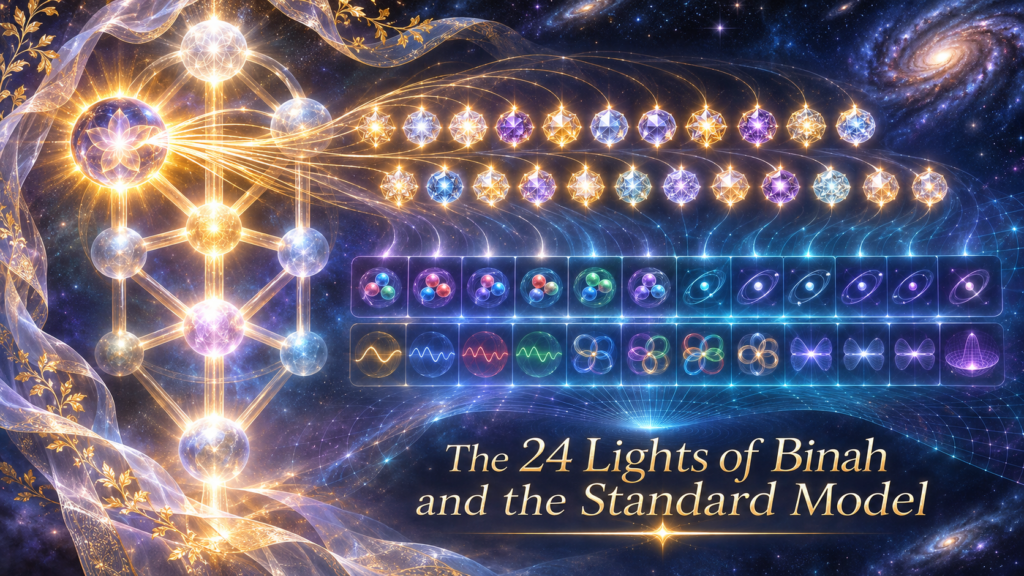
Binah, differentiation, and the structure of particle physics

Synopsys

Jewish tradition tells a beautiful story about the first wedding. Before G-d brought Eve to Adam, He adorned her with twenty-four ornaments, like a bride on her wedding day. The rabbis even found the number in the wording. In Hebrew, each letter also stands for a number (gematria), and the letters of the word for “and He brought her” add up to 24.

The Kabbalists, the Jewish mystics, saw more here than jewelry. To them the ornaments are what give the bride her shape. They prepare her to stand on her own and to meet her partner face to face. The mystics also say where the ornaments come from: Binah, “Understanding,” whom they call the heavenly Mother. Binah is the power that takes a sudden flash of insight and unfolds it into something with parts, structure, order, and detail. So the ornaments stand for structure: the many distinct features that turn something simple into something whole.

Now jump to modern physics. Physicists have found that everything in the universe is built from a short list of elementary particles. Twelve of them are particles of matter: six kinds of quarks, which make up protons and neutrons, and six lighter particles in the same family as the electron—they are all called "femions." Twelve more carry the forces that act between them. These are the photon, the particle of light; eight “gluons,” which glue quarks together; and three particles behind the “weak force,” which causes some kinds of radioactivity--they are all called "bosons." Twelve fermions plus twelve bosons makes twenty-four elementary particles.

One famous particle, the Higgs boson, stands apart from both groups. Its job is to give many of the other particles their mass. In the bride’s story, it plays the part of the parents who dress the bride rather than one of the ornaments.

The number is the hook, but it isn’t the point. What interests me is that both traditions tell the same story: a world worth living in needs differences. If every particle were the same, there would be no atoms, no chemistry, no stars, and no life. One simple rule shows this. No two particles of matter of the same kind can be in exactly the same state at once. Because of this rule, atoms have their layered structure and solid objects don’t collapse into themselves. Particles of light follow no such rule. Any number of them can crowd together, which is how a laser beam works. The Kabbalists drew a similar distinction between “vessels,” which set limits and give form, and “lights,” which flow and blend. A world needs both.

The essay also looks at other twenty-fours in Jewish tradition. One is the twenty-four books of the Hebrew Bible, which the Midrash compares to a bride’s ornaments. Another is the twenty-four hours of the day. Yet another is twenty-four books of Tanach--the Hebrew Bible.

I don’t claim that the Zohar predicted modern physics. This is a structural parallel. Still, it points to something real. Working in completely different languages, mystics and physicists both describe a universe that is beautiful not because everything in it is the same, but because its many different parts fit together into one whole.
1. The Mystery of Twenty-Four
What could the twenty-four ornaments of the primordial bride, described in the Zohar, possibly have in common with the elementary particles of modern physics? At first glance, nothing whatsoever.
The Zohar speaks in the symbolic language of divine emanations, spiritual lights, and the mystical relationship between the masculine and feminine aspects of the Creator and of the Creation. Particle physics, by contrast, describes the fundamental constituents of matter and their interactions through quantum fields, gauge symmetries, and mathematical equations.
These two intellectual traditions developed in radically different historical environments and conceptual frameworks. One explores the metaphysical structure of Creation; the other investigates its physical structure. Yet I would like to suggest an intriguing structural parallel between them.
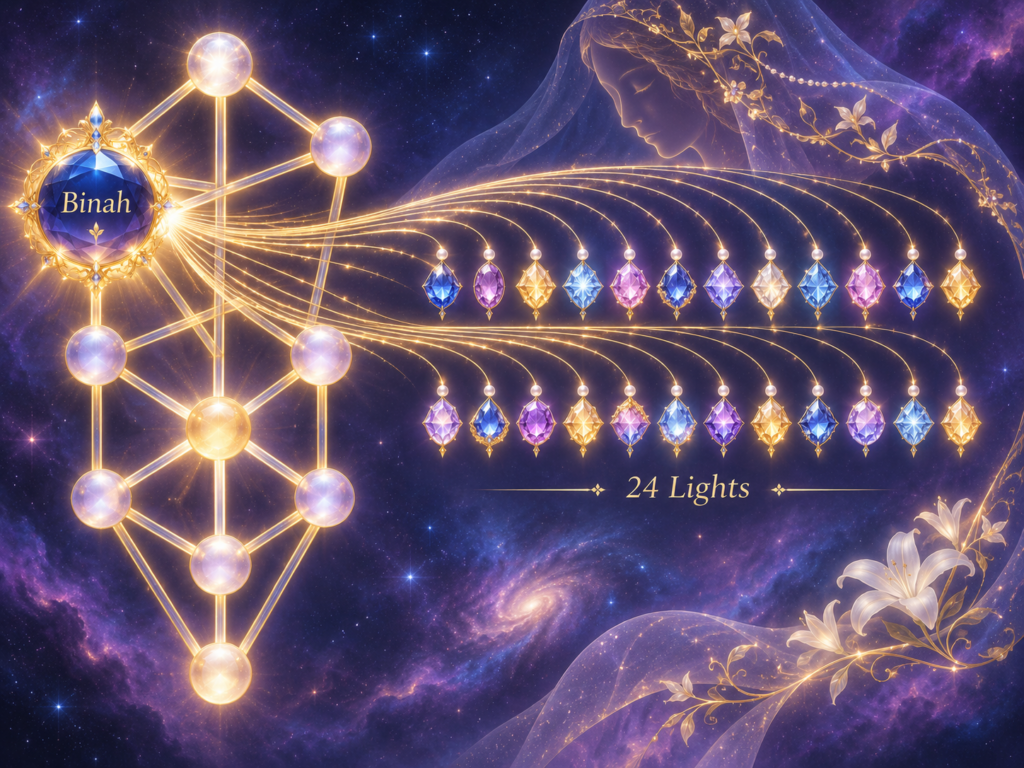
According to the Midrash, the Zohar, and later Kabbalistic tradition, the primordial bride, Ḥavah (Eve), was adorned with twenty-four ornaments before being presented to Adam. These ornaments are linked to a supernal source of illumination, the maternal partzuf Imma (“Mother”), which corresponds to the sefirah of Binah (“understanding”), and to the formation of the feminine partzuf Nukva (“female” in Aramaic), which corresponds to Malkhut (“kingship”).[1]
Remarkably, the elementary particle content of the Standard Model can also be organized into twenty-four entries under an explicitly stated counting convention: twelve matter particles (fermions) and twelve force carriers (gauge bosons).
Is this merely a numerical coincidence? Perhaps.
But there may be something more interesting than numerical agreement: a structural analogy between the differentiation of divine illumination in Kabbalah and the differentiation of the fundamental fields through which the physical universe acquires its properties.
I first set out the Kabbalistic sources for the twenty-four ornaments and their roots in Binah; I then describe the Standard Model and the counting that yields twenty-four; finally, I ask what the parallel can and cannot mean.
2. The Twenty-Four Ornaments of the Bride
The biblical starting point is the creation of the first humans:
And the Lord G‑d built the side that He had taken from the man into a woman, and He brought her to the man. (Genesis 2:22)
The Hebrew word for “and He brought her,” vayevi’eha (ויבאה), has a numerical value of twenty-four:
6 (Vav) + 10 (Yud) + 2 (Bet) + 1 (Alef) + 5 (Heh) = 24.
The Zohar interprets this numerical correspondence as an allusion to the twenty-four ornaments with which the primordial bride was adorned by her Creator before being presented to Adam.[2]
The tradition itself is older than the Zohar. The Midrash asks how God brought Ḥavah to Adam and answers that He first adorned her with twenty-four ornaments, citing Ezekiel 28:13: “You were in Eden, the garden of God; every precious stone was your covering.” The Talmud adds that God Himself braided her hair before presenting her to Adam. Elsewhere the Midrash identifies the twenty-four ornaments of a bride with the finery listed in Isaiah 3:18–24.[3]
The Zohar explains that “bringing her” was not merely a physical translocation; rather, the Creator prepared the primordial bride (who mystically represents Nukva) for union. Drawing on this verse, it teaches that a bride’s father and mother must bring her into the groom’s domain. In Kabbalistic terms, the father and mother are Abba and Imma—the supernal Father and Mother—who prepare the bride and present her.[4]
These are not merely decorative accessories. Within the symbolic world of Kabbalah, bridal adornment signifies the preparation, ordering, and completion of the feminine principle for its union with the masculine principle.
The connection between Ḥavah (Eve) and partzuf Imma has a strong biblical grounding:
The man named his wife Ḥavah, because she was the mother of all the living. (Genesis 3:20)
The name Ḥavah, “mother of all the living,” links her to the maternal principle. Strictly speaking, however, Kabbalah identifies the bride with Nukva (Malkhut), the “lower mother” (Imma Tata’ah), who receives her structure from the “supernal mother,” Imma Ila’ah (Binah). Ḥavah is thus a mother in her own right and, at the same time, a reflection of Binah below.
The Zohar notes a cosmic symmetry reflecting the principle zeh le’umat zeh (“this against that”; Ecclesiastes 7:14). When the primordial serpent seduced Ḥavah, it cast into her twenty-four kinds of impurity (zuhama). The Zohar finds this number in G‑d’s curse of the serpent: “I will put enmity (ve’eivah) between you and the woman” (Genesis 3:15). Ve’eivah (ואיבה) is an anagram of vayevi’eha (ויבאה)—it is spelled with exactly the same five letters as and so it too equals twenty-four. Against the twenty-four ornaments of holiness stand twenty-four kinds of impurity. The ornaments are therefore not only beautification but also protection, and after the sin they become the pattern for its repair (tikkun). The significance of this symmetry will become clear later.[5]
Eve is not simply another creature appearing in the Garden of Eden. She is built, prepared, and adorned before entering into a relationship with Adam.
In the Kabbalistic interpretation, this process reflects the formation of Nukva, the feminine partzuf associated with Malkhut, which must acquire its own developed structure before attaining a mature relationship with Zeir Anpin (“Lesser Countenance”), the masculine partzuf.
In Lurianic Kabbalah, this formation is part of a more elaborate process involving the emergence of distinct spiritual configurations, the transmission of divine illumination, and the development of the feminine[6] into an independent spiritual structure.
The maternal partzuf of Imma plays a central role in these processes. Binah is not merely understanding in the ordinary intellectual sense. It represents the power by which an initially undifferentiated insight becomes elaborated, articulated, and structured. Where Ḥokhmah (wisdom) is often compared to the initial flash of insight, Binah develops that insight into a comprehensible system. The Talmud defines the person of understanding (navon) as one who “understands one thing from another” (mevin davar mitokh davar), that is, one who draws out distinctions and consequences.[7] This distinction will become important when we turn to physics.
For now, the essential point is that the twenty-four ornaments signify the completion and ordering of the feminine spiritual structure. The lights and adornments make possible a form of existence capable of standing in a differentiated relationship with another. This is not simply beautification; it is formation.
The same verb returns a few chapters later, in the story of Isaac and Rebecca’s marriage:
And Isaac brought her into his mother Sarah’s tent, and took Rebekah, and she became his wife; and he loved her: and Isaac was comforted after his mother’s death. (Genesis 24:67)
Here too the text uses the word vayevi’eha (ויבאה)—“and he brought her”—spelled exactly as in Genesis 2:22. The repetition invites comparison between the two scenes.[8]
Rebecca personifies the feminine partzuf Nukva, associated with Malkhut, while Isaac embodies the corresponding masculine aspect of Zeir Anpin. Their union echoes the earlier presentation of Ḥavah to Adam.
3. From Binah to Malkhut: The Emergence of Structure
To appreciate the significance of the twenty-four ornaments, we must consider the larger Kabbalistic framework.
The ten sefirot describe different modalities through which divine unity becomes manifest in Creation.[9]
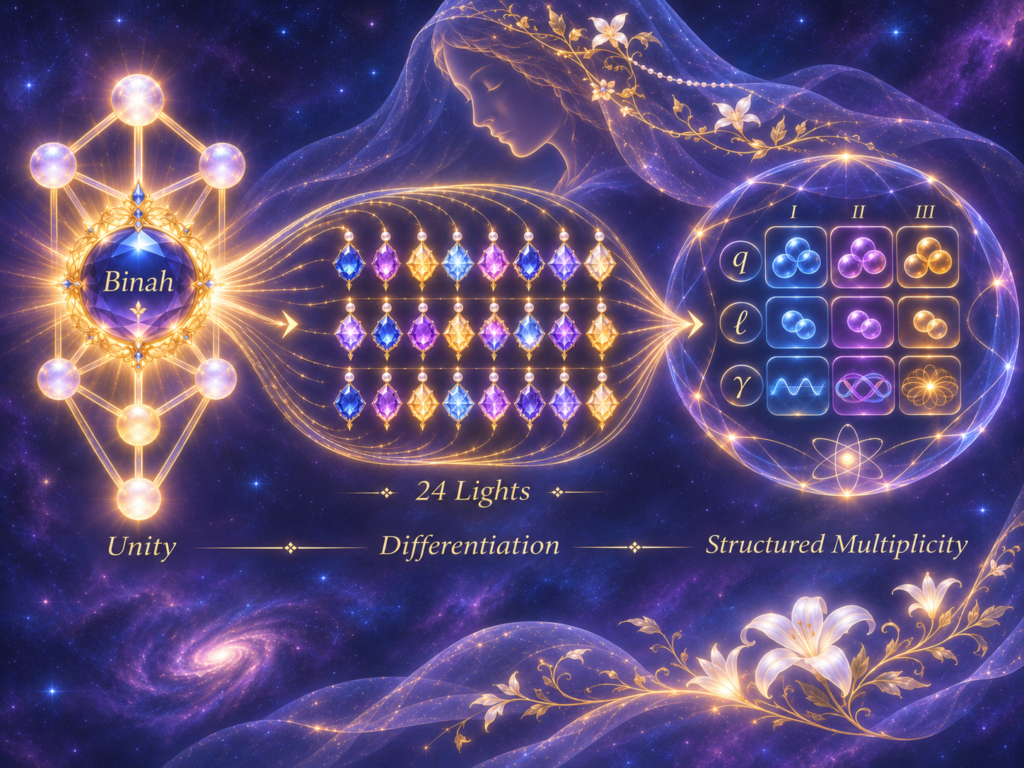
Within this framework, Binah occupies a particularly important position. Binah is the Supernal Mother, Imma Ila’ah. The maternal metaphor conveys the process through which a potentiality is developed into a structured reality.
In the metaphysical language of Kabbalah, the maternal principle participates in the development and organization of the lower partzufim—Zeir Anpin and Nukva.[10]
The emergence of Nukva as an independent feminine configuration is particularly significant. The feminine must not remain merely an undifferentiated appendage of the masculine. It must acquire its own structure and identity.
The Lurianic doctrine of nesirah (“cutting” or “sawing”), the separation of the initially joined masculine and feminine configurations, provides a striking expression of this principle.
Separation is not necessarily alienation. On the contrary, differentiation makes genuine relationship—in Kabbalistic terminology, a face-to-face union—possible. The rabbinic teaching that Adam was first created “two-faced” (du-partzufin), male and female joined back to back, and was then “sawn” apart into two, expresses this principle; the Lurianic term nesirah takes its name from that sawing.[11]
Two beings that are not distinguishable from one another cannot relate as independent partners. Similarly, a structure that contains no distinctions cannot display the rich organization required for complex interactions.
In this sense, differentiation is not the negation of unity. It is the means through which the possibilities latent within unity become manifest.
Following nesirah, Nukva becomes a distinct spiritual configuration. Yet for her full development, Imma Ila’ah (Binah) transmits the organizing illumination.[12],[13]
According to the Lurianic sources, this illumination reaches Nukva in the form of twenty-four dinim (“judgments”) that originate in Imma and come to rest in the twenty-four permutations of Ad-nai, the name of Malkhut. That judgments should come from Binah is a familiar Zoharic idea: Binah is the root of Gevurah, and “judgments are aroused from her” (dinin mit’arin minah).
In this context, din signifies judgment, restraint, and delimitation—the boundaries that give a spiritual configuration definition and contour.
These twenty-four boundaries from Imma furnish the Bride with an inner structure. In their rectified form they appear as the twenty-four jewels that complete and beautify her.[14]
Here the beauty of the Kabbalistic bride meets the beauty of the Standard Model: twenty-four ornaments invite comparison with the twenty-four species of elementary particles considered below.
Creation requires not only existence but differentiation.
And differentiation requires structure.
4. Binah and the Structure of Time
In the temporal dimension, Ḥokhmah (Abba—Supernal Father) may be viewed as the past, Binah (Imma—Supernal Mother) as the future, and Zeir Anpin, the “son” born of their union, as the present. Metaphorically, the past impregnates the future, which gives birth to the present moment.
Binah also plays a pivotal role in the organization of time: the twenty-four-fold symbolism of its lights invites comparison with the twenty-four hours of the day: twelve of daylight and twelve of night, as Jewish law reckons them.
I have previously discussed the parallels between the Standard Model and the Tetragrammaton in my essay, “Tetragrammaton and the Standard Model.”[15]
The divine name Havayah, the Tetragrammaton (yud–heh–vav–heh), contains a repeated letter. Its twelve distinct permutations suggest a further relationship between divine names and the structure of time.[16]
Four different letters admit 4! = 24 permutations, whereas the repeated letter heh in Havayah gives 4!/2! = 12 distinct arrangements. The four different letters of Ad-nai yield twenty-four arrangements.[17],[18]
There is a subtlety here that strengthens the argument. Mathematically, the two hehs of Havayah are the same letter, so the name has only twelve distinct arrangements. Kabbalistically, however, the two hehs are not the same: the first (upper) heh stands for Binah and the second (lower) heh for Malkhut. Once the two are distinguished, Havayah also yields 4! = 24 combinations. The Lubavitcher Rebbe reads the Tanya as teaching that twelve of these twenty-four combinations govern the twelve hours of the day, while the name Ad-nai governs the night. The twenty-fourfold structure thus appears precisely when Binah and Malkhut, the Mother and the Bride, are recognized as distinct.[19]
Kabbalistic tradition associates twelve permutations of Havayah with the twelve daytime hours, revealing a mystical correspondence between the divine name and the unfolding of time.
The divine name Ad-nai, associated in Kabbalah with Malkhut, contains four distinct letters—alef, dalet, nun, and yud—and thus admits 4! = 24 permutations. In prayer and Torah reading, Ad-nai is also pronounced in place of the written Tetragrammaton.[20]
The divine names Havayah and Ad-nai, associated with the day and night respectively, offer complementary patterns of twelvefold and twenty-fourfold differentiation.[21],[22]
5. The Standard Model: The Alphabet of Matter
Modern particle physics has arrived at an extraordinarily successful description of the fundamental constituents of the observable material world. This description is known as the Standard Model.
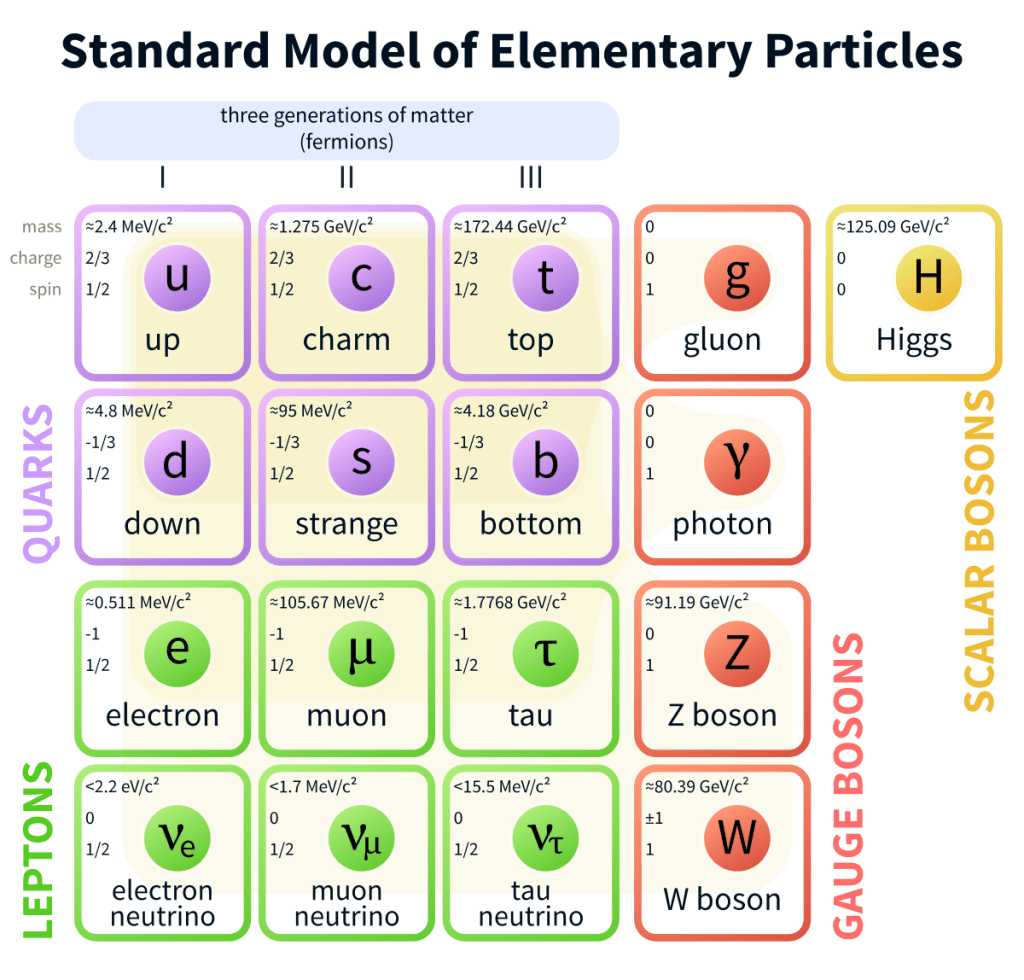
It classifies elementary particles into two principal categories: fermions, the building blocks of matter, and bosons, which comprise the carriers of the three forces the theory describes (the electromagnetic, weak, and strong interactions) together with the Higgs boson. Gravity is not part of the Standard Model.
The fermions come in twelve flavors.
There are six quarks: Up, Down, Charm, Strange, Top, Bottom. And six leptons: Electron, Muon, Tau, Electron neutrino, Muon neutrino, Tau neutrino.[23]
These twelve flavors are organized into three generations. Each generation contains two quarks and two leptons. The second and third generations repeat the basic pattern of the first, but with larger masses (clearly so for the charged particles; the ordering of the tiny neutrino masses is still being measured). Why nature contains precisely three generations remains an unanswered question.
The bosonic sector includes the photon; the weak gauge bosons W⁺, W⁻, and Z; eight gluons, which carry the strong interaction; and the Higgs boson.
Under the counting convention I adopt here, the gauge bosons (the force carriers) contribute another twelve entries; the Higgs boson is treated separately, for reasons explained below:
| Bosonic entries | Number |
| Photon | 1 |
| W⁺ and W⁻ bosons | 2 |
| Z boson | 1 |
| Gluon octet | 8 |
| Higgs boson (scalar; counted separately) | — |
| Total | 12 |
Together with the twelve fermion flavors, this gives:
12 + 12 = 24.
Here is the resulting organization of the Standard Model:
| Fermionic sector | Bosonic sector |
| 6 quark flavors | 8 gluon components |
| 6 lepton flavors | 1 photon |
| 2 W bosons (W⁺, W⁻) | |
| 1 Z boson | |
| (Higgs boson: counted separately) | |
| 12 | 12 |
It is important to clarify what this count means.
The commonly cited number of elementary particles in the Standard Model is seventeen. That tally counts twelve fermions, four types of force carrier (photon, gluon, W, and Z), and the Higgs boson. It treats the gluon as a single particle type rather than distinguishing its eight color states, and it counts the W once.
My convention instead counts each gauge boson separately: eight gluons, W⁺, W⁻, Z, and the photon.
This is not an arbitrary choice. Twelve is the number of independent generators of the Standard Model’s symmetry group, SU(3) × SU(2) × U(1): 8 + 3 + 1 = 12. In a gauge theory, each generator requires exactly one gauge field, so the number of force carriers is fixed by the symmetry itself, not by the preferences of whoever is counting. On the fermion side, twelve is the number of distinct flavors: three generations of four. Both halves of the count are thus defined by the structure of the theory.[24]
The eight gluon components correspond to the eight generators of the SU(3) color gauge algebra. They are distinct fields that themselves carry color charge, which is why, unlike photons, gluons interact with one another.
What of the Higgs boson? In this count it stands apart, and for good reason. It is not a gauge boson and corresponds to no symmetry generator. Its role is different: the Higgs field has a nonzero value throughout space, and through their interactions with it the W and Z bosons, the quarks, and the charged leptons acquire their masses. Of the four real components of the Higgs field, three are absorbed by the W⁺, W⁻, and Z as these become massive; only the fourth survives as the Higgs boson discovered at CERN in 2012. One may see in the Higgs field something like the one who adorns rather than one of the ornaments: in the Zohar’s image, Abba and Imma prepare and present the bride but are not themselves among her adornments. I offer this as an image, not as a correspondence.[25]
This gives twenty-four entries, but it is a deliberately chosen level of classification rather than an invariant prediction that nature must contain exactly twenty-four particles.[26] Nevertheless, under the stated convention, the Standard Model exhibits a striking numerical arrangement: twelve fermion flavors and twelve gauge bosons. And these are not arbitrary additions to the theory. They reflect its established field content and symmetry structure.
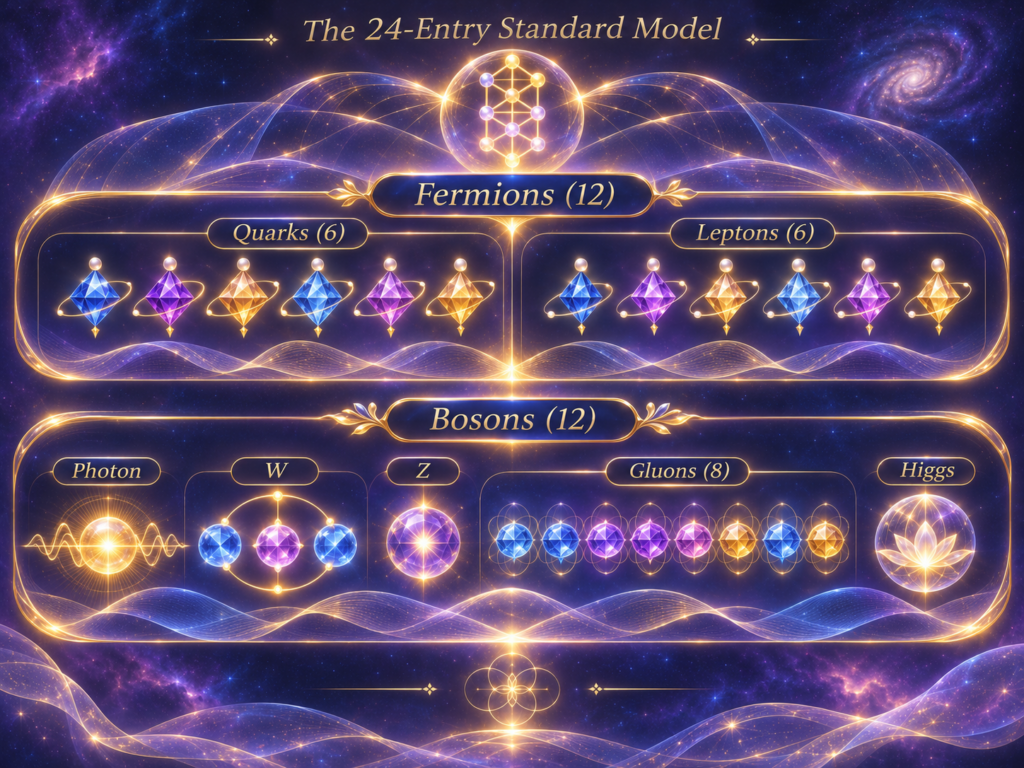
Three parallels between the Standard Model and Kabbalah are particularly striking.
First, the twenty-four ornaments of Ḥavah—and their Kabbalistic connection to the lights of Binah—correspond numerically to the twenty-four entries in our Standard Model classification.
Second, the Kabbalistic division of time into twelve and twelve, with permutations of Havayah governing the twelve hours of the day and the name Ad-nai governing the twelve hours of the night, invites comparison with the twelve fermions and twelve gauge bosons of the Standard Model.
Third, the twenty-four forms of impurity associated with the primordial serpent stand opposite the twenty-four holy ornaments of Ḥavah (zeh le’umat zeh), which annihilate the impurity. This opposition calls to mind the symmetry of particles and antiparticles in quantum field theory, where matter and antimatter can annihilate in their interactions.[27]
Physics adds an intriguing twist. In the early universe, matter and antimatter were produced in almost equal amounts and almost entirely annihilated each other. The world we see is made of the small surplus that remained, roughly one particle of matter for every billion or so annihilated pairs. Why this imbalance exists is still unexplained; the Standard Model alone cannot account for it. The Kabbalistic image of two opposed sets of twenty-four, in which the side of holiness ultimately prevails, offers a suggestive counterpart.[28]
6. From Unity to Multiplicity: The Role of Symmetry
To understand the possible correspondence, we must move beyond the numerical coincidence. The deeper parallel lies in the emergence of differentiated structure.
Modern physics describes the fundamental interactions through symmetries. The Standard Model is built upon the gauge group:
SU(3) × SU(2) × U(1).
These mathematical structures govern the strong and electroweak interactions.
The group SU(3), associated with the strong interaction, has eight generators, corresponding to the eight gluon gauge-field components.
The electroweak sector is described by SU(2) × U(1). Its four gauge fields (three from SU(2), usually labeled W¹, W², W³, and one from U(1), labeled B) are reorganized through the Higgs mechanism into the photon, the Z boson, and the charged W⁺ and W⁻ bosons.
Before symmetry breaking, there is no photon and no Z boson as such. The physical W⁺ and W⁻ are combinations of W¹ and W², while the photon and the Z are two different mixtures of W³ and B, set by the weak mixing (Weinberg) angle. After electroweak symmetry breaking, a particular pattern emerges. The photon remains massless. The W and Z bosons become massive.
The Higgs field acquires a nonzero vacuum expectation value, and a physical Higgs excitation remains in the spectrum. A symmetry that was present in the underlying equations becomes realized in a vacuum that distinguishes among the possible field directions.
The resulting physical world possesses properties and interactions that depend on this differentiated structure.[29]
This suggests a philosophical analogy.
In Kabbalah, undifferentiated divine illumination cannot be manifest in the lower worlds without the sefirotic structures that mediate, delimit, and articulate its expression.
In physics, abstract symmetries alone do not describe the observable universe without a specification of fields, interactions, and the state in which those symmetries are realized.
The parallel is structural: divine illumination becomes manifest through the ordered differentiation of the sefirot, while physical fields exhibit the richly organized multiplicity described by quantum field theory.
And this is where Binah becomes particularly interesting.
7. Binah: The Mother of Differentiation
The sefirah of Binah is conventionally translated as Understanding. But understanding is not merely the possession of information. It is the perception of distinctions, relationships, and organizing principles.
To understand a complicated system, we must identify its components and discover how they relate to one another. We distinguish cause from effect, substance from property, symmetry from asymmetry, and the general principle from its particular manifestations.
An undifferentiated flash of insight may contain a great deal of potential meaning, but understanding emerges when that meaning is articulated. This is the movement from Ḥokhmah to Binah. Ḥokhmah offers the initial point; Binah develops the structure. Kabbalistic letter symbolism makes the same point graphically: the yud of the Tetragrammaton, a mere point, stands for Ḥokhmah, while the first heh, which extends that point in length and breadth, stands for Binah.[30]
In the language of Kabbalah, the Supernal Mother (Imma Ila’ah) gives form to what is initially present in potential.
The metaphor is especially appropriate because physical birth likewise involves differentiation. A fertilized egg begins as a single cell, yet through successive stages of development it gives rise to the highly organized structures of a living organism. A living body cannot function as an undifferentiated mass of cells. It requires tissues, organs, regulatory systems, boundaries, and communication pathways. Complex unity is possible only because its components acquire differentiated roles.
We encounter a parallel principle in particle physics. The Standard Model is not a random collection of unrelated particles. Its particle content is organized according to mathematical representations of the underlying gauge symmetries. Different particles possess different masses, charges, spins, and interaction properties. Their differences are precisely what make the rich variety of physical phenomena possible.
Electrons participate in electromagnetic interactions and the structure of atoms. Quarks participate in strong interactions and form hadrons. Neutrinos interact weakly and play important roles in astrophysical and cosmological processes. Gauge bosons mediate interactions, while the Higgs sector contributes to the electroweak vacuum structure and the masses of elementary particles.
The observable universe depends on the differentiated roles of these fields. If every field were physically indistinguishable from every other, the complex structures familiar to us could not arise in the same way.[31]
One might therefore see in the twenty-four-fold organization of the Standard Model a suggestive physical counterpart to the Kabbalistic image of the twenty-four lights of Binah or the twenty-four adornments of Malkhut giving distinct form to a completed spiritual configuration.
The essential correspondence is not between an ornament and a specific particle, but between two accounts of differentiation within an ordered whole.
8. Why Ornaments Rather Than Building Blocks?
There is another curious aspect of the Zoharic symbolism.
Why does the Zohar speak of ornaments? If the twenty-four adornments symbolize fundamental structures, would it not be more appropriate to compare them to bones, organs, or foundations? Why jewelry?
Perhaps because an ornament does something different from a building block. A building block is primarily a constituent of a structure. An ornament makes a structure’s character visible. It reveals distinctions, emphasizes relationships, and expresses the identity of the whole.
A crown signifies sovereignty. A ring may signify commitment. A garment can express dignity, status, or belonging.
Within the symbolism of the Zohar, the bride’s adornments disclose her readiness for union. She has acquired a complete and fitting configuration.
This suggests that the twenty-four ornaments should not be understood as twenty-four pieces of spiritual matter from which the bride is mechanically assembled. Rather, they symbolize the differentiated perfections through which the feminine spiritual structure becomes complete. This observation helps clarify the physical analogy.
The elementary particles of the Standard Model are not merely bricks from which the universe is constructed. Their properties and interactions determine the forms of matter and the dynamics of physical systems.
The electron is not significant merely because it exists. Its charge, mass, spin, and interactions are essential to the formation of atoms and chemistry. The gluon fields are not significant merely because there are eight color components. Their non-Abelian gauge structure determines the character of the strong interaction.
Thus, the physical identity of each field is inseparable from its place in the larger theoretical structure. In this sense, particles are not only constituents of the world. They are also expressions of its fundamental order.
That may be a more fruitful parallel to the Kabbalistic ornaments than a literal identification of twenty-four spiritual lights with twenty-four physical particles.
9. The Twenty-Four Books of the Tanach
The Kabbalistic symbolism of the number twenty-four extends beyond the creation of Ḥavah.
The Hebrew Bible, the Tanach, contains twenty-four books. The link between these books and the bride’s ornaments is already explicit in the Midrash: just as a bride is adorned with the twenty-four ornaments listed in Isaiah, so a Torah scholar must be adorned with knowledge of the twenty-four books.[32] The Zohar and later mystical teachings associate these books with adornments of the divine bride and with the giving of the Torah at Mount Sinai as a symbolic wedding between G‑d and Israel. On the night of Shavuot, Tikkun Leil Shavuot traditionally includes readings from the beginning and end of each of the twenty-four biblical books; in the mystical interpretation, such study adorns the Shechinah in preparation for union with the Holy One.
The twenty-four books of Tanach form an ordered scriptural whole: five books of Torah, eight books of Prophets, and eleven books of Writings.[33] Each book possesses its own character, yet together they form the canonical Hebrew Scriptures.
Multiplicity is not abolished by unity. It becomes organized within unity. The comparison illustrates how the richness of a coherent whole can depend on differentiated elements.
The twenty-four ornaments signify the completed bride. The twenty-four books constitute the completed biblical canon. And the twenty-four entries proposed here organize the fundamental particle content of the Standard Model. In each case, plurality appears within a larger order.
10. A Possible Correspondence Between Matter and Form
Our counting convention introduces another interesting feature. The twenty-four Standard Model entries divide into twelve fermionic and twelve bosonic entries.[34] The fermions are the elementary constituents of matter, while the gauge bosons carry the interactions among them.
This suggests two complementary aspects of the physical world: what constitutes matter, and what governs its interactions and properties. The distinction evokes a recurring philosophical theme: the relationship between that which exists and the principles that organize its behavior.
Kabbalah similarly describes existence through relationships between illumination and the structures that delimit its manifestation, frequently expressed through the concepts of orot (lights) and kelim (vessels).
Physics allows us to sharpen this comparison. Fermions obey the Pauli exclusion principle: no two identical fermions can occupy the same quantum state. This is why electrons arrange themselves in shells around the nucleus, why chemistry exists, and why ordinary matter takes up space instead of collapsing. Bosons obey the opposite rule: any number of them can share a single state, which is why photons can be gathered into a laser beam. Fermions, in other words, behave like vessels (kelim); each marks out its own place and sets a boundary. Bosons behave like light (orot), which can overlap and merge without limit. Indeed, the paradigmatic boson is the photon, the quantum of light itself.[35]
In Kabbalistic terms, the exclusion principle is a principle of din: of limitation and boundary. This is the very quality that, as we saw, Imma transmits to the bride in the form of twenty-four judgments, giving her an inner structure. Without exclusion there would be no atoms, no chemistry, and no structured world.
The physical universe requires both differentiated constituents and the interactions through which those constituents participate in larger structures. A world containing isolated particles without interactions could never produce the richly organized cosmos we observe. And interactions without the appropriate fields and states would not constitute the world with which we are familiar.
The universe emerges from an interdependent system of constituents, relations, and governing symmetries. This is reminiscent of Lurianic Kabbalah, in which functioning spiritual configurations (partzufim) require the integration of multiple differentiated aspects (sefirot comprising orot-lights and kelim-vessels).
11. Is Twenty-Four a Coincidence?
We must now confront the most obvious objection. Are we merely discovering the same number in two unrelated systems and then constructing an elaborate analogy around it?
This is a legitimate concern. The human mind is remarkably adept at finding patterns. Given enough numerical possibilities, coincidental correspondences are inevitable.
The number twenty-four recurs in the ornaments of the Bride, the lights and judgments associated with Binah and Malkhut, the hours of the day, the permutations of divine names, and the books of the Tanach.[36] This recurrence invites contemplation of ordered plurality.[37],[38]
Furthermore, as already noted, twenty-four is not an invariant count of elementary particles. One obtains different totals depending on whether one counts particle families, individual charge states, color components, antiparticles, or independent quantum fields.
The ease with which twenty-four can be reached also cuts both ways. Counting the twelve fermions together with their twelve antiparticles, for example, gives twenty-four as well. A skeptic may fairly ask whether, with enough flexibility, almost any number could be found. The best answer I can give is that the count proposed here was not tailored: each half corresponds to a quantity defined by the theory itself, the number of fermion flavors and the number of symmetry generators.
A genuinely physical prediction must not depend on choosing a classification solely because it produces a desired number. For this reason, I would not claim that the twenty-four ornaments of the Zohar predict the twenty-four particles of the Standard Model. Nor would I suggest that a one-to-one correspondence between specific Kabbalistic lights and specific elementary particles has been established. Such claims would require far more than numerical agreement. They would require a principled mapping capable of explaining why particular particles correspond to particular lights, and ideally producing consequences that are not already built into the comparison. We have no such mapping.
But the absence of a scientific prediction does not render a philosophical analogy meaningless. Metaphors are not equations. A structural parallel may illuminate two different systems without demonstrating a causal or historical relationship between them.
The interesting question is therefore whether the Kabbalistic understanding of Creation through ordered differentiation offers a useful philosophical perspective on the remarkable architecture revealed by modern physics. I believe it does.
12. From Divine Unity to the Diversity of Creation
We can now return to the larger theological question. How does an extraordinarily diverse universe emerge from a single divine source?
Kabbalah approaches this question through the language of emanation, contraction, concealment, differentiation, and the progressive development of spiritual structures. The infinite divine light is not identical to the finite phenomena through which Creation becomes manifest.
The sefirot and partzufim describe the ordered modalities of divine manifestation, allowing unity to be expressed through multiplicity without compromising the ultimate unity of G‑d.
Modern physics approaches a very different question. It asks what fundamental fields and interactions account for the physical phenomena we observe. The Standard Model answers this question with extraordinary precision through a mathematical framework governed by gauge symmetries.
Despite their profound differences, both frameworks invite us to contemplate the relationship between unity and diversity.
In physics, a limited collection of quantum fields and interactions gives rise to an astonishing variety of material structures: atomic nuclei, atoms, molecules, stars, planets, and living organisms.
In Kabbalah, the multiplicity of divine manifestations is understood as arising within a deeper metaphysical unity.
The analogy is particularly suggestive when viewed through Binah. Binah is the development of understanding through articulation and distinction. The twenty-four ornaments of the bride symbolize a perfected, differentiated spiritual configuration.
And the twenty-four entries of our Standard Model classification represent one particular way of organizing its fermion flavors and gauge bosons.
Is the number twenty-four coincidental? I tend to think not. Kabbalah describes differentiation emerging from primordial unity through the structures of the sefirot and partzufim. Particle physics likewise reveals a structured multiplicity of fundamental fields, organized by symmetries and their realization in the physical vacuum. Whatever the ultimate significance of the numerical resonance, the structural parallel is philosophically suggestive.
Conclusion: The Beauty of Differentiation
The Zohar describes Ḥavah adorned with twenty-four ornaments before her presentation to Adam. The same word, vayevi’eha, appears when Isaac brings Rebecca into Sarah’s tent. In the mystical interpretation of Shavuot, Israel too is adorned through the twenty-four books of the Torah’s wider scriptural canon. Each image expresses the spiritual perfection of the Bride.
Lurianic Kabbalah traces the twenty-fourfold bridal imagery to the formative judgments and lights with which Binah, the Supernal Mother, illuminates and builds Nukva (Malkhut). The permutations of the divine names Havayah and Ad‑nai offer further patterns of twelve and twenty-four, reflected symbolically in the hours of day and night.
Modern physics, working within an entirely different intellectual framework, describes a universe whose elementary constituents and interactions are organized by a surprisingly elegant system of mathematical symmetries. Under the counting convention adopted in this essay, its elementary particle content can be arranged into twenty-four entries: twelve fermion flavors and twelve gauge bosons, with the Higgs boson standing apart.
The numerical agreement is intriguing. The deeper parallel concerns the relationship between unity, differentiation, and structure.
The physical universe is not an undifferentiated collection of identical objects. It is a richly articulated system in which different fields possess different properties and perform different roles.
Likewise, in Kabbalah, the emergence of a complete spiritual configuration requires the differentiation and harmonious integration of distinct aspects. Binah, the Supernal Mother, is particularly associated with the development of structure out of initially undifferentiated understanding (Ḥokhmah).
Perhaps this is why the language of ornaments is so appropriate. An ornament does not simply add something to an otherwise complete entity. In the mystical imagery of the bride, the full complement of ornaments expresses her achieved perfection. Every ornament contributes to the harmony of the whole.
The same may be said, metaphorically, of the diverse constituents of the physical universe. Each type of elementary field contributes its own distinct possibilities to the structure of nature.
The beauty lies not merely in the individual components but in their harmonious integration into a coherent cosmos.
I do not claim that the twenty-four ornaments of Kabbalah are literally the twenty-four particles of the Standard Model. My proposal is more modest, but perhaps more philosophically fruitful.
The twenty-four ornaments of the Kabbalistic bride and the twenty-four-entry structure of the Standard Model invite us to contemplate the same profound principle: the emergence of an ordered, differentiated world from an underlying unity.
In Kabbalah, this process is expressed through the imagery of divine light and the maternal power of Binah.
In physics, it is expressed through quantum fields, gauge symmetries, and their realization in the physical vacuum.
The languages are different. The methods are different. The explanatory domains are different. Yet both direct our attention to the extraordinary fact that Creation is not merely existence; it is structured existence. Not merely multiplicity, but multiplicity integrated into unity.
And perhaps that is the most important message hidden in the twenty-four ornaments of the primordial bride:
The beauty of Creation lies not in the absence of differences, but in the harmony that allows differences to form a unified whole.
[1] In Lurianic Kabbalah, a partzuf is a dynamic configuration of inter-included sefirot, in which each sefirah contains aspects of the others. The partzufim mediate the flow of divine illumination.
[2] Zohar I, 48b (the twenty-four bridal ornaments); Zohar III, 79a (twenty-four kinds of impurity). https://www.zoharonline.org/zohar/english/volume-1/bereshit/daf-48b/.
[3] Bereshit Rabbah 18:1 (Eve’s twenty-four ornaments, with Ezekiel 28:13); Babylonian Talmud, Berakhot 61a and Shabbat 95a (God braided Eve’s hair); Midrash Tanḥuma, Ki Tisa, cited by Rashi on Exodus 31:18 (the bride’s twenty-four ornaments are those listed in Isaiah 3).
[4] Isaiah 3:18–24 describes the finery of the daughters of Zion: anklets, headbands, crescent ornaments, pendants, bracelets, veils, tiaras, armlets, sashes, perfume boxes, amulets, rings, nose rings, festive robes, mantles, shawls, bags, fine garments, turbans, and cloaks, followed by additional items of apparel and fragrance. Kabbalistic interpretation associates this twenty-fourfold bridal finery with the adornments of Ḥavah.
[5] Zohar III, 79a (Aḥarei Mot), on the twenty-four kinds of impurity and the gematria of ve’eivah (Genesis 3:15). On the serpent’s “filth” (zuhama), see also Babylonian Talmud, Shabbat 146a.
[6] In Kabbalah, masculine and feminine signify giving and receiving, as well as the relationship of a transcendent purpose to its realization in the lower worlds. Their union expresses a fruitful partnership in accomplishing the divine purpose.
[7] Babylonian Talmud, Ḥagigah 14a; Sanhedrin 93b. On Ḥokhmah as the first flash of insight (koaḥ mah) and Binah as the faculty that develops it in detail, see R. Shneur Zalman of Liadi, Tanya, Likutei Amarim, ch. 3.
[8] Genesis 24:67 repeats vayevi’eha, “and he brought her,” the verb used in Genesis 2:22. Its gematria is twenty-four.
[9] Scholem, Gershom, Kabbalah (Keter, 1974).
[10] Fine, Lawrence, Physician of the Soul, Healer of the Cosmos: Isaac Luria and His Kabbalistic Fellowship (Stanford University Press, 2003).
[11] Babylonian Talmud, Berakhot 61a and Eruvin 18a; Bereshit Rabbah 8:1, which uses the verb nasar, “to saw.” In Lurianic Kabbalah, Zeir Anpin and Nukva likewise begin “back to back” (aḥor be-aḥor) and, after nesirah, can turn “face to face” (panim be-panim).
[12] For the Lurianic symbolism of the formation of Nukva by illumination from Imma, see R. Chaim Vital, Etz Chaim, and Sha’ar HaKavanot, derushim concerning Shavuot.
[13] Wisnefsky, Moshe Yaakov, trans. and ed., “Ornaments for the Bride,” Chabad.org. https://www.chabad.org/kabbalah/article_cdo/aid/379524/jewish/Ornaments-for-the-Bride.htm.
[14] Zohar, Idra Zuta, p. 293b. §1. See also Etz Chaim, the discussions of the building of Nukva and the transmission of illumination from Imma.
[15] Poltorak, Alexander. “Tetragrammaton and the Standard Model,” QuantumTorah.com, May 25, 2023. https://quantumtorah.com/tetragrammaton-and-the-standard-model/.
[16] Luria, Isaac, “Creation and the Name of 72,” trans. and ed. Moshe Yaakov Wisnefsky, Chabad.org. https://www.chabad.org/kabbalah/article_cdo/aid/380598/jewish/Creation-and-the-Name-of-72.htm
[17] For four distinct letters the number of permutations is 4! = 4 × 3 × 2 × 1 = 24.
[18] Since Havayah contains two identical occurrences of heh, its distinct letter permutations number 4!/2! = 12.
[19] R. Shneur Zalman of Liadi, Tanya, Likutei Amarim, ch. 41, with the notes of R. Menachem M. Schneerson; see the commentary on this chapter in Lessons in Tanya (Kehot).
[20] As it is explained in the Zohar, the 24 tzirufei of the name Elo-him associated with Binah—the so-called 24 judgments of Binah—descend from Yesod on Imma to the forehead of Zeir Anpin and from there to Nukva, where they illuminate 24 tzirufei of the name Ad-nai. Idra Zuta, p. 293a. (While the 24 tzirufei of Ad-nai are permutations, the 24 tzirufei of the name Elo-him are not and are constructed differently.) See also, Etz Ḥaim, Sha’ar 15, ch. 6; and Tanya, chapter 41.
[21] See R. Shneur Zalman of Liadi, Tanya, Likutei Amarim, ch. 41, for the mystical association of permutations of the divine names with the hours.
[22] See Tanya, Likutei Amarim, ch. 41, on the correspondence between the names Havayah and Adonai and the periods of day and night.
[23] CERN, “The Standard Model.” https://home.cern/science/physics/standard-model
[24] On the correspondence between gauge generators and gauge fields, see Michael E. Peskin and Daniel V. Schroeder, An Introduction to Quantum Field Theory (Addison-Wesley, 1995), ch. 15 (non-Abelian gauge theories) and ch. 20 (the electroweak theory).
[25] ATLAS Collaboration, Physics Letters B 716 (2012): 1–29; CMS Collaboration, Physics Letters B 716 (2012): 30–61. The Higgs mechanism does not account for all mass: the photon and gluons remain massless, the origin of neutrino masses is still open, and most of the mass of protons and neutrons (and hence of ordinary matter) comes from the energy of the strong interaction rather than from the Higgs field.
[26] The eight gluon fields correspond to the generators of the SU(3) gauge algebra; W⁺ and W⁻ are distinct charge-conjugate states. The twenty-four-entry tally used here is a particular convention of classification. See Particle Data Group, Review of Particle Physics (2026).
[27] This analogy is not precise because some bosons are their own antiparticles. The photon, the Z boson, and the Higgs boson are their own antiparticles, while the W⁺ and W⁻ are each other’s antiparticles. (The term “Majorana” refers to fermions that would be their own antiparticles; whether neutrinos are Majorana particles is an open experimental question.)
[28] On the matter–antimatter asymmetry of the universe, see the reviews on Big-Bang cosmology and Big-Bang nucleosynthesis in the Particle Data Group’s Review of Particle Physics.
[29] Particle Data Group, Review of Particle Physics (2026). https://pdg.lbl.gov/. It would be incorrect to say that symmetry breaking creates all elementary particles or that all particle masses arise from the Higgs mechanism. The Standard Model is considerably more subtle. Nevertheless, symmetry and its breaking are fundamental to understanding why particles possess their particular interactions and properties.
[30] See, e.g., R. Shneur Zalman of Liadi, Tanya, Iggeret HaTeshuvah, ch. 4.
[31] Peskin, Michael E., and Daniel V. Schroeder, An Introduction to Quantum Field Theory (Addison-Wesley, 1995).
[32] Midrash Tanḥuma, Ki Tisa 16; quoted by Rashi on Exodus 31:18, s.v. ke-khalloto; Shemot Rabbah 41:5.
[33] The traditional order is given in the Babylonian Talmud, Bava Batra 14b–15a.
[34] The Higgs scalar differs in function from gauge bosons, and fermion–boson classification is not equivalent to a strict matter–force dichotomy.
[35] F. J. Dyson and A. Lenard, “Stability of Matter. I,” Journal of Mathematical Physics 8 (1967): 423–434; E. H. Lieb, “The Stability of Matter,” Reviews of Modern Physics 48 (1976): 553–569.
[36] We can add to the list twenty-four priestly watches of 1 Chronicles 24 and the twenty-four priestly gifts. On first blush, it appears that the number 24 is not rare. However, they all share the same root-source. Just as Kabbalah states that all fours have to do with the four letters of the Tetragrammaton, we can say that all twenty-fours have to do with the permutations of the four letters of the Tetragrammaton (where the first and second appearance of letter heh are distinguished) or the the permutations of the four letters of the name Ad‑nai. Sometimes, twenty-four can be rooted in the 24 tzirufim of the name Elo-him.
[37] Zohar I, 8a. Mystical bridal adornment through study of Torah on Shavuot.
[38] Berlin, Adele, and Marc Zvi Brettler, eds., The Jewish Study Bible, 2nd ed. (Oxford University Press, 2014).


